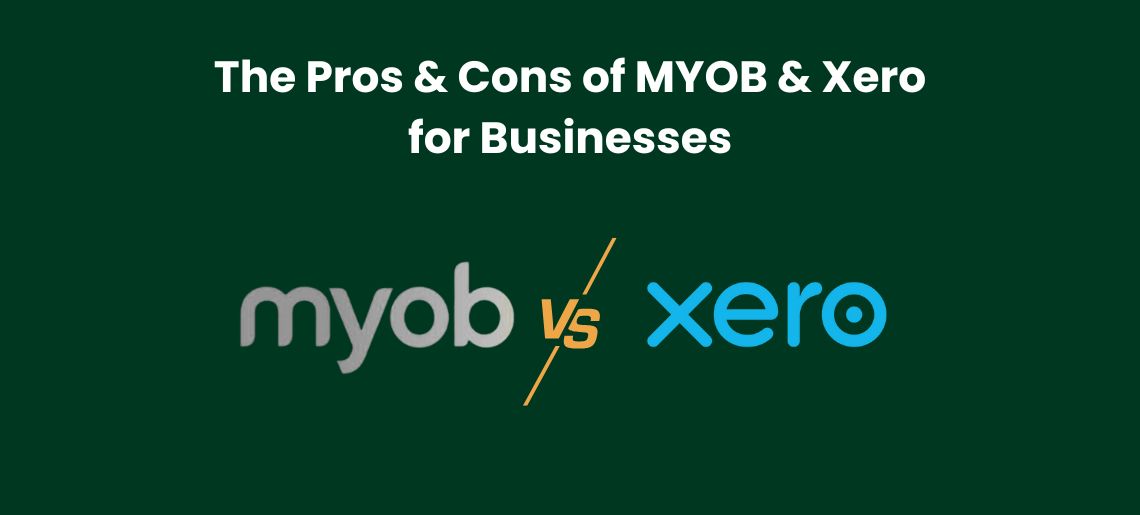
The Pros & Cons of MYOB & Xero for Businesses
Choosing the right accounting software is one of the most important decisions for any business. From managing daily transactions to staying compliant with tax obligations, the right platform can save time, reduce errors, and provide clarity over financial performance.
In Australia, MYOB and Xero dominate the small to medium business accounting software market. Both platforms are trusted, ATO-compliant, and feature-rich—but they are built with different types of businesses in mind.
This blog provides a detailed breakdown of the pros and cons of MYOB and Xero, helping business owners, sole traders, and growing companies decide which solution best fits their needs today and in the future.
Understanding MYOB and Xero
Before comparing features, it’s important to understand the philosophy behind each platform.
- MYOB (Mind Your Own Business) has been a cornerstone of Australian accounting software for decades. It offers both desktop and cloud options and is often preferred by businesses with more complex accounting and payroll requirements.
- Xero is a cloud-first platform designed for simplicity, automation, and ease of use. It is especially popular with startups, small businesses, and accountants who value real-time collaboration.
Both platforms support Australian tax requirements such as GST, BAS, Single Touch Payroll (STP), and superannuation, but their approach to usability, flexibility, and scalability differs.
MYOB: Pros & Cons
Advantages of MYOB
1. Strong Australian Compliance and Payroll Capabilities
MYOB is deeply tailored to Australian business regulations. It provides advanced tools for:
- GST tracking and BAS preparation
- Single Touch Payroll (STP) reporting
- Superannuation and award interpretation
- Detailed payroll reporting and compliance
For businesses with multiple employees, complex pay structures, or industry awards, MYOB’s payroll functionality is a major advantage.
2. Desktop and Cloud Flexibility
Unlike many modern platforms, MYOB still offers desktop-based software alongside its cloud solutions. This flexibility benefits businesses that:
- Prefer local data storage
- Have limited or unreliable internet access
- Require advanced desktop features
This hybrid approach appeals to traditional businesses and long-established companies.
3. Advanced Accounting Features
MYOB supports more complex accounting needs such as:
- Inventory management
- Job costing
- Multi-account tracking
- Detailed financial reporting
These features make MYOB suitable for businesses that have outgrown basic bookkeeping tools.
4. Familiarity Among Long-Standing Businesses
Many Australian accountants and business owners have used MYOB for years. This familiarity reduces training time for experienced users and makes MYOB a comfortable option for businesses transitioning from legacy systems.
Disadvantages of MYOB
1. Higher Pricing
MYOB plans are often more expensive than Xero, especially when payroll, inventory, or advanced features are required. Costs can increase as the business grows and needs additional modules.
2. Steeper Learning Curve
Compared to Xero, MYOB’s interface can feel complex and less intuitive for beginners. New users may require professional setup or training to use the software effectively.
3. Limited Third-Party Integrations
While MYOB integrates with several apps, its ecosystem is smaller than Xero’s. This can limit automation opportunities or require workarounds for businesses using multiple digital tools.
4. Maintenance for Desktop Versions
Desktop versions of MYOB require:
- Manual updates
- Data backups
- Software installations
For businesses seeking a fully hands-off, cloud-based solution, this can feel outdated.
Xero: Pros & Cons
Advantages of Xero
1. User-Friendly Interface
Xero is widely praised for its simple, intuitive design. Even users with little accounting knowledge can quickly learn how to:
- Send invoices
- Reconcile bank transactions
- Track expenses
- Generate reports
This makes Xero ideal for business owners who manage their own bookkeeping.
2. 100% Cloud-Based Access
Xero is fully cloud-based, meaning:
- Access anytime, anywhere
- Automatic software updates
- Secure cloud backups
This flexibility suits modern businesses, remote teams, and owners who want real-time visibility of their finances.
3. Extensive App Integration Ecosystem
Xero integrates with hundreds of third-party applications, including:
- Payroll and HR tools
- Inventory management systems
- POS and eCommerce platforms
- CRM and payment gateways
This makes Xero highly scalable and ideal for businesses that rely on automation and connected systems.
4. Strong Accountant and Bookkeeper Collaboration
Xero is widely used by Australian accountants and bookkeepers. Its cloud-based structure allows:
- Real-time collaboration
- Easy file sharing
- Faster reporting and advisory support
This reduces friction between business owners and their financial advisors.
For a deeper understanding of features, pricing, and real-world use cases, explore our complete guide on Xero accounting software for small businesses.
Disadvantages of Xero
1. Limited Advanced Accounting Features
While Xero is excellent for small businesses, it may feel restrictive for companies that require:
- Advanced inventory management
- Detailed job costing
- Complex manufacturing workflows
These features often require paid add-ons.
2. Payroll Costs Can Add Up
Payroll functionality may cost extra depending on the plan and number of employees. For businesses with larger teams, payroll expenses can increase quickly.
3. Internet Dependency
Because Xero is cloud-only, a stable internet connection is essential. Businesses in areas with poor connectivity may find this limiting.
4. Less Customisation for Advanced Users
Xero prioritises simplicity, which can limit deep customisation options for experienced accountants or finance teams.
MYOB vs Xero: Feature Comparison
| Feature | MYOB | Xero |
|---|---|---|
| Deployment | Desktop & Cloud | Cloud-only |
| Ease of Use | Moderate | Very easy |
| Payroll | Advanced | Add-on based |
| Integrations | Limited | Extensive |
| Best for | Complex businesses | Small & growing businesses |
| Compliance | Strong Australian focus | Strong Australian focus |
Which Software Is Right for Your Business?
MYOB Is Better If:
- Your business has complex payroll or inventory needs
- You prefer desktop or hybrid software
- You require detailed accounting control
- You operate in industries with awards or job costing
Xero Is Better If:
- You’re a small business, startup, or sole trader
- You want simple, cloud-based accounting
- You rely on integrations and automation
- You collaborate closely with an accountant
Cost Considerations
Pricing should never be the only factor, but it is important. While Xero often appears cheaper upfront, costs can rise with payroll and add-ons. MYOB may be more expensive initially but includes advanced features that reduce the need for third-party tools.
Evaluating total cost of ownership not just subscription price is key.
To see how these choices play out across different industries, take a look at our in-depth breakdown of MYOB vs Xero preferences among Australian businesses in 2025.
Final Verdict: MYOB vs Xero
There is no universal “winner.” Both platforms are excellent, but they serve different business profiles:
- MYOB is best for businesses needing depth, structure, and advanced payroll control.
- Xero excels in simplicity, flexibility, and cloud-based efficiency.
The right choice depends on your business size, complexity, budget, and growth plans.
Accounting software is not just a compliance tool—it’s a foundation for smarter decision-making and sustainable growth. By understanding the pros and cons of MYOB and Xero, Australian businesses can choose a solution that supports both current operations and future ambitions.
For businesses unsure about setup, migration, or optimisation, professional guidance from an accountant or bookkeeper can ensure a smooth and successful implementation.
Frequently Asked Questions
Is MYOB or Xero better for Australian businesses?
Both MYOB and Xero are ATO-compliant and reliable. MYOB suits businesses with complex payroll or inventory needs, while Xero is ideal for small businesses seeking easy-to-use, cloud-based accounting.
Which is cheaper: MYOB or Xero?
Xero generally has lower entry-level pricing, but costs can increase with payroll and add-ons. MYOB may cost more upfront but includes advanced features that reduce reliance on third-party tools.
Is Xero good for small businesses in Australia?
Yes, Xero is widely used by Australian small businesses due to its simplicity, cloud access, and strong integration ecosystem.
Is MYOB better for payroll?
MYOB offers more advanced payroll features, making it suitable for businesses with multiple employees, awards, and complex pay structures.
Do accountants prefer MYOB or Xero?
Many Australian accountants prefer Xero for real-time collaboration, but MYOB is still widely supportead, especially for businesses with advanced accounting needs.