

Key Takeaways
✅ Payday Super begins on 1 July 2026
✅ SBSCH closes 30 June 2026
✅ Super must be paid each payday
✅ Payment must reach funds within 7 business days
✅ Funds must allocate within 3 business days
✅ Xero Auto Super is the easiest compliance solution
✅ Elite Plus Accounting helps businesses transition smoothly
The business landscape moves quickly, and keeping up with payroll and super obligations has never been more crucial. For Australian employers, small businesses in particular a landmark reform is on the horizon: Payday Super 2026.
Until now, most employers paid super quarterly. But from 1 July 2026, the government’s new Payday Super legislation requires super contributions to be paid on every payday instead of quarterly. This applies to all businesses, big or small, and brings major shifts to payroll timing, cash flow, and compliance expectations.
For employers searching for guidance on terms like “xero payday super,” “payday super xero,” “xero and payday super,” or “super payment dates 2026,” this updated guide breaks down everything you need to know and how Xero makes the transition simple.
A New Era: What Super 2026 Means for Employers
Superannuation is the backbone of Australia’s retirement system, but quarterly payments often created delays, confusion, and compliance challenges. With Super 2026 reforms coming into effect, all contributions must now be sent at the same time wages are processed.
From 1 July 2026:
- Super must be paid per pay cycle
- Contributions must reach funds within 7 business days
- Funds must allocate payments within 3 business days
- Quarterly super processing becomes obsolete
This shift gives employees more consistent retirement savings growth and encourages real-time compliance — while improving transparency across Australia’s superannuation system.
Why Payday Super 2026 Was Introduced
The ATO estimates billions in unpaid or delayed super every year. Many small businesses delay payments until the quarter ends, leading to compliance issues and reduced compound growth for employees.
The new system addresses problems such as:
- Delayed quarterly processing
- Manual payroll errors
- Cash flow misuse
- Inconsistent super reporting
By linking contributions directly to pay cycles, super pay day 2026 becomes a more reliable, transparent and fair system for workers.
Common Causes of Super Payment Delays (and How Payday Super Fixes Them)
1. Quarterly Delays
Small businesses often defer payments until quarter-end, creating large time gaps.
2. Manual Entry Errors
Incorrect super calculations, missed employees, or late transfers.
3. Cash Flow Challenges
Funds may be prioritised elsewhere before quarterly super is processed.
Payday Super eliminates these issues
By requiring super to be processed every payday, employers have fewer steps to track, fewer things to manually reconcile, and clearer compliance responsibilities.
SBSCH Is Ending: What This Means for Small Businesses
Many small employers currently use the Small Business Superannuation Clearing House (SBSCH) to batch and process quarterly payments. But as real-time super becomes mandatory, SBSCH will no longer be compatible.
SBSCH Phase-Out Timeline
| Date | Milestone |
|---|---|
| 9 Oct 2025 | Payday Super legislation introduced |
| 1 Oct 2025 | No new SBSCH registrations |
| 30 Jun 2026 | Final day SBSCH can be used |
| 1 Jul 2026 | Payday Super begins |
Small employers will need to move to payroll platforms that support automatic per-pay super payments — and this is where Xero Payday Super becomes the ideal solution.
How Xero Makes Payday Super Easy
For businesses searching online for “xero payday super”, or “payday super xero”, the answer is simple:
Xero Auto Super fully supports the new Payday Super 2026 system.
Xero automates super calculations, sends contributions with each pay run, and ensures super payment dates 2026 and beyond are always met.
Benefits of Using Xero for Payday Super
- Integrated Payroll + Super (no switching systems)
- Automatic contributions on each pay run
- ATO-compliant reporting
- Reduced errors and manual entry
- Digital audit trail for all super payments
- Easy transition from SBSCH
Even micro and small businesses find Xero’s automation reduces time spent on compliance and eliminates the stress of remembering deadlines.
Key Payday Super Rules Every Employer Must Know
1. Qualifying Earnings (QE)
Super Guarantee (SG) applies to:
- Ordinary Time Earnings
- Bonuses
- Commissions
Accurate calculation is critical. Xero and payday super automatically handle QE each pay.
2. 7-Business-Day Payment Requirement
Super must reach the fund within 7 business days after payday.
3. 3-Business-Day Allocation Deadline
Funds must allocate contributions within 3 days or return them.
These rules highlight why automation is essential — manual systems will struggle under Super2026 requirements.
How Payday Super 2026 Impacts Small Businesses
1. Cash Flow Adjustments
Small business superannuation processes will shift from quarterly lumps to regular ongoing payments. Budgets must reflect real-time super outflows.
2. Software Updates
Older payroll tools won’t work under Super 2026 rules.
Businesses must upgrade to compliant systems like Xero.
3. Compliance Risk Reduction
Late payments trigger the Superannuation Guarantee Charge (SGC), a costly, non-tax-deductible penalty.
Automating now prevents expensive mistakes later.
Preparing Your Business for Super Pay Day 2026
A simple approach to prepare before the July 2026 deadline:
Step 1: Review Payroll Setup
Ensure your system can automate Payday Super and integrate with the ATO.
Step 2: Enable Xero Auto Super
Verify employee fund details and run test payments.
Step 3: Notify Employees
Tell staff that super will now appear in their funds every payday.
Step 4: Reassess Cash Flow
Plan for more regular super payments.
Step 5: Get Expert Help
A payroll advisor or accountant can eliminate risk and handle setup.
How Elite Plus Accounting Makes Your Transition Easier
We specialise in helping small businesses adopt modern, compliant systems for Payday Super 2026.
Our Services Include:
- Xero Auto Super setup & training
- Payroll processing & STP reconciliation
- SBSCH exit planning
- Cash flow forecasting (Virtual CFO)
- Quarterly ATO compliance reviews
We ensure your business is fully prepared for super 2026, compliant with new rules, and confidently operating ahead of deadlines.
Ready to Transition Before 2026? Let’s Get Your Payroll Future-Ready
The introduction of Payday Super 2026 marks a major shift for employers — but with the right tools and support, the transition is smooth and stress-free.
At Elite Plus Accounting, we help you:
- Automate super through Xero Payday Super
- Streamline payroll
- Stay compliant
- Improve cash flow planning
- Avoid penalties and errors
Future-proof your payroll before the July 2026 deadline — with confidence.
Frequently Asked Questions
What is Payday Super 2026 and when does it start?
Payday Super 2026 is a new government reform requiring employers to pay superannuation on every payday instead of quarterly. It becomes mandatory from 1 July 2026 and replaces the traditional quarterly cycle.
How does Xero support Payday Super?
Xero supports the new rules through Xero Payday Super (Auto Super), which automatically calculates and sends super contributions each pay run. This makes it easy for employers to stay compliant with the updated super payment dates 2026.
Will the SBSCH still be available after Payday Super starts?
No. The Small Business Superannuation Clearing House (SBSCH) will no longer support real-time payments. It closes to new users on 1 October 2025 and fully ends on 30 June 2026, requiring all businesses to move to systems like Xero.
What does Payday Super mean for small business superannuation?
Small business superannuation will shift to more frequent payments, as super must now be paid every payday. This requires updated payroll software, improved cash flow planning, and automated systems such as payday super Xero.
What are the super payment deadlines under the new rules?
Under Payday Super 2026, super must reach employees’ super funds within 7 business days of payday, and funds must allocate contributions within 3 business days. Manual processing will no longer be practical or compliant.
get in touch
Connect with Our Experts
Our dedicated team of accountants and bookkeepers is here to guide you toward the best financial solutions. Reach out today and speak with one of our experienced professionals to get started on the right path.


Recent Blogs
A common assumption among Australian business owners is: “They have an ABN and send me an invoice, so they are responsible for their own super.” Unfortunately, it is not always that simple. For super guarantee purposes, the ATO looks at the substance of the arrangement. Some independent contractors must still receive super where the contract is wholly […]
Read More
Working two jobs in Australia can affect how much tax is withheld from your pay. Learn how the $18,200 tax-free threshold works, when to claim it, and how claiming it from multiple employers could lead to an unexpected tax bill.
Read More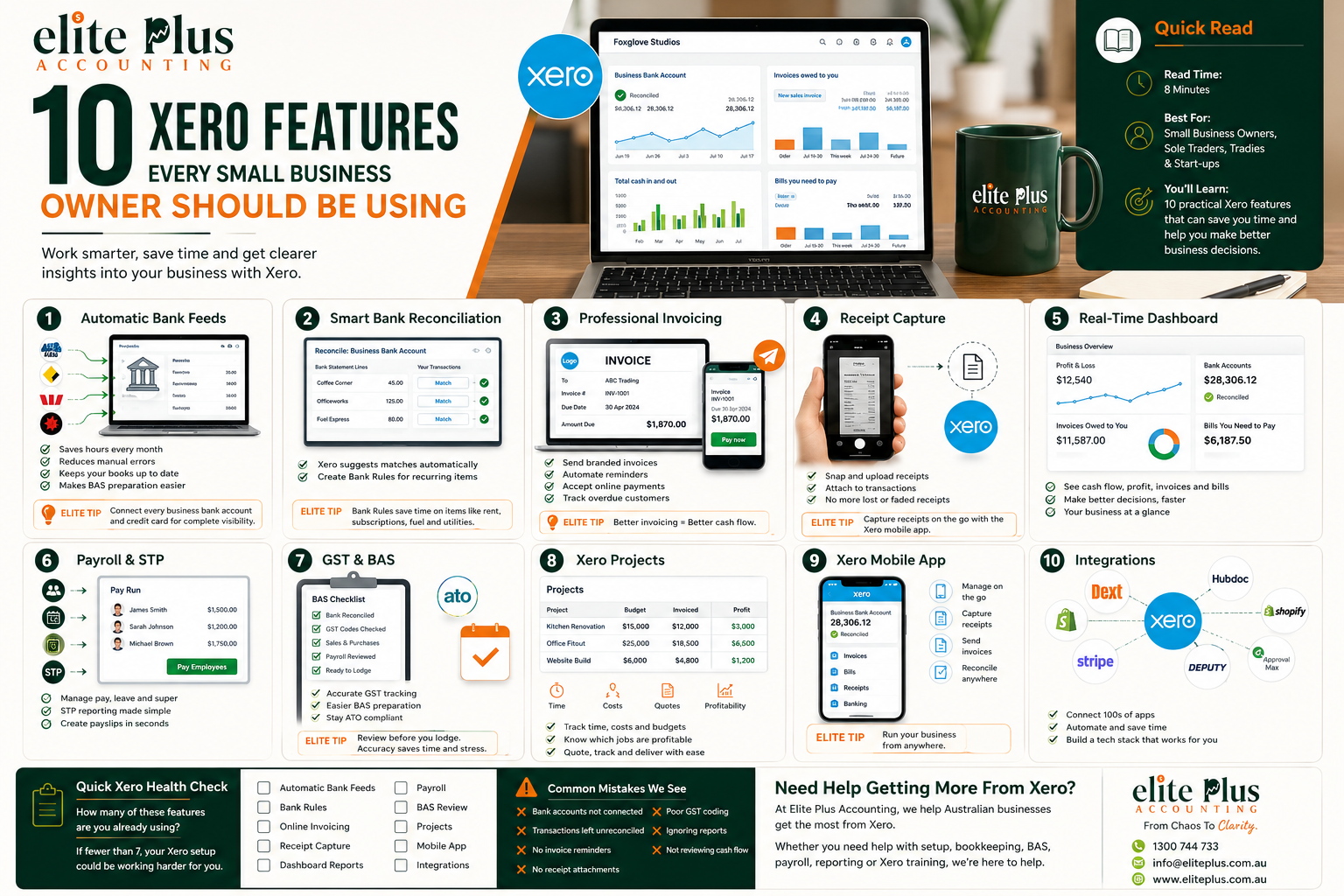
Discover 10 essential Xero features that help small business owners manage finances, save time, track expenses, improve accuracy, and make smarter business decisions with ease.
Read More