
If you have sold an investment property, some shares, or another asset for a profit, the ATO will want a portion of that gain. This is capital gains tax, or CGT. It applies to a wide range of assets, and the rules around it catch a lot of investors off guard simply because they did not look into it before they sold.
This guide covers how CGT works in Australia, what triggers it, how the tax is calculated, and what you can do to reduce what you owe. The goal is to give you a clear picture so that tax time is not a shock.
What Is Capital Gains Tax in Australia?
CGT is not a separate type of tax. It sits inside your regular income tax. When you sell an asset for more than you paid, the profit is called a capital gain. The ATO adds that gain on top of your other income for the year, and you pay tax on it at your normal marginal rate.
CGT has applied to assets in Australia since 20 September 1985. If you bought an asset before that date, it is generally exempt. Everything bought on or after that date is subject to CGT rules when you eventually sell it.
What Assets Are Subject to CGT?
Not every asset triggers CGT, but the list is broader than most people expect. Below are the main asset types that the ATO applies CGT to.
Assets commonly subject to CGT:
- Investment properties and land
- Shares and units in managed funds
- Cryptocurrency
- Business assets, including goodwill and equipment
- Collectables worth more than $500, such as artwork or antiques
Assets that are generally exempt from CGT:
- Your main residence (your primary home)
- Personal use assets bought for under $10,000
- Cars and motorcycles
- Compensation received for a personal injury
- Assets acquired before 20 September 1985
What Triggers a CGT Event?
A CGT event is any situation that results in a gain or loss on an asset. Selling is the most obvious one. But there are others that people do not always think about until it is too late.
Gifting an asset to someone is treated as a CGT event. The ATO considers the market value of the asset at the time of the gift to be the sale price, even though no money changed hands. Inheriting an asset does not usually trigger CGT immediately, but when you later sell that inherited asset, the gain is calculated from the date and value that the original owner acquired it.
Common CGT events include:
- Selling an investment property or shares
- Gifting an asset to another person
- Having an asset destroyed or lost and receiving an insurance payout
- Converting a personal-use asset into an income-producing one
- A property being compulsorily acquired by the government
How Is CGT Calculated?
The basic calculation is sale price minus cost base equals capital gain. The cost base is not just the purchase price though. The ATO allows you to include a range of associated costs, and adding those in can reduce your taxable gain by a meaningful amount.
Missing items from your cost base is one of the most common accounting mistakes people make.Every dollar you leave out is a dollar you could end up paying tax on unnecessarily. Good record keeping from the day you acquire an asset makes it much easier to get this right.Professional bookkeeping services from the day you acquire an asset makes it much easier to get this right.
What can be included in your cost base:
| Cost Category | Examples |
|---|---|
| Purchase costs | Purchase price, stamp duty, legal fees |
| Ownership costs | Council rates, some interest costs |
| Improvement costs | Renovations, additions, structural work |
| Disposal costs | Agent commissions, legal fees on sale |
Example:
You buy an investment property for $500,000. You spend $25,000 on a renovation and pay $15,000 in other eligible costs like stamp duty and legal fees. Your cost base is $540,000. If you sell for $700,000, your capital gain is $160,000, not $200,000. That difference of $40,000 matters when it is being taxed at your marginal rate.
CGT Tax Rates in Australia (2025-26)
There is no separate CGT rate. Your capital gain is added to your taxable income and taxed at whatever marginal rate applies to your total income for that year.
| Taxable Income | Tax Rate |
|---|---|
| $0 to $18,200 | 0% |
| $18,201 to $45,000 | 16% |
| $45,001 to $135,000 | 30% |
| $135,001 to $190,000 | 37% |
| Over $190,000 | 45% |
A 2% Medicare levy also applies to most Australian residents. The total rate you pay on a capital gain depends on how much other income you have in the same year, which is why timing a sale can make a real difference to your tax bill.
The 50% CGT Discount
If you hold an asset for more than 12 months before you sell it, you may only have to pay tax on half of your capital gain. This is the 50% CGT discount, and it is one of the most useful concessions available to individual investors in Australia.
The discount applies to individuals and most trusts. Super funds get a reduced version, at one-third instead of half. Companies do not get the discount at all. That is one reason why the structure you hold your investments in matters when it comes to your overall tax position.
How the 50% discount works in practice:
- You sell shares after holding them for 18 months
- Your capital gain is $60,000
- After the 50% discount, only $30,000 is added to your income
- At a 30% tax rate, you pay $9,000 instead of $18,000
Who qualifies:
- Individual Australian residents who have held the asset for more than 12 months
- Most trusts
- Super funds (one-third discount, not 50%)
Companies are not eligible for the CGT discount. This is something worth understanding if you are weighing up different investment structures.
Small Business CGT Concessions
If you own and operate a small business, there is a separate set of CGT concessions that can reduce or even remove your tax liability when you sell business assets. These concessions exist specifically for small businesses and are separate to the standard 50% discount.
To access these concessions, your business generally needs to have an annual turnover under $2 million, or your net assets need to be under $6 million. Meeting one of these tests opens the door to the following:
- 15-year exemption: If you have held an active business asset for 15 years and you are 55 or over and retiring, the entire gain may be exempt from CGT
- 50% active asset reduction: Halves the capital gain on the sale of an active business asset
- Retirement exemption: You can exclude up to $500,000 of capital gains from a business sale over your lifetime if the proceeds go toward retirement
- Rollover relief: Allows you to defer a capital gain if you are reinvesting in a replacement asset or restructuring
These concessions can be stacked in some circumstances, which means the tax saving can be very large. A lot of small business owners are not aware they qualify. It is one area where speaking with an accountant who handles tax planning for small businesses well before a sale can pay off significantly. For businesses looking for higher-level guidance on these exits, a Virtual CFO can provide the strategic oversight needed to maximize these concessions.
How Capital Losses Work
A capital loss happens when you sell an asset for less than its cost base. Losses cannot be used to reduce your ordinary income, but they can be offset against capital gains in the same financial year.
If your losses are greater than your gains in a given year, the leftover loss is not wasted. You carry it forward and use it against capital gains in future years. The ATO tracks these carried-forward losses, but you still need to report them in your tax return each year until they are used up. This makes it important to keep a record of any loss you carry forward, even if you do not have gains to use it against immediately. This is why accurate management reports and record-keeping are so vital, you don’t want to lose track of those “tax offsets” for future profits.
When and How to Report CGT
CGT is reported in your income tax return for the financial year in which the CGT event occurred. The key date is usually the contract date, not the settlement date. So if you sign contracts on a property in June, that gain goes in your return for that financial year even if settlement happens in August.
If you know a large gain is coming, it helps to set aside some money during the year. A lot of people are caught off guard by a CGT bill when they lodge their return and find they owe more than expected. Estimating your likely tax position during the year, particularly before a major sale, helps avoid that. If you want to get a clearer picture of how a sale will affect your overall tax position, reviewing it as part of your individual tax return preparation is a good way to plan ahead.
Clearing Up the Part That Actually Matters
CGT is one of those areas where knowing the basics puts you well ahead of most investors. Once you understand the 50% discount, the cost base rules, how losses work, and when exemptions apply, the calculation itself is not that hard.
The bigger risk is not understanding any of this until after a sale has happened. At that point, your options to reduce what you owe are limited. Planning before you sell, even if it is just a rough estimate, gives you room to make decisions that could save you a decent amount. Keep your records from day one, check whether any exemptions apply to your situation, and do not assume CGT will sort itself out at tax time.
Ready to ensure you aren’t overpaying the ATO? Contact the team at Elite Plus Accounting today to discuss your CGT position and book your tax consultation.
Frequently Asked Questions
Do I pay CGT on cryptocurrency trades?
Yes. The ATO views cryptocurrency as an asset, not money. Every time you sell, trade, or swap one crypto for another, it triggers a CGT event. You must calculate the gain or loss based on the market value in AUD at the time of the trade.
What is the "6-year rule" for main residences?
If you move out of your home and rent it out, you can often continue to treat it as your main residence for CGT purposes for up to six years. However, you generally cannot claim the exemption on another property during that same period.
Can I use the 50% CGT discount if I’m a business owner?
If you operate as a sole trader or trust, you may be eligible for the 50% discount on assets held for over 12 months. Companies, however, are not eligible for this discount and pay tax on the full capital gain.
What happens if I inherit a property?
You don’t usually pay CGT immediately upon inheriting an asset. However, CGT rules apply when you eventually sell it. The “cost base” will depend on whether the deceased person bought the property before or after 1985 and whether it was their main residence.
Can I offset a capital loss against my salary?
No. Capital losses can only be used to offset capital gains. If you don’t have enough gains to use the loss this year, you can carry it forward indefinitely to offset future capital gains.
get in touch
Connect with Our Experts
Our dedicated team of accountants and bookkeepers is here to guide you toward the best financial solutions. Reach out today and speak with one of our experienced professionals to get started on the right path.


Recent Blogs
A common assumption among Australian business owners is: “They have an ABN and send me an invoice, so they are responsible for their own super.” Unfortunately, it is not always that simple. For super guarantee purposes, the ATO looks at the substance of the arrangement. Some independent contractors must still receive super where the contract is wholly […]
Read More
Working two jobs in Australia can affect how much tax is withheld from your pay. Learn how the $18,200 tax-free threshold works, when to claim it, and how claiming it from multiple employers could lead to an unexpected tax bill.
Read More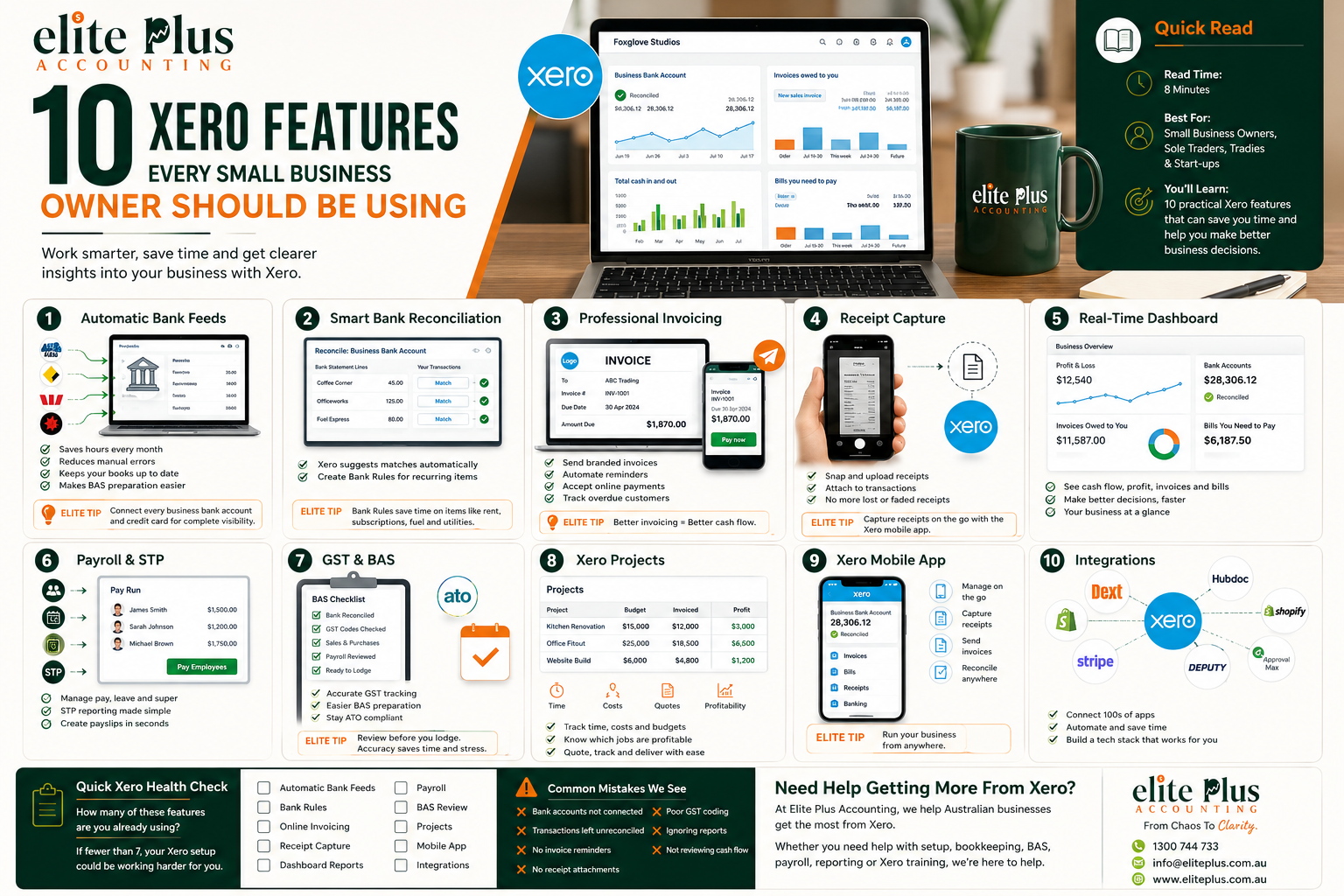
Discover 10 essential Xero features that help small business owners manage finances, save time, track expenses, improve accuracy, and make smarter business decisions with ease.
Read More