

Every business relies on assets like buildings, machinery, vehicles, and computers to run daily operations. Over time, these assets lose value because of constant use and age. This gradual loss in value is known as depreciation in accounting. It is a way for businesses to spread the cost of an asset over its useful life of asset accounting, rather than recording it all at once. This approach helps business owners see a clearer picture of how their assets contribute to earnings each year, making financial statements more accurate and realistic.
For small businesses, understanding accounting depreciation is important because it affects how they plan expenses, measure profits, and manage growth. When you track depreciation properly, it becomes easier to understand how much your equipment or property is truly worth at any given time. It also helps you prepare for future investments by knowing when an asset will need to be repaired or replaced. Without a clear depreciation record, business owners might overestimate their profits or underestimate their long-term costs.
In this blog, you will gain complete knowledge about what Depreciation is, the importance of Depreciation in accounting for small businesses, what assets depreciate over time, and the different methods used to calculate it. You will also understand how keeping accurate records of Depreciation helps you maintain clear financial reports, plan better for the future, and make smarter business decisions. Lastly, we will talk about how an accountant can help you handle Depreciation efficiently, making sure everything is managed correctly and in line with your business goals.
Depreciation Explained: What It Means In Accounting
Depreciation is the process of spreading the cost of a tangible asset over the time it is used in a business. Instead of recording the full cost of an item like machinery, vehicles, or furniture in the year it was purchased, the cost is divided across its useful life. This approach recognises that these assets lose value over time due to daily use, wear and tear, or becoming outdated. By doing this, businesses can see how much of an asset’s value has been used up and how much remains, which makes financial reporting more accurate and practical.
In asset depreciation accounting, each year a portion of the asset’s value is recorded as an expense to reflect its decreasing worth. This is tracked through a record known as what is accumulated depreciation, which shows the total amount written off since the asset was first purchased. Depreciation ensures that financial statements show the real value of a business’s assets and overall financial position.
Importance Of Depreciation In Accounting For Small Businesses
For small businesses, depreciation plays an important role in showing the real worth of their operations. As equipment, vehicles, or furniture lose value over time, recording this decrease helps owners understand the current value of their fixed assets depreciation. It also ensures that financial statements show an accurate picture of what the business owns and how those assets are performing. When depreciation is calculated correctly, it gives a fair view of profit and loss, which helps business owners make better financial and investment decisions.
Having a clear depreciation schedule also supports budgeting and long-term planning. It helps business owners know when major assets will need repair or replacement and prepare funds in advance. This avoids sudden financial strain and supports smoother cash flow management. Keeping proper depreciation records also makes financial reports more transparent and easier to review. In short, depreciation is not only an accounting process but also a helpful tool for tracking business growth and managing resources effectively.
Assets That Commonly Depreciate Over Time
There are some assets that lose their value with the passage of time. It is important for every business owner to know which assets depreciate and how this affects financial reporting. Keep on reading, as you will see the list of assets that commonly depreciate over time.
- Vehicles: Cars, vans, and trucks used for business begin losing value from the moment they are purchased. Factors like distance travelled, condition, and age affect their worth, which is recorded using methods such as the straight-line depreciation method.
- Machinery and equipment: Tools, factory machines, and construction equipment wear out over the years of use. Regular maintenance can extend their life, but their value still declines as newer technology and improved models appear in the market.
- Computers and technology: Items like laptops, printers, and routers depreciate quickly due to fast technological changes. These assets often need replacement sooner than others because they become outdated faster.
- Furniture and office fittings: Desks, chairs, cabinets, and lighting fixtures lose value gradually as they wear out from daily use. Businesses track these using the diminishing value depreciation method to reflect their real worth over time.
- Buildings and improvements: While land does not depreciate, structures like offices, fences, and carparks do. Their value decreases due to age and usage, which is recorded under the accumulated depreciation definition for better financial clarity.
Types Of Depreciation Methods Used In Accounting
There are many different types of depreciation methods, and it is essential for your business to know about them. Read below to discover the four major types of depreciation methods used in accounting.
Straight-Line Method
The straight-line depreciation method is the simplest and most common approach. It spreads the cost of an asset evenly across its useful life, meaning the same amount is recorded as an expense each year. This method works best for assets that wear out evenly over time, such as office furniture or fixtures. For example, if a piece of equipment costs $10,000 and has a life of five years, the business will record $2,000 in depreciation each year until the asset’s value is fully written off.
Diminishing Value Method
The diminishing value depreciation method assumes that an asset loses more of its value during the first few years of use. The amount of depreciation reduces each year as the asset ages. This method is suitable for assets like vehicles or computers that lose value quickly due to wear, usage, or technological changes. For instance, a $10,000 asset with a five-year life will have higher deductions in the first two years, with smaller amounts recorded in later years.
Sum-of-the-Years’ Digits (SYD)
The sum-of-the-years’ digits method is an accelerated depreciation approach that allocates a higher expense in the early years and smaller amounts later. It uses a simple formula based on the asset’s age and useful life. For example, an asset with a five-year life will use the sum of 1+2+3+4+5 (which equals 15) to assign depreciation values each year. This method helps reflect how assets often provide greater benefits when they are newer and more efficient.
Units-of-Production Method
The units-of-production method bases depreciation on how much an asset is used rather than time. It is ideal for equipment, vehicles, or machines that have measurable output. For example, if a $10,000 machine is expected to produce 100,000 units during its life and produces 20,000 units in a year, the depreciation expense for that year will be $2,000. This method provides a clear picture of wear and tear according to actual usage instead of calendar years.
Benefits Of Recording Depreciation Accurately
There are some amazing advantages of recording depreciation accurately. It not only helps a business maintain clear financial records but also supports better planning and long-term growth. To know more about these benefits, keep on reading.
- Better financial insight and transparency: When depreciation is recorded correctly, financial reports show a true and fair view of how the business is performing. It helps identify the real value of assets and shows profits more accurately, which builds trust among owners and investors.
- Helps in budgeting for replacements and upgrades: Accurate depreciation records show how much value an asset has lost over time. This allows a business to plan ahead for repairs or replacements, preventing sudden, large expenses and keeping operations running smoothly.
- Keeps reports consistent and reliable for future planning: Consistent recording of depreciation ensures financial statements stay accurate year after year. This makes it easier to compare results, monitor performance trends, and make confident decisions for future investments or expansions.
- Builds confidence in business decision-making: With correct depreciation data, business owners can make smarter choices about asset management, maintenance, and growth strategies. It gives a clearer picture of how resources are being used and where improvements are needed.
- Improves compliance and investor trust: Transparent financial reporting that includes accurate depreciation builds confidence with lenders, investors, and other stakeholders. It shows that the business follows proper accounting standards, which strengthens credibility and supports funding opportunities.
Role Of An Accountant In Managing Depreciation
An accountant plays a key role in managing depreciation by ensuring every asset is tracked, recorded, and updated correctly throughout its life. They set up depreciation schedules in accounting software such as Xero or MYOB to automate calculations and keep records accurate. By doing this, they make sure that each asset’s value is reduced gradually and properly reflected in your financial reports. They also maintain a fixed asset register that lists important details like purchase cost, depreciation method, and remaining value, helping you always know where your business stands.
Accountants also make the process of understanding depreciation much simpler for business owners. They prepare clear and easy-to-read reports that show how asset values change over time and how this affects your overall financial position. Their expertise helps ensure compliance with accounting standards and ATO guidelines, avoiding potential errors or confusion. More importantly, they guide you on when it might be time to replace or upgrade assets, helping you plan ahead and make confident financial decisions.
Conclusion
Understanding depreciation is essential for keeping your business finances clear and accurate. Here you have learned about what depreciation is, why it is important in accounting for small businesses, and which assets typically depreciate over time. You also explored the different methods used to calculate depreciation and how accurate record-keeping helped maintain clear financial reports and smarter planning for the future. Lastly, you discovered how an accountant played a key role in managing depreciation effectively, ensuring everything was handled correctly and aligned with your business goals. Managing depreciation properly not only helps you understand your true financial position but also supports long-term growth and confidence in your decisions.
We at Elite Plus Accounting are a team of friendly and experienced professionals who make accounting simple and stress-free. Our focus is on helping business owners understand their numbers, make smarter decisions, and grow with confidence. Whether it is managing depreciation, improving financial reports, or planning for future success, we are here to support you every step of the way. You can contact us on 1300 744 733 or email us at info@eliteplusaccounting.com.au to book your free consultation and discover how we can make a difference for your business.


Recent Blogs
A common assumption among Australian business owners is: “They have an ABN and send me an invoice, so they are responsible for their own super.” Unfortunately, it is not always that simple. For super guarantee purposes, the ATO looks at the substance of the arrangement. Some independent contractors must still receive super where the contract is wholly […]
Read More
Working two jobs in Australia can affect how much tax is withheld from your pay. Learn how the $18,200 tax-free threshold works, when to claim it, and how claiming it from multiple employers could lead to an unexpected tax bill.
Read More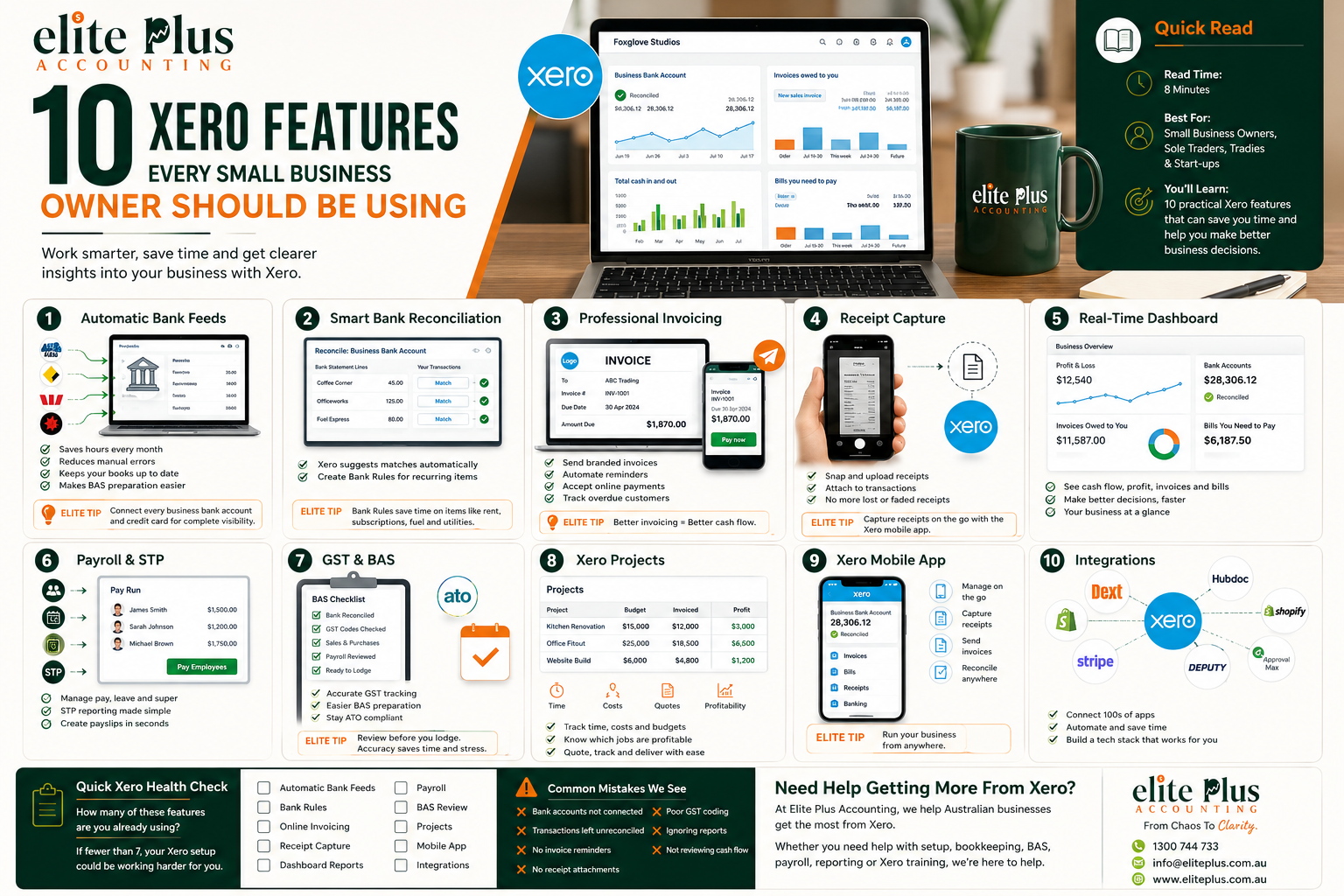
Discover 10 essential Xero features that help small business owners manage finances, save time, track expenses, improve accuracy, and make smarter business decisions with ease.
Read More