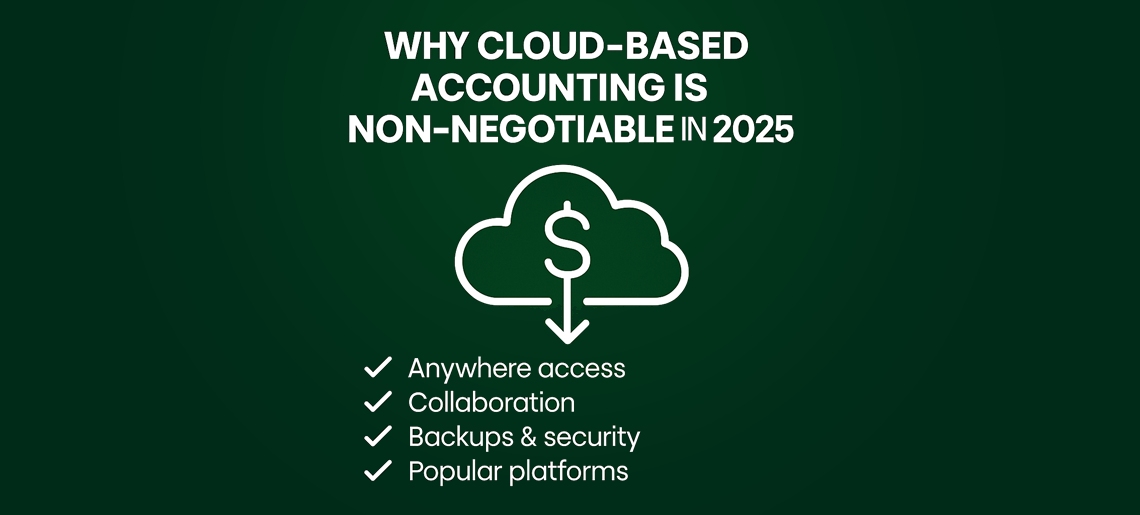
Why Cloud-Based Accounting Is Non-Negotiable in 2025

In 2025, running a business means being fast, accurate, and adaptable — and that’s where cloud-based accounting comes in. It’s no longer just a nice-to-have but an essential tool that keeps your business organised, efficient, and ready for growth. Whether you’re a small business, startup, or growing enterprise, adopting cloud accounting is no longer optional; it’s a strategic move to stay competitive, compliant, and financially agile.

What Is Cloud-Based Accounting?

Cloud-based accounting makes finance real-time, collaborative, secure, and scalable.

Traditionally, accountants worked on the same software, installed separately on their desktops and hosted on-premises, effectively localising finance and limiting access to real-time data.

Cloud accounting puts everyone on the same system, enabling easy data sharing and real-time access. Accountants and team members can securely access financial data anytime, from any device, without being tied to one location. Users log in to the system and can access and work on updated data, with real-time backup for enhanced security.

There is no need for manual sharing of updated files or constant follow-ups to obtain the latest information. With cloud accounting, your team works on the same data, collaborates efficiently, and drives real-time results.

What Makes Cloud Accounting Powerful?

1. Anytime, Anywhere Access

Cloud accounting lets you access your financial data from any device, whether it’s a laptop, tablet, or smartphone. This means you can check invoices, track expenses, or review cash flow while travelling, working from home, or even at a client meeting. For businesses with remote teams or multiple locations, this flexibility ensures everyone stays on the same page without delays.

2. Real-Time Reporting And Dashboards

Modern cloud accounting platforms provide live dashboards that give an instant overview of your financial health. You can see your revenue, profits, expenses, and overdue invoices in real time. This visibility allows business owners to make quick, informed decisions, identify trends, and plan budgets more accurately, avoiding surprises at the end of the month.

3. Automated Invoicing And Payment Reminders

Manual invoicing can be time-consuming and prone to delays. Cloud accounting software automates the entire process: it generates invoices, sends them to clients, and even follows up with reminders for overdue payments. This ensures faster cash flow, reduces the risk of missed payments, and lets your team focus on more strategic activities rather than administrative work.

4. Bank Feeds And Transaction Matching

By linking your bank accounts to your accounting software, transactions are automatically imported and categorised. This reduces manual data entry, eliminates errors, and saves hours of bookkeeping work every week. Many systems also flag inconsistencies, helping you spot mistakes or fraudulent transactions quickly.

5. Improved Compliance

Staying compliant with financial regulations, payroll requirements, and reporting standards is critical. Cloud accounting software automatically updates for local regulations like BAS, GST, superannuation, and Single Touch Payroll (STP) in Australia. This helps prevent fines, ensures timely submissions, and gives you peace of mind during audits.

6. Advanced Security And Data Protection

Data stored in the cloud is much safer than on a personal computer. Providers use encryption, multi-factor authentication, and automatic backups to protect sensitive financial information. Even if a device is lost or stolen, your data remains secure, minimising the risk of loss or cyberattacks.

7. Cost-Effective And Scalable

Unlike traditional accounting systems that require expensive software licenses and servers, cloud platforms work on a subscription basis. You pay only for the features you need. As your business grows, you can easily add new users, locations, or entities without costly IT upgrades, making it a smart, scalable solution.

8. Seamless Integration With Other Tools

Cloud accounting software connects easily with payment gateways like Stripe and PayPal, inventory management, point-of-sale systems, payroll software, CRMs, and project management tools. This unified ecosystem ensures all your business data is linked, reducing manual work, improving accuracy, and providing a complete view of operations.

9. Enhanced Collaboration And Team Productivity

With multiple users working in real-time, accountants, managers, and staff can collaborate without version conflicts or delays. Notes, approvals, and updates are visible instantly, making teamwork smoother. Teams can focus on strategic tasks instead of reconciling spreadsheets or hunting for information.

10. Data-Driven Insights And Decision-Making

Cloud accounting software provides advanced analytics and forecasting tools. You can track spending trends, compare monthly performance, and predict cash flow needs. This insight allows you to make smarter business decisions, plan for growth, and respond proactively to challenges rather than reacting to them after the fact.

Important Takeaways:

  • Access your financial data anytime, anywhere with cloud accounting.
  • Automation reduces manual work, saving time and minimising errors.
  • Stay compliant effortlessly with automatic payroll and regulatory updates.
  • Cloud storage keeps your data safer than local devices.
  • Subscription-based plans make cloud solutions cost-effective and scalable.
  • Integrations connect your systems for a unified business overview.
  • Real-time collaboration boosts team productivity and accuracy.
  • Advanced analytics and dashboards support informed, data-driven decisions.

Making The Move: Tips For A Smooth Transition

1. Choose The Right Platform

Begin by evaluating cloud accounting platforms based on features, pricing, and integrations. Look for tools that support real-time data syncing, automated bank feeds and payroll modules. Ensure the system works seamlessly with existing tools (e.g., payroll, POS, CRM) to avoid starting from scratch. 

2. Work With A Cloud-Savvy Accountant

Partner with an accountant or advisor experienced in cloud migrations. They can set up your system correctly from day one, assist in migrating data, ensure your chart of accounts is optimised and help you align processes and workflows with best practice rather than simply replicating legacy methods.

3. Plan Your Migration Timeline

Map out a clear migration schedule and target a quiet period, such as outside your end-of-financial-year rush. Avoid launching during busy times to minimise operational disruption. This step ensures payroll, BAS, and month-end reconciliations aren’t compromised during transition. 

4. Train Your Team

Ensure your staff are comfortable with the new system before “go-live”. Conduct training sessions, share user guides, set up support channels, and create a transition checklist. Confident users minimise errors, encourage adoption and get full value from the new platform.

Final Thoughts

Cloud-based accounting is no longer just a convenience; it’s a necessity for modern businesses seeking efficiency, accuracy, and control. With real-time access, automation, and advanced data security, it empowers business owners to stay informed and agile in decision-making. Those still using traditional systems risk falling behind due to limited visibility, slower processes, and greater potential for errors. Embracing the cloud means embracing growth, flexibility, and smarter financial management.

At Elite Plus Accounting, we make your transition to cloud accounting simple and stress-free. Our experts handle setup, migration, and training so you can focus on running your business confidently. Whether you’re switching from manual systems or upgrading your software, we ensure you get the most from cloud technology. Contact us at info@eliteplusaccounting.com.au  or call 1300 744 733 to get started.
What Does An Accountant Do And Why Your Australian Business Needs One

Running a business is exciting, but managing the numbers can quickly become overwhelming. From recording daily transactions to keeping an eye on business expenses, it can be difficult to stay on top of everything. Many business owners start off handling it all themselves, but as the business grows, so do the financial responsibilities. This is when having a small business accountant by your side makes a big difference. They take the stress out of managing your finances, so you can focus on running and growing your business with confidence.

Before we go further, it is important to understand what an accountant does and how their work impacts your business every single day. Accountants do much more than record figures. They analyse your financial position, help you plan for the future, and give you insights that help you make better decisions. With professional Accounting Services Australia, you can reduce mistakes, improve cash flow, and make sure your business is operating smoothly throughout the year.

In this blog, you will get to learn about all things accountants, such as the role accountants play and the major reasons why every business needs one. An accountant helps you spend less time on the numbers and more on growing your business. You will also understand how they give you a clear picture of your finances, keep your business compliant, handle payroll the right way, and guide you in choosing the best accounting software. Lastly, you will discover when is the right time to bring an accountant on board and how their expert support can help your business grow with confidence.

Understanding The Role Of An Accountant

An accountant plays a key part in helping a business stay organised, make clear financial decisions, and plan for steady growth. Their job goes far beyond just keeping records. Through reliable accounting services, they manage, analyse, and guide a company’s financial activities to make sure everything runs smoothly. Whether you are running a start-up or an established company, having a small business accountant Australia ensures that your financial tasks are handled correctly, giving you time to focus on growing your business. Professional business accounting services help you save time, stay compliant, and improve your financial clarity.

Here are some of the main roles accountants handle:

  • Daily bookkeeping and reconciliations: Accountants record daily business transactions and match them with bank records to make sure your financial data is accurate and up to date.
  • Financial reporting and oversight: They prepare key reports like income statements and balance sheets, helping you understand how your business is performing.
  • Payroll management (including pay runs, STP and payslips): Accountants process employee payments, ensure correct deductions, and manage Single Touch Payroll reporting to stay compliant.
  • BAS lodgement via registered BAS agent: A small business accountant Australia can handle your Business Activity Statements accurately and on time, avoiding unnecessary delays or penalties.
  • Setting up accounting software (Xero/MYOB/QuickBooks): Accountants help you choose and set up the right software to simplify your daily financial tasks and improve accuracy.
  • Supporting business structure, compliance, and growth clarity: Through ongoing business accounting services, accountants offer advice on structuring your business correctly, meeting legal requirements, and planning for future growth.

Top Reasons Why Every Business Needs An Accountant

There are many great benefits of having an accountant that can make running your business much easier. If you have been wondering why to hire an accountant, the six reasons below will help you understand how they can truly support your business.

Reason 1: Spend Less Time On Numbers And More On Growth

One of the biggest advantages of hiring an accountant is gaining more time to focus on growing your business. Managing numbers, invoices, and reports can take up hours each week, leaving little room for planning or development. By using outsourced accounting, you can hand over all the detailed financial work to experts who handle it efficiently and accurately. With professional bookkeeping services for small businesses, your records stay up to date, and you no longer have to worry about errors or missed deadlines. This lets you spend more time doing what you do best, building your business and achieving long-term success.

Reason 2: Understand Your Finances To Make Smart Choices

Understanding your finances helps you make smarter decisions that support steady growth and long-term success. With Accounting Services Australia, a professional accountant prepares clear and accurate financial reports that small business owners can rely on. These reports give you a full view of your income, expenses, and cash flow, making it easier to plan ahead and manage your money wisely. Through detailed business performance analysis, your accountant helps you see what is working well and what needs improvement. This guidance allows you to make confident decisions about budgeting, investments, and growth opportunities based on real financial insights, not guesswork.

Reason 3: Stay Compliant And Avoid Business Risks

Staying compliant with financial rules is important for every business, and an accountant makes this process simple and stress-free. With professional business compliance services, your accountant keeps your records accurate and ensures all financial reports meet government requirements. They help you avoid penalties, errors, and legal issues by keeping everything up to date and properly managed. A registered BAS agent Australia also ensures your Business Activity Statements are prepared and lodged correctly. By staying compliant and reducing financial risks, you protect your business reputation, avoid unnecessary stress, and keep your operations running smoothly throughout the year.

Reason 4: Manage Payroll Smoothly And Accurately

An accountant helps make payroll easier and more reliable for every business. With professional payroll services, small business owners can save time, avoid costly errors, and ensure every employee is paid correctly and on time. Accountants handle detailed tasks like wage calculations, leave entitlements, and superannuation contributions while keeping up with the latest rules set by the Single Touch Payroll provider system. They also maintain accurate employee records and ensure timely reporting to the right authorities. This level of support keeps your payroll running smoothly, protects employee trust, and allows you to focus on running your business without stress or delays.

Reason 5: Choose And Set Up The Right Accounting Software

An accountant helps a business make the best use of modern technology by recommending and setting up software that fits its needs perfectly. With expert accounting software setup services, business owners can save time, stay organised, and gain a clear view of their finances. Accountants assist with Xero setup small business solutions, ensuring everything from accounts and bank feeds to payroll and reports is configured correctly. They also help integrate other tools to create a smooth and automated system. This smart setup reduces errors, improves efficiency, and gives business owners confidence that their financial records are accurate and up to date.

Reason 6: Expert Guidance To Plan And Grow Your Business

An accountant plays a key role in helping a business grow by providing expert advice and clear financial direction. With virtual CFO services, business owners can access high-level financial guidance without needing a full-time executive. Accountants offer business financial strategy support by analysing reports, setting realistic budgets, and creating long-term plans that support steady growth. They help identify profitable opportunities, manage risks, and improve cash flow to ensure the business remains strong through changing market conditions. With their support, business owners can make confident decisions that lead to sustainable success and a more secure financial future.

When Should You Hire An Accountant For Your Business?

Knowing the right small business accountant timing can make a big difference in your success. It is best to hire an accountant early, such as when you are starting a business or registering for an ABN or company. This helps you set up strong financial systems and avoid mistakes that could affect your business later. An accountant can also guide you when cash flow becomes unpredictable, helping you track income and expenses more clearly. They ensure that your financial foundation is strong, saving you time and stress as your business starts to grow.

You should also consider when to hire an accountant as your operations expand. Once you hire staff and payroll becomes more complex, professional help ensures everything runs smoothly and stays compliant. Similarly, when you are ready to scale or plan for future growth, an accountant can create budgets and forecasts to keep you on track. They also help you gain clearer financial visibility, making it easier to make confident decisions that support long-term stability and growth.

Conclusion

Having the right accountant by your side can make managing your business much easier and more effective. Here, you have learned about the important role an accountant plays and the top reasons why every business needs one. You started by understanding how an accountant helps you spend less time on numbers and more on growth, then how they make it easier to understand your finances for smarter decisions. You also discovered how they help you stay compliant and avoid risks, manage payroll smoothly, and choose the right accounting software. Finally, you learned how their expert guidance supports long-term business growth and when the right time is to hire one for your business.

At Elite Plus Accounting, we are here to make managing your business finances simple, stress-free, and efficient. Whether you need help with bookkeeping, compliance, or planning for growth, our team is ready to support you every step of the way. We take the time to understand your goals and provide personalised solutions that truly fit your business needs. With our reliable and professional accounting services, you can focus on what matters most — running and growing your business with confidence. To learn more or book a consultation, contact us today at info@eliteplusaccounting.com.au or give us a call on 1300 744 733.

Bookkeeping vs Accounting: What’s the Difference and Why It Matters for Small Businesses in Australia

Running a small business in Melbourne means keeping a close eye on your financial health. However, many business owners still use bookkeeping and accounting as if they mean the same thing. In reality, they serve different but connected purposes — and understanding the difference between bookkeeping and accounting can help you avoid costly mistakes and improve your financial decision-making.

While bookkeeping focuses on recording transactions, accounting interprets that financial data to help you plan, stay compliant, and grow sustainably. Together, bookkeeping and accounting form the backbone of strong financial management for any business.

Bookkeeping vs Accounting: The Foundation of Financial Success

When comparing bookkeeping vs accounting, bookkeeping manages the daily financial activities, while accounting provides analysis and reporting.

  • Bookkeeping: Daily transactions, payroll, BAS, GST, STP, and maintaining accurate financial records.
  • Accounting: Reporting, forecasting, compliance, and strategic planning for business growth.

This distinction is crucial because bookkeeping vs accounting software, bookkeeping vs accounting vs auditing, and bookkeepers and accountants all play unique roles in shaping your business’s financial performance.

What Is Bookkeeping?

Bookkeeping involves the consistent, accurate recording of financial transactions. Whether you use manual processes or tools like Xero, MYOB, or QuickBooks, good bookkeeping ensures your financial data is always ready for BAS or ATO audits.

Key Bookkeeping Functions

  • Recording daily transactions (sales, purchases, expenses, payments).
  • Payroll and STP compliance: Keeping wages, super, and Single Touch Payroll accurate.
  • BAS lodgements: Ensuring all GST obligations are correct and timely.
  • Maintaining clean financial bookkeeping that accountants rely on for deeper analysis.

If you’ve ever wondered about bookkeeping services, it is the process that provides the foundation for accurate reporting, budgeting, and growth planning.

What Is Accounting?

Accounting takes the information from bookkeeping and turns it into meaningful insights. It answers questions like business profitability, financial performance, and long-term sustainability. This is where the difference between bookkeeping vs accounting becomes clear.

Key Accounting Functions

  • Financial statements: Profit & Loss, Balance Sheet, Cash Flow.
  • Forecasting, budgets, and compliance.
  • Identifying errors, savings, opportunities, and future risks.
  • Supporting accounting for small business growth.

If you’ve ever asked, “Is bookkeeping and accounting the same?”, the answer is no; accounting interprets what bookkeeping records.

Bookkeeping vs Accounting: Key Differences

Aspect Bookkeeping Accounting
Focus Recording transactions Analysing and interpreting data
Purpose Accuracy, organisation Strategy, growth, forecasting
Compliance BAS, GST, STP Reporting, tax compliance, regulatory submissions
Tools Xero, MYOB, QuickBooks Reports, dashboards, forecasting tools
Outcome Organised books Strategic insights for better decisions

These differences help you understand what is the difference between bookkeeping and accounting, and why both are essential.

Why Both Matter for Small Businesses in Melbourne, Australia

1. Compliance (BAS, GST, STP)

Bookkeepers handle daily compliance, while accountants ensure final accuracy and strategy.

2. Cash Flow Management

Bookkeeping tracks your incoming and outgoing cash; accounting uses that data to forecast cash flow and prevent shortages.

3. Growth & Profitability

Accurate account bookkeeping helps accountants analyse financial patterns and identify growth opportunities.

4. Cost Efficiency

Outsourcing both accounting & bookkeeping often reduces expenses compared to hiring in-house.

Common Misconception: Do You Need Both?

Some business owners think they only need an accountant once a year. This leads to:

  • Incomplete or messy records
  • Higher accounting fees
  • Missed deductions
  • Incorrect BAS lodgements

Consistent bookkeeping ensures accountants can focus on strategy instead of fixing errors.

Choosing the Right Financial Support

Bookkeeping Only

Great for startups needing support with invoices, payroll, BAS, and basic compliance.

Accounting Only

Best when your books are already handled and you need tax planning, advisory, or reporting.

Both Bookkeeping and Accounting

Ideal for growing businesses needing end-to-end financial support — from reporting and bookkeeping to planning and forecasting.

Why Elite Plus Accounting Is the Right Partner

Elite Plus Accounting offers complete bookkeeping and accounting support tailored to Australian small businesses.

What You Get:

  • Comprehensive BAS, GST, STP, payroll, and reporting support
  • Experienced BAS agents, accountants, and advisors
  • Smart tools including Xero, MYOB, QuickBooks, and cloud bookkeeping solutions
  • Affordable, transparent pricing without lock-in contracts
  • Local Australian expertise in ATO compliance
  • Strategic insights for business growth and profitability

Whether you need help with fixing accounting errors for small business in Melbourne, bookkeeping for small business in Australia, or financial bookkeeping, the team has you covered.

Move Forward With Confidence — Contact Us Today

For small businesses, bookkeeping and accounting work together to keep your finances clear, compliant, and growth-ready. Bookkeeping captures your daily numbers, while accounting turns those numbers into insights that drive better decisions.

At Elite Plus Accounting, you get both — accurate bookkeeping, reliable reporting, and strategic advisory that strengthens your financial future. Let us help you streamline your books and future-proof your business with expert accounting and bookkeeping support.

Frequently Asked Questions

Is bookkeeping the same as accounting?

No, bookkeeping and accounting are not the same — but they work closely together. Bookkeeping focuses on recording daily financial transactions, while accounting interprets that data to create reports, analyse performance, and guide financial decisions.

Yes — ideally, you need both. A bookkeeper maintains your day-to-day records, BAS, and payroll compliance, while your accountant uses that data for reporting, analysis, and strategic advice. Having both ensures accuracy, compliance, and cost efficiency.

Top options include Xero, MYOB, and QuickBooks Online — all ATO-compliant and ideal for small businesses. At Elite Plus Accounting, we work with all three and help you choose the best one for your business needs.

Technically yes — some professionals are qualified to handle both bookkeeping and accounting. Outsourcing both to a firm gives you the best of both worlds under one roof.

Bookkeepers usually charge $40–$90/hour, while accountants range from $100–$250/hour. Many firms offer affordable combined packages.

EOFY 2025: Your Ultimate Year-End Checklist for Small Business

As the end of the financial year (EOFY) gets closer, it’s important for small business owners to start preparing early. EOFY isn’t just about lodging returns; it’s a good time to tidy up your finances, make the most of available deductions, and set your business up for the year ahead.

To help you stay on track, here’s a complete EOFY 2025 checklist tailored to small businesses in Australia.

Understanding EOFY: The Basics

The End of Financial Year (EOFY) is an important time for any business. It marks the end of a 12-month accounting period, when businesses complete their financial records and prepare important reports.

Here’s a quick look at what EOFY involves:

  • Finalising: Closing the financial records for the year.
  • Reporting: Submitting all required financial documents.
  • Planning: Looking at the year’s performance to make future business decisions.

Preparing for EOFY includes tasks like reviewing financial statements, checking accounts, and making any necessary adjustments.

Businesses also use this time to review their finances closely, checking depreciation, expenses, and ensuring all records are accurate and up to date.

EOFY isn’t just about numbers; it’s also a good opportunity to review your business strategies and set goals for the next year.

Why EOFY Matters: Review, Reflect, And Plan For Growth

EOFY isn’t just a date on the calendar; it’s a chance to pause and think about your business.

Look back at the past year: how did your business do? Did you meet your revenue and profit goals? How’s your cash flow? Are there expenses you can reduce or trends you should act on? This is the time to see what’s working and what needs improvement.

Then, look ahead. Whether you want to grow, start new projects, or improve profits, set clear goals for the next financial year. If your current plan isn’t working, EOFY is the perfect time to adjust and refocus.

You don’t have to handle it all alone. Speaking with your accountant can help you see things more clearly and make better choices for your business. EOFY can be more than just a reporting period; it’s an opportunity to make confident, well-informed decisions.

This simple checklist will walk you through key EOFY steps, helping you stay organised and ready for the year ahead..

1. Reconcile Your Accounts

Start by making sure that all your financial accounts are fully up-to-date before 30 June 2025. This includes your bank accounts, credit cards, loans, and online payment accounts like PayPal. Reconciling your accounts means checking that every transaction is recorded correctly and your records match the statements from your bank or service providers.

Here’s what you should do step by step:

  • Match Transactions: Go through each transaction in your accounting software and make sure it matches what is shown on your bank, credit card, loan, and PayPal statements. This helps catch mistakes or missing entries early.
  • Check for Missing Entries: Look carefully for any transactions that appear in your statements but are not recorded in your books, and add them. This could include bank fees, refunds, or payments received directly into your accounts.
  • Clean Up Suspense Accounts: Sometimes transactions get recorded in a “suspense account” if it’s not clear where they belong. Go through these and allocate them correctly to the right category.

Taking the time to reconcile your accounts ensures your financial records are accurate. Accurate records make it easier to prepare year-end reports, identify mistakes early, and understand your business’s financial health. Doing this before EOFY also reduces stress and helps you stay on top of important deadlines.

2. Review Accounts Receivable And Payable

Before EOFY, take the following actions:

  • Chase Unpaid Invoices: Follow up on overdue invoices to improve cash flow.
  • Write off Bad Debts: If certain debts are uncollectible, consider writing them off.
  • Record Unpaid Supplier Bills: Ensure all liabilities are accurately reflected in your accounts.

Proper management of receivables and payables ensures accurate financial statements.

3. Complete Payroll Reconciliation And STP Finalisation

Review gross wages, PAYG, and superannuation for all employees. Finalise your Single Touch Payroll (STP) submission with the ATO to make sure all records are accurate and up to date. Ensure that all superannuation payments are processed before 30 June so they’re included in this financial year’s reports.

4. Maximise Your Deductions

Consider these simple strategies to manage your EOFY spending effectively:

  • Prepay Key Costs: Pay upcoming expenses like rent, subscriptions, and insurance early to stay organised and manage cash flow.
  • Plan Asset Purchases: Invest in essential business equipment or tools that support operations before 30 June to strengthen your asset base.
  • Stocktaking: Review your inventory and clear out old or unused stock to keep your records current.
  • Review Business Expenses: Check your work-related costs, such as home office and vehicle use, to make sure they’re properly recorded.

Tip: Rules for asset purchasing thresholds may change after 1 July 2025, so it’s wise to stay informed before making large purchases.

5. Declare Director Loans or Dividends (if applicable)

If your business operates as a company, make sure any director loans and dividends are properly recorded and documented. Clear records help maintain transparency and ensure your financial statements remain accurate and compliant with legal requirements.

5.1 Review Director Loans: Ensure Compliance with Division 7A Rules

Under Division 7A regulations, loans from a private company to its directors or shareholders (or their associates) may be treated as dividends unless specific conditions are met. To ensure compliance:

Establish a Complying Loan Agreement: Prepare a written loan agreement before the company’s financial lodgement deadline. The agreement should include the parties’ names, the loan amount, repayment terms, and an interest rate that meets or exceeds the ATO’s benchmark rate (currently 8.77% for 2025).

Repay Loans on Time: If a complying loan agreement is in place, ensure that the minimum annual repayments are made on time to avoid the loan being treated as a deemed dividend.

Maintain Proper Documentation: Keep records of all transactions, agreements, and repayments related to director loans to substantiate compliance in case of an ATO audit.

5.2 Declare and Minute Any Dividends Issued

Declaring dividends involves a few formal steps, and getting them right helps your company stay compliant and well-documented:

  • Board Resolution: The board of directors must pass a resolution recommending the dividend.
  • Shareholder Approval: For final dividends, shareholder approval is required at the annual general meeting (AGM).
  • Document the Declaration: Ensure that the dividend declaration is minuted in the board meeting minutes and that appropriate entries are made in the company’s financial records.
  • Payment Within 30 Days: Once declared, dividends must be paid to shareholders within 30 days to comply with the Corporations Act.

5.3 Document Shareholder Loans: Ensure Proper Documentation

If a company provides loans to its shareholders, it’s essential to:

  • Create a Written Agreement: Similar to director loans, shareholder loans should be documented with a written agreement outlining the loan amount, terms, interest rate, and repayment schedule.
  • Ensure Compliance with Regulations: Make sure the loan arrangement follows all relevant company and financial compliance rules to avoid it being treated as an undeclared distribution.
  • Maintain Records: Keep detailed records of all transactions related to shareholder loans, including agreements, repayments, and communications.

Proper documentation and adherence to company regulations are essential to avoid potential compliance issues.

6. Check Superannuation Obligations

  • Q4 Super Guarantee: The super guarantee for the fourth quarter must be paid by 28 July. However, to claim the deduction in the current financial year, ensure payment is made by 30 June.
  • Salary Sacrifice Arrangements: Finalise any salary sacrifice arrangements before 30 June.

Timely superannuation contributions help your business stay compliant and show genuine care for your team.

7. Backup and Archive Your Records

  • Secure Backup: Ensure all cloud or desktop files are securely backed up.
  • Archive Source Documents: Archive receipts, invoices, and contracts for ATO audit protection.

Keeping your records backed up and well-organised helps you stay compliant and makes it easier to find what you need later on.

8. Review Business Performance

EOFY is an excellent time to reflect on your business’s performance:

  • Profit and Margins: Assess your profits and margins for the year.
  • Expense Management: Evaluate whether your expenses are under control.
  • Investment Areas: Identify areas where you should invest in for the upcoming financial year.

Working with your accountant or financial advisor can help you create a clear performance snapshot or simple dashboard that highlights how your business is really tracking.

Bonus Tip: Plan Ahead For Cash Flow And Financial Strategy

Before 30 June, meet with your accountant to review upcoming financial obligations, super contributions, and key business expenses. Discuss strategies such as prepaying costs, taking advantage of available asset write-offs, and structuring director or shareholder loans effectively. Early financial planning gives your business more breathing room, improves cash flow, and strengthens your position for the year ahead, ensuring you start FY26 with clarity, confidence, and better control over your finances.

Final Thoughts

EOFY 2025 doesn’t have to feel overwhelming. With clear organisation and early preparation, you can close the year confidently and set your business up for a stronger FY26. Take this opportunity to review your performance, plan upcoming goals, and tidy up your financial records. A structured approach ensures smoother operations, improved cash flow, and better visibility over your business performance, helping you move into the new financial year with confidence and focus.

We make EOFY simple and stress-free for small business owners. At Elite Plus Accounting, we help you stay compliant, manage reporting, and plan ahead for success. If you need expert guidance to prepare for FY26, reach out to us at info@eliteplusaccounting.com.au  or call 1300 744 733. We’re here to help your business stay on track.

Payday Super 2026: What Every Small Business Needs to Know About the New Super Rules

Key Takeaways

✅ Payday Super begins on 1 July 2026

✅ SBSCH closes 30 June 2026

✅ Super must be paid each payday

✅ Payment must reach funds within 7 business days

✅ Funds must allocate within 3 business days

✅ Xero Auto Super is the easiest compliance solution

✅ Elite Plus Accounting helps businesses transition smoothly

The business landscape moves quickly, and keeping up with payroll and super obligations has never been more crucial. For Australian employers, small businesses in particular a landmark reform is on the horizon: Payday Super 2026.

Until now, most employers paid super quarterly. But from 1 July 2026, the government’s new Payday Super legislation requires super contributions to be paid on every payday instead of quarterly. This applies to all businesses, big or small, and brings major shifts to payroll timing, cash flow, and compliance expectations.

For employers searching for guidance on terms like “xero payday super,” “payday super xero,” “xero and payday super,” or “super payment dates 2026,” this updated guide breaks down everything you need to know and how Xero makes the transition simple.

A New Era: What Super 2026 Means for Employers

Superannuation is the backbone of Australia’s retirement system, but quarterly payments often created delays, confusion, and compliance challenges. With Super 2026 reforms coming into effect, all contributions must now be sent at the same time wages are processed.

From 1 July 2026:

  • Super must be paid per pay cycle
  • Contributions must reach funds within 7 business days
  • Funds must allocate payments within 3 business days
  • Quarterly super processing becomes obsolete

This shift gives employees more consistent retirement savings growth and encourages real-time compliance — while improving transparency across Australia’s superannuation system.

Why Payday Super 2026 Was Introduced

The ATO estimates billions in unpaid or delayed super every year. Many small businesses delay payments until the quarter ends, leading to compliance issues and reduced compound growth for employees.

The new system addresses problems such as:

  • Delayed quarterly processing
  • Manual payroll errors
  • Cash flow misuse
  • Inconsistent super reporting

By linking contributions directly to pay cycles, super pay day 2026 becomes a more reliable, transparent and fair system for workers.

Common Causes of Super Payment Delays (and How Payday Super Fixes Them)

1. Quarterly Delays

Small businesses often defer payments until quarter-end, creating large time gaps.

2. Manual Entry Errors

Incorrect super calculations, missed employees, or late transfers.

3. Cash Flow Challenges

Funds may be prioritised elsewhere before quarterly super is processed.

Payday Super eliminates these issues

By requiring super to be processed every payday, employers have fewer steps to track, fewer things to manually reconcile, and clearer compliance responsibilities.

SBSCH Is Ending: What This Means for Small Businesses

Many small employers currently use the Small Business Superannuation Clearing House (SBSCH) to batch and process quarterly payments. But as real-time super becomes mandatory, SBSCH will no longer be compatible.

SBSCH Phase-Out Timeline

DateMilestone
9 Oct 2025Payday Super legislation introduced
1 Oct 2025No new SBSCH registrations
30 Jun 2026Final day SBSCH can be used
1 Jul 2026Payday Super begins

Small employers will need to move to payroll platforms that support automatic per-pay super payments — and this is where Xero Payday Super becomes the ideal solution.

How Xero Makes Payday Super Easy

For businesses searching online for “xero payday super”, or “payday super xero”, the answer is simple:

Xero Auto Super fully supports the new Payday Super 2026 system.

Xero automates super calculations, sends contributions with each pay run, and ensures super payment dates 2026 and beyond are always met.

Benefits of Using Xero for Payday Super

  • Integrated Payroll + Super (no switching systems)
  • Automatic contributions on each pay run
  • ATO-compliant reporting
  • Reduced errors and manual entry
  • Digital audit trail for all super payments
  • Easy transition from SBSCH

Even micro and small businesses find Xero’s automation reduces time spent on compliance and eliminates the stress of remembering deadlines.

Key Payday Super Rules Every Employer Must Know

1. Qualifying Earnings (QE)

Super Guarantee (SG) applies to:

  • Ordinary Time Earnings
  • Bonuses
  • Commissions

Accurate calculation is critical. Xero and payday super automatically handle QE each pay.

2. 7-Business-Day Payment Requirement

Super must reach the fund within 7 business days after payday.

3. 3-Business-Day Allocation Deadline

Funds must allocate contributions within 3 days or return them.

These rules highlight why automation is essential — manual systems will struggle under Super2026 requirements.

How Payday Super 2026 Impacts Small Businesses

1. Cash Flow Adjustments

Small business superannuation processes will shift from quarterly lumps to regular ongoing payments. Budgets must reflect real-time super outflows.

2. Software Updates

Older payroll tools won’t work under Super 2026 rules.
Businesses must upgrade to compliant systems like Xero.

3. Compliance Risk Reduction

Late payments trigger the Superannuation Guarantee Charge (SGC), a costly, non-tax-deductible penalty.

Automating now prevents expensive mistakes later.

Preparing Your Business for Super Pay Day 2026

A simple approach to prepare before the July 2026 deadline:

Step 1: Review Payroll Setup

Ensure your system can automate Payday Super and integrate with the ATO.

Step 2: Enable Xero Auto Super

Verify employee fund details and run test payments.

Step 3: Notify Employees

Tell staff that super will now appear in their funds every payday.

Step 4: Reassess Cash Flow

Plan for more regular super payments.

Step 5: Get Expert Help

A payroll advisor or accountant can eliminate risk and handle setup.

How Elite Plus Accounting Makes Your Transition Easier

We specialise in helping small businesses adopt modern, compliant systems for Payday Super 2026.

Our Services Include:

  • Xero Auto Super setup & training
  • Payroll processing & STP reconciliation
  • SBSCH exit planning
  • Cash flow forecasting (Virtual CFO)
  • Quarterly ATO compliance reviews

We ensure your business is fully prepared for super 2026, compliant with new rules, and confidently operating ahead of deadlines.

Ready to Transition Before 2026? Let’s Get Your Payroll Future-Ready

The introduction of Payday Super 2026 marks a major shift for employers — but with the right tools and support, the transition is smooth and stress-free.

At Elite Plus Accounting, we help you:

  • Automate super through Xero Payday Super
  • Streamline payroll
  • Stay compliant
  • Improve cash flow planning
  • Avoid penalties and errors

Future-proof your payroll before the July 2026 deadline — with confidence.

Frequently Asked Questions

What is Payday Super 2026 and when does it start?

Payday Super 2026 is a new government reform requiring employers to pay superannuation on every payday instead of quarterly. It becomes mandatory from 1 July 2026 and replaces the traditional quarterly cycle.

Xero supports the new rules through Xero Payday Super (Auto Super), which automatically calculates and sends super contributions each pay run. This makes it easy for employers to stay compliant with the updated super payment dates 2026.

No. The Small Business Superannuation Clearing House (SBSCH) will no longer support real-time payments. It closes to new users on 1 October 2025 and fully ends on 30 June 2026, requiring all businesses to move to systems like Xero.

Small business superannuation will shift to more frequent payments, as super must now be paid every payday. This requires updated payroll software, improved cash flow planning, and automated systems such as payday super Xero.

Under Payday Super 2026, super must reach employees’ super funds within 7 business days of payday, and funds must allocate contributions within 3 business days. Manual processing will no longer be practical or compliant.

What Small Businesses Need to Know About ATO Debt Recovery in 2025

Running a small business means handling a lot of moving parts, and keeping your finances in order is one of the most important ones. In 2025, many business owners are seeing the ATO become more active in following up on overdue balances, especially after the quiet years during the pandemic. This can create stress for those who’ve fallen behind, but it’s something that can be managed with the right support.

In this guide, we’ll explain how ATO debt recovery works, why it happens, and what steps you can take to keep your business on track. With clear records, regular reporting, and good financial planning, you can stay organised, avoid pressure, and focus on keeping your business strong and growing.

Why ATO Debt Recovery Matters For Small Businesses

Small businesses keep our economy moving, but many operate with limited cash flow. When payments to the ATO fall behind, even small delays can create added pressure. In 2025, the ATO will become more active in following up on outstanding balances, which means unpaid amounts can grow faster than expected.

If ignored, these debts can lead to serious outcomes such as:

  • Legal notices or court action from the ATO itself
  • Director Penalty Notices (DPNs) make owners personally liable
  • Garnishee orders placed directly on business bank accounts
  • Credit reports showing unpaid debts lower the business’s reputation

Understanding these risks helps you take early action. With good record-keeping, regular reviews, and timely lodgements, you can stay ahead and protect your business from unnecessary stress.

1. ATO Is Back In Full Collection Mode

During the COVID period, the ATO slowed its collection process to give businesses some breathing space. Now that those years have passed, the ATO is fully active again and focusing strongly on recovering outstanding balances. In 2025, it continues to follow up more regularly, monitor overdue accounts, and take action faster when payments fall behind. This makes it important for small businesses to stay organised and communicate early if payments become difficult.

How the ATO Recovers Debt

The ATO uses several strategies to recover unpaid business debts:

  • Director Penalty Notices (DPNs): These notices make company directors personally responsible for unpaid PAYG or super amounts. Ignoring a DPN can create personal financial risk and make recovery harder later.
  • Garnishee Notices: The ATO can request funds directly from a business bank account to recover unpaid balances. This usually happens after reminders have been sent and no action is taken.
  • Legal Action: If the debt remains unpaid for a long time, the ATO may take the matter to court or begin winding-up steps. This can affect the business’s ability to continue trading.
  • Credit Reporting: The ATO can report overdue amounts to credit agencies, which can lower a business’s credit score and make it harder to get finance or supplier credit.

Tip: Contacting the ATO early shows that you’re willing to resolve the matter. Open communication can help you avoid stronger actions and keep your business in control.

2. Common Triggers For ATO Action

Certain actions or missed lodgements can prompt ATO follow-ups. Knowing these triggers helps businesses act early and avoid costly enforcement.

2.1 Late or Missed BAS and PAYG Lodgements

The ATO closely monitors Business Activity Statements (BAS) and Pay As You Go (PAYG) obligations. Missing deadlines—even by a few days—can trigger penalties and interest.

2.2 Unpaid Superannuation Guarantee (SG) Contributions

Superannuation is not optional. Failing to pay SG contributions can result in Director Penalty Notices, making directors personally liable for both the debt and interest charges.

2.3 Failure to Engage With the ATO

Ignoring ATO communications is a fast track to enforcement. Even small debts can escalate if you fail to respond or engage. The ATO often takes stronger action against businesses that don’t respond or engage. Staying proactive and replying early shows cooperation — and communication is key.

Pro Tip: Document all correspondence with the ATO. Keeping records can help if disputes arise or if you need to negotiate repayment plans.

3. Payment Plans Are Becoming Stricter

Previously, businesses could access flexible, interest-free arrangements. In 2025, payment plans will have tighter rules.

3.1 Shorter Repayment Terms

Most payment plans now have 6–12 month repayment periods. Longer-term arrangements are rare and usually require detailed financial justification.

3.2 Higher Upfront Payments

Businesses must now commit to larger initial instalments, demonstrating the ability to make consistent payments.

3.3 Interest Applies Unless Remitted

Interest usually builds up on unpaid amounts, making what you owe higher over time. The ATO may waive interest only in exceptional cases.

3.4 Immediate Recovery for Non-Compliance

Failing to adhere to an agreed plan can trigger immediate enforcement actions, including garnishee notices or legal proceedings.

Tip: Conduct realistic cash flow forecasting before negotiating a payment plan. If necessary, seek professional help from an accountant experienced in ATO negotiations.

4. Interest on ATO Debt Is No Longer Deductible

From 1 July 2025, general interest charges (GIC) on outstanding business debts will become non-deductible. This shift increases the real cost of carrying ATO debt, making timely repayment or financial planning more important than ever.

For example, a business with $50,000 in outstanding ATO debt may end up paying an effective interest rate exceeding 14%, making it more expensive than most commercial loans.

Implication: Businesses can no longer offset interest charges against income, making proactive repayment or financing even more important.

5. Steps Small Businesses Can Take To Protect Themselves

Avoiding financial stress starts with being proactive. Here are practical strategies:

5.1 Stay Lodgement Compliant

Even if you cannot pay in full, ensure all BAS, PAYG, and SG lodgements are submitted on time. Being up-to-date demonstrates compliance and can reduce enforcement pressure.

5.2 Engage Early With the ATO

Contact the ATO as soon as possible if you face difficulties. Discuss repayment options and provide realistic proposals. Early engagement shows good faith.

5.3 Review Cash Flow Forecasts

Assess your business’s ability to repay debts. Accurate cash flow forecasts allow you to negotiate achievable repayment plans and avoid overcommitting.

5.4 Consider Private Finance or Restructuring

If debt is unmanageable, explore private loans or restructuring options. Sometimes exploring alternative finance options can help lower interest costs and ease short-term pressure, giving your business more room to recover.

5.5 Work With an Experienced Accountant

An accountant familiar with ATO procedures can help:

  • Communicate effectively with the ATO
  • Negotiate repayment plans
  • Minimise penalties and interest
  • Protect directors from personal liability

6. Additional Tips For Smart ATO Debt Management

Proactive debt management helps businesses stay in control:

  • Keep Accurate Financial Records: Detailed records make it easier to justify repayment proposals and track compliance.
  • Monitor Debt Interest: Check interest accrual regularly to prevent surprises.
  • Seek Professional Guidance: If managing several business debts feels overwhelming, getting expert advice can help you organise payments clearly and ease financial stress.
  • Use Technology: Accounting software can automate lodgements, track payments, and provide alerts for upcoming obligations.

7. Avoiding Common Mistakes

Many small business owners inadvertently make mistakes that trigger enforcement:

  • Ignoring letters or emails from the ATO – Silence can escalate enforcement.
  • Assuming small debts are harmless – Even minor amounts can lead to garnishee notices.
  • Failing to seek professional advice – DIY approaches often lead to miscommunication or missed opportunities to reduce penalties.

Pro Tip: Treat all ATO communication seriously, and respond promptly with accurate information.

Final Thoughts

In 2025, the ATO is more active than ever in recovering outstanding business debts. Small businesses that stay proactive, compliant, and organised are far better positioned to manage their obligations and avoid unnecessary stress. Seeking professional guidance early can make all the difference in protecting your business and its financial future.

At Elite Plus Accounting, we help small businesses stay compliant, communicate effectively with the ATO, and find practical repayment solutions that work. Our experienced team provides clarity, support, and peace of mind every step of the way. Reach out to us at info@eliteplusaccounting.com.au or call 1300 744 733 to get started today.