
Profitable businesses close their doors every year. The reason is rarely poor sales or bad products. Most fail because they run out of cash at the wrong time. According to data from the Australian Bureau of Statistics, a significant percentage of business failures within the first three years are caused by inadequate cash flow.
Cash flow manages the timing of money coming in and going out of your business. A company can show a strong profit on paper while struggling to pay suppliers or staff. This disconnect between profit and available cash creates serious operational problems that compound quickly. To keep your business healthy, you must understand how to manage this timing.
Understanding Cash Flow vs Profit
Cash flow and profit tell two different stories about your business health. Profit measures revenue against expenses on paper. Cash flow tracks the actual dollars moving through your bank account. High profit margins are great, but they cannot pay your rent if the cash is still sitting in your customer’s pocket.
An invoice for $15,000 counts as profit the moment you issue it. However, if the client pays in 60 days, your bank account stays at zero from that sale today. You still need to cover wages, rent, and supplier bills this week. This gap between earning the money and receiving the payment is where most businesses get into trouble. Understanding your cash conversion cycle helps identify these timing gaps.
Common Causes of Cash Flow Problems
1. Rapid Growth Without Financial Planning
Business expansion requires upfront investment. New inventory, additional staff, or larger premises all demand cash before any new revenue arrives. A company can secure major contracts but lack the working capital to fulfill them. Without a cash cushion, a business can actually grow its way into bankruptcy.
Growth feels positive, but it drains reserves fast. A retail business that doubles its order volume needs to pay suppliers upfront for that increased stock. The cash outlay happens immediately while customer payments might trickle in over weeks or months. Proper financial forecasting ensures you have the capital to support your success.
2. Extended Payment Terms and Late Payers
Standard payment terms of 30 days often stretch to 60 or 90 days in practice. Customers often prioritize their own cash flow over yours. Late payments from multiple clients create a cumulative cash shortage that is hard to manage. The completed work generated profit, but the bank account is empty because the money is tied up in accounts receivable.
A consulting firm might complete five projects worth $100,000 in January. All invoices carry 30 day terms. By March, only $40,000 has arrived. The firm has already paid its contractors, software subscriptions, and office rent in full. This creates a gap that can stop a business from meeting its daily obligations.
3. Inventory Management Issues
Stock represents cash tied up in products that have not sold yet. Over ordering or holding onto slow moving inventory locks away funds needed elsewhere. Seasonal businesses face this challenge more than most. Effective retail bookkeeping ensures you only buy what you can sell quickly to keep funds moving.
A clothing retailer might order $25,000 in winter jackets expecting strong sales. If the weather is mild, half the stock remains unsold by spring. That $12,500 sits in a warehouse while the business needs cash for new seasonal inventory. The money is spent but unavailable for use when the business needs it most.
4. Fixed Costs Exceeding Revenue Capacity
Long term commitments to rent, salaries, and contracts continue regardless of sales performance. Businesses sometimes structure overhead that outpaces their realistic revenue generation. This structure is unsustainable if revenue does not grow quickly or if the market changes unexpectedly.
A professional services firm might sign a five year lease on office space for $8,000 monthly. They hire four staff members at $75,000 each. Fixed costs total $33,000 per month before any other spending. If the firm only invoices $28,000 in a slow month, they have a $5,000 hole to fill immediately.
How Poor Cash Flow Damages Operations
Cash shortages create challenges that extend beyond simple number problems. They affect every part of your daily work and long term strategy. These issues often start small but grow into a crisis that is difficult to manage without professional help.
Managing cash flow is just as important as finding new customers. When you lack funds, you spend your time fighting fires instead of building your business. This pressure leads to mistakes and missed targets that can hurt your reputation in the long run.
Damage to Supplier Relationships
Suppliers reduce credit terms or demand cash on delivery when businesses pay late consistently. This damages relationships built over years. It also limits your operational flexibility and makes it harder to get the supplies you need to finish jobs for your own clients.
If you cannot get the supplies you need on credit, you have to find the cash upfront. This makes your cash flow problem even worse and creates a cycle of debt. Avoiding common accounts payable errors is the best way to keep your supply chain running smoothly.
Staff Morale and Retention Problems
Staff morale deteriorates when payroll timing becomes uncertain. Employees need reliable income to manage their own lives and pay their own bills. Late or delayed wages push good staff to seek stable employment elsewhere, which leaves you understaffed.
The remaining team feels anxious and productivity drops as they worry about their future. Consistent payroll management is essential for maintaining team stability and trust. A happy team is the foundation of any successful business in Australia.
Missing Critical Growth Opportunities
Limited cash reserves force businesses to decline beneficial opportunities. These chances rarely return, and the business watches growth pass while managing daily survival. Strategic decisions get replaced by reactive crisis management, which stops a business from reaching its full potential.
Common missed opportunities include:
- Bulk Discounts: A supplier might offer a 25% discount for bulk ordering, but the company cannot fund the larger purchase.
- Acquisitions: A competitor’s client list might become available for purchase, but there is no capital to acquire it.
- Equipment Upgrades: Newer, faster equipment could increase your output but you cannot afford the deposit.
Early Warning Signs of a Crisis
You should monitor your bank balance regularly to find patterns before they become critical. Tracking your balance weekly shows whether the trend is moving up or down. A gradually declining balance indicates growing pressure even when you still have some cash in the bank.
Comparing accounts payable and accounts receivable exposes timing mismatches. If you owe suppliers $75,000 due next week but customers owe you $90,000 due next month, you have a $75,000 gap. You must find a way to cover that gap until the customer payments arrive.
Key indicators to watch include:
- Increased reliance on overdraft facilities.
- Paying bills later than your usual schedule.
- Choosing which suppliers to pay based on who complains the loudest.
- Taking longer to pay yourself a salary.
- Chasing customer payments more aggressively than before.
- Feeling relief rather than expectation when a payment arrives.
Strategies to Improve Cash Flow
Faster Invoicing and Follow Up
Immediate invoice processing shortens your payment cycle. Every day of delay in sending an invoice adds a day before the payment arrives. Many businesses wait several days after completing work to prepare invoices, which costs them working capital.
Systematic payment follow up improves collection rates. Contact customers a few days before a payment falls due rather than waiting until it is late. Most late payments happen because of an oversight, and a polite reminder produces results without damaging your relationship.
Tightening Payment Terms
Reducing payment windows from 30 days to 14 days improves your cash position significantly. Most customers accept reasonable terms without question if the work is high quality. Requesting 50% upfront for project based work provides the cash to cover your costs.
Existing clients may resist changes at first, but some will agree to the new terms. Even converting half of your client base to shorter terms improves your cash position. The request costs nothing, and many customers will accommodate it to keep a good supplier.
Consistent Expense Reduction
A systematic review of recurring costs identifies savings opportunities. Unused software subscriptions, excessive service plans, and forgotten memberships accumulate over time. A thorough audit typically finds hundreds of dollars in monthly savings that add up over a year.
Renegotiating service contracts also produces results for your bottom line. Internet providers, insurance companies, and suppliers often offer better rates to retain loyal customers. The effort required is minimal compared to the annual savings you can generate for your business.
Inventory Optimization
Ordering smaller quantities more frequently reduces the cash tied up in stock. Your unit costs might increase slightly, but the freed working capital usually outweighs that difference. This trade off improves your operational flexibility and reduces the risk of being stuck with dead stock.
A business that normally orders $30,000 of stock every quarter could switch to $10,000 monthly orders. This frees $20,000 in working capital for other needs. Keeping your inventory lean is one of the fastest ways to improve your bank balance.
Taking Control of Your Financial Future
Cash flow problems are solvable with early intervention and consistent attention. Successful businesses prioritize cash management as much as they prioritize sales. They track money movement carefully and maintain reserves for unexpected situations to ensure long term stability. Effective use of accounting software allows you to monitor these trends in real time and pursue new opportunities without the fear of running out of funds.
Managing these financial details can be overwhelming when you are busy running a company. If you find yourself struggling to stay on top of your numbers, the team at Elite Plus Accounting can help you gain clarity. We work with you to build accurate forecasts and manageable systems that protect your bank account. Contact us today to take control of your cash flow and build a sustainable business that lasts.
Frequently Asked Questions
What is the difference between cash flow and profit?
Why do profitable businesses still fail due to cash flow issues?
How can I improve my business cash flow quickly?
What are the warning signs of cash flow problems?
How often should I monitor my cash flow?
get in touch
Connect with Our Experts
Our dedicated team of accountants and bookkeepers is here to guide you toward the best financial solutions. Reach out today and speak with one of our experienced professionals to get started on the right path.


Recent Blogs
A common assumption among Australian business owners is: “They have an ABN and send me an invoice, so they are responsible for their own super.” Unfortunately, it is not always that simple. For super guarantee purposes, the ATO looks at the substance of the arrangement. Some independent contractors must still receive super where the contract is wholly […]
Read More
Working two jobs in Australia can affect how much tax is withheld from your pay. Learn how the $18,200 tax-free threshold works, when to claim it, and how claiming it from multiple employers could lead to an unexpected tax bill.
Read More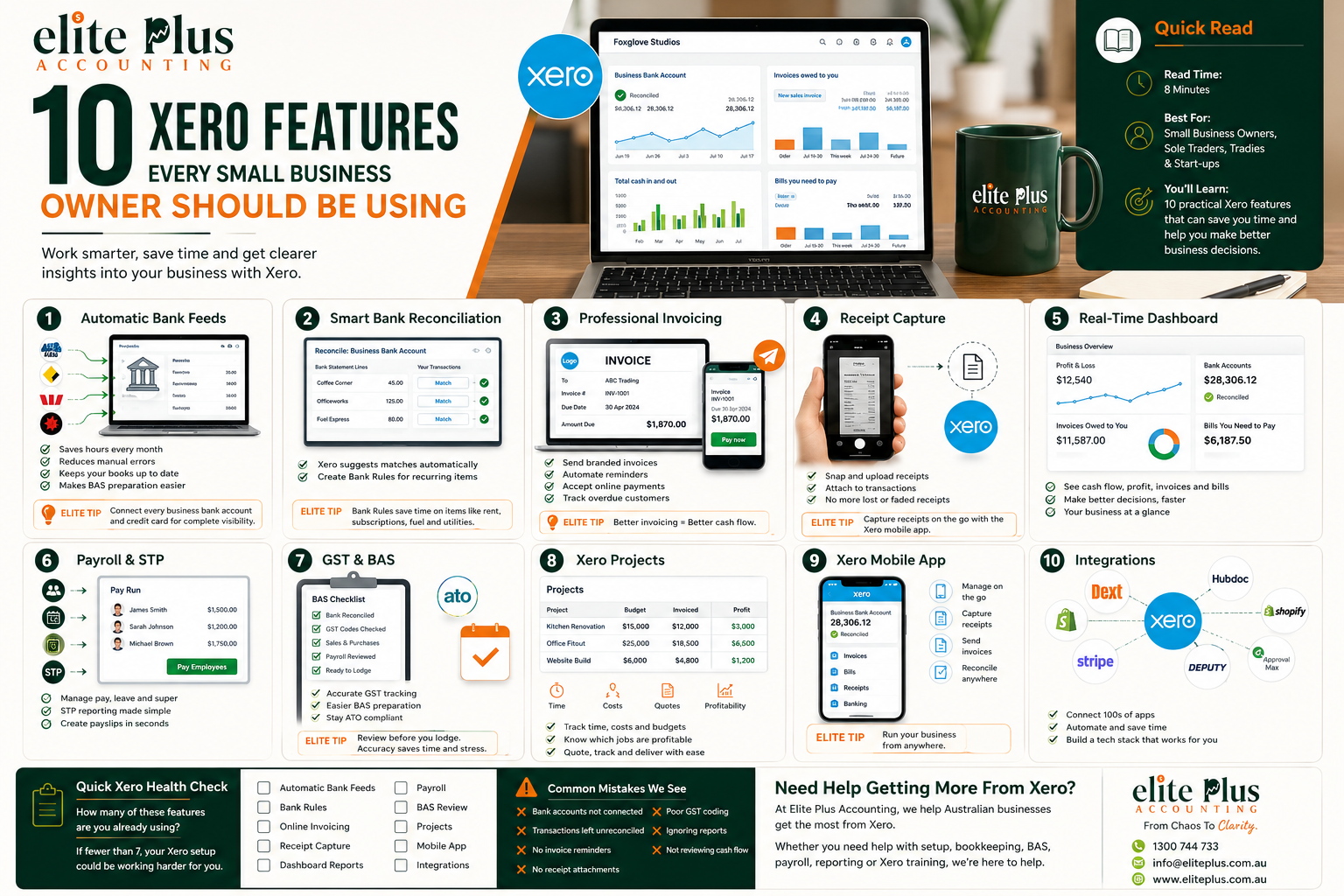
Discover 10 essential Xero features that help small business owners manage finances, save time, track expenses, improve accuracy, and make smarter business decisions with ease.
Read More