
Tax time catches a lot of small business owners off guard. Not because they are doing the wrong thing on purpose, but because running a business is busy, and Australian tax rules are not simple. Things slip. Records go missing. Deadlines sneak up.
The problem is, the ATO does not really care why it happened. Late lodgements, under-reported income, and missed super payments all come with penalties. And those costs can hit hard when you are already watching every dollar. Knowing what the common mistakes are is a decent first step toward not making them.
Why Small Businesses Get Tax Wrong More Often
Small business owners are usually doing five jobs at once. You are the operator, the salesperson, the customer service rep, and sometimes the bookkeeper too. Tax tends to sit at the bottom of the to-do list until it becomes urgent.
Most mistakes are not about tax knowledge at all. They come down to messy records, missed deadlines, or assumptions that turn out to be wrong. The nine mistakes below are the ones that show up most often, and they are all avoidable.
1. Poor Record-Keeping
Good tax compliance starts with good records. If you cannot show where your income came from and what your expenses were, your tax return is already on shaky ground.
The ATO can ask you to back up any claim you make, from a deduction for tools to a GST credit on a supplier invoice. Without proper documentation, you may lose deductions you were entitled to, or end up on the ATO’s radar. Tools like Xero or MYOB make this much easier, and solid bookkeeping does not have to take hours each week.
What to keep:
- Invoices and receipts for all business expenses
- Bank statements showing income and payments
- Payroll records for all employees
- Records of any asset purchases or disposals
- Motor vehicle logbooks if claiming vehicle costs
2. Mixing Personal and Business Finances
This is one of the most common issues for sole traders and small business owners. Using the same bank account for personal spending and business transactions makes it very hard to track what is actually a business expense.
When it comes time to prepare your tax return, sorting through mixed transactions is time-consuming and error-prone. You might miss legitimate deductions, or accidentally claim personal spending as a business cost, which the ATO treats as overclaiming. The fix is simple: open a separate business bank account and use it only for business.
3. Not Registering for GST When Required
Businesses with annual turnover of $75,000 or more must register for GST. If you cross that threshold and do not register, you are still liable for the GST you should have been collecting, and the ATO can backdate that liability.
A lot of growing businesses hit that mark without realising it, especially if turnover picks up quickly. If you are getting close to $75,000, keep an eye on your numbers. Once you are registered, you lodge a BAS each quarter and report the GST you have collected and claimed.
| GST Threshold | Requirement |
|---|---|
| Under $75,000 per year | Registration is optional |
| $75,000 or more per year | Must register for GST |
| Taxi, rideshare, or Uber drivers | Must register regardless of turnover |
| Non-profit organisations | Must register if turnover is $150,000 or more |
4. Missing BAS and Tax Return Deadlines
Missing a lodgement date means penalties before you have even looked at what you owe. The ATO charges a failure-to-lodge penalty, and interest can add up on top of that.
Quarterly BAS is due 28 days after the end of each quarter. Individual and company tax returns have their own deadlines, usually October for individuals lodging on their own, or later if you use a registered tax agent. If keeping track of dates is a problem, having someone handle your lodgements for you takes that risk off your plate entirely.
5. Getting Worker Classifications Wrong
Whether someone is an employee or a contractor makes a real difference to your obligations. Get it wrong and you could owe unpaid super, PAYG withholding, and leave entitlements you did not budget for.
The distinction is not just about whether someone has an ABN. The ATO looks at the actual nature of the arrangement, things like who controls how the work is done, whether the person works for multiple clients, and whether they take on financial risk. A lot of small businesses have misclassified workers as contractors when the ATO considers them employees. That can be a costly correction to make down the line.
Key differences between employees and contractors:
- Employees work regular hours, follow your direction, and are entitled to super, leave, and PAYG withholding
- Contractors run their own business, set their own hours, and are responsible for their own tax
- Having an ABN does not automatically make someone a contractor
- The ATO’s Employee/Contractor Decision Tool is free and worth using if you are unsure
6. Missing Superannuation Obligations
Super is not optional. If you have employees who earn $450 or more per month (and from July 2022, this threshold was removed, so super applies regardless of earnings), you need to make super contributions of at least 11.5% of their ordinary time earnings for 2024-25.
Super must be paid by the quarterly due date. If it is late, even by a day, you cannot claim it as a tax deduction, and you may have to pay the Superannuation Guarantee Charge on top. This catches a lot of employers out, especially when cash flow is tight near the end of a quarter. Good payroll management means super is scheduled properly, not scrambled at the last minute.
| Quarter | Super Contribution Due Date |
|---|---|
| 1 July to 30 September | 28 October |
| 1 October to 31 December | 28 January |
| 1 January to 31 March | 28 April |
| 1 April to 30 June | 28 July |
7. Claiming Deductions Without Proper Evidence
Claiming deductions you are not entitled to is one of the ATO’s main data-matching targets. But the more common issue is actually businesses missing deductions they are entitled to because they did not keep records.
Both situations are a problem. Overclaiming without receipts can lead to penalties. Under-claiming means paying more tax than you should. Put simply: if it is a genuine business expense, keep the evidence. If it is partly personal, you can only claim the business portion.
Common deductions small businesses often miss:
- Home office costs if you work from home
- Accounting and bookkeeping fees
- Bank fees on business accounts
- Business insurance premiums
- Subscriptions to industry-specific software or publications
- Training and professional development costs
8. Not Planning for Tax During the Year
A lot of small business owners treat tax as a once-a-year problem. They wait until June, or later, and then deal with whatever the number turns out to be. By then, most of the moves that could have reduced the bill are off the table.
Things like prepaying certain expenses before 30 June, topping up super contributions, or using the instant asset write-off all need to happen before the financial year ends. If you are not watching your numbers during the year, those options are not available to you. This is one of the main reasons ongoing financial visibility, whether through management reports or a virtual CFO, can make a real difference to what you end up paying.
9. Trying to Handle Everything Alone
Tax law changes. Rates change. ATO focus areas shift from year to year. It is hard to stay across all of it when your main job is running a business.
The cost of getting it wrong, whether that is a penalty, a missed deduction, or a payroll error, is usually more than the cost of getting help. A registered tax agent or accountant does not just do the paperwork. They spot things you would not notice, and they make sure your obligations are met properly. If you are setting up for the first time and want to get things right from the start, proper business setup support covers registrations, structure, and obligations before any of these mistakes have a chance to happen.
Common Mistakes and How to Avoid Them
| Mistake | Why It Happens | How to Avoid It |
|---|---|---|
| Poor record-keeping | No system in place | Use accounting software; keep all receipts |
| Mixing personal and business funds | Convenience | Separate bank account for business only |
| Not registering for GST | Unaware of threshold | Monitor annual turnover; register at $75,000 |
| Missing lodgement deadlines | No reminder system | Use a tax agent or calendar reminders |
| Wrong worker classification | Misunderstanding the rules | Use the ATO's decision tool; get advice |
| Late super payments | Cash flow issues | Schedule contributions in advance each quarter |
| Claiming without evidence | Records not kept | Keep receipts and logs for all business expenses |
| No tax planning during the year | Reactive approach | Review numbers quarterly with an accountant |
| Doing everything alone | Trying to save money | Work with a registered tax agent or bookkeeper |
Sorting It Out Before It Becomes a Problem
Most of these mistakes are fixable. Better records, a separate business account, and keeping track of lodgement dates will take care of several of them right away. The trickier ones, like worker classification and tax planning, are worth getting proper advice on.
Tax does not need to be the most stressful part of running a business. With the right systems in place, it just becomes another thing that gets done on time.
Working with Your Numbers, Not Against Them
Small businesses in Melbourne and across Australia lose real money every year through avoidable tax mistakes. Not from dishonesty, just from being busy and not having the right setup. Getting on top of it now, rather than after the ATO sends a letter, is almost always easier and cheaper.
At Elite Plus Accounting, we work with small business owners on exactly this kind of thing, from keeping books clean to lodging BAS on time and making sure super is right. If your tax situation feels messy or uncertain, book a free consultation and we can take a look at where things stand.
Frequently Asked Questions
What are the most common tax mistakes small businesses make in Australia?
How much can you get fined for late BAS lodgement in Australia?
What is the GST registration threshold for small businesses?
Can I claim home office expenses as a small business tax deduction?
What happens if I misclassify an employee as a contractor?
get in touch
Connect with Our Experts
Our dedicated team of accountants and bookkeepers is here to guide you toward the best financial solutions. Reach out today and speak with one of our experienced professionals to get started on the right path.


Recent Blogs
A common assumption among Australian business owners is: “They have an ABN and send me an invoice, so they are responsible for their own super.” Unfortunately, it is not always that simple. For super guarantee purposes, the ATO looks at the substance of the arrangement. Some independent contractors must still receive super where the contract is wholly […]
Read More
Working two jobs in Australia can affect how much tax is withheld from your pay. Learn how the $18,200 tax-free threshold works, when to claim it, and how claiming it from multiple employers could lead to an unexpected tax bill.
Read More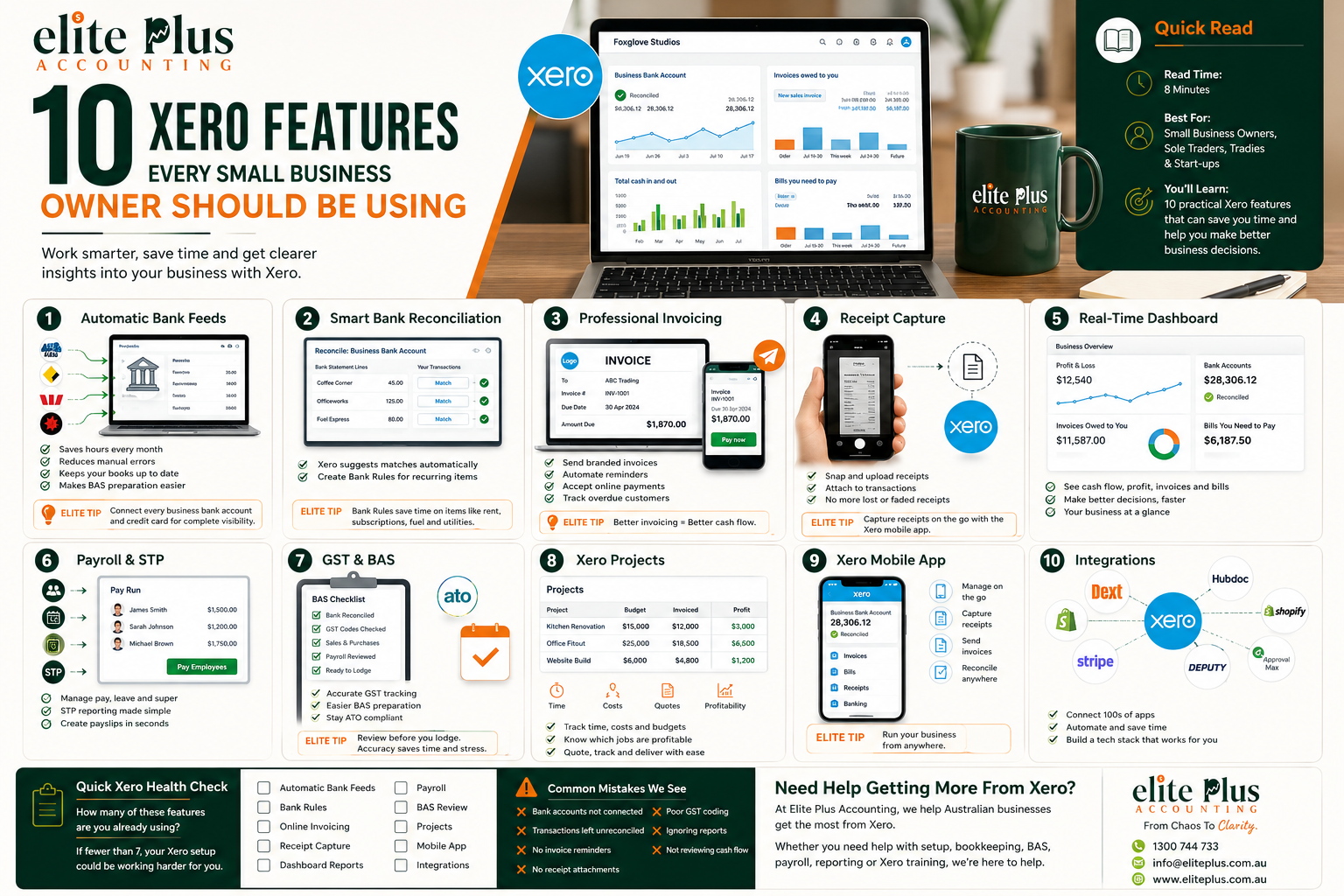
Discover 10 essential Xero features that help small business owners manage finances, save time, track expenses, improve accuracy, and make smarter business decisions with ease.
Read More