
Getting a letter from the Australian Taxation Office is one of those moments that can instantly make a business owner’s stomach drop.
You see the ATO logo on the envelope and suddenly your mind starts racing.
“Am I being audited?”
“Did I make a mistake?”
“Is my business in trouble?”
“How much is this going to cost me?”
For many business owners across Australia, receiving ATO correspondence creates stress and anxiety before they even understand what the letter is actually about.
The good news is this:
Most ATO letters are not as scary as they first appear.
Many notices are routine administrative letters, automated reminders, or requests for clarification rather than serious investigations. However, the biggest mistake business owners make is ignoring the letter or delaying action.
At Elite Plus Accounting, we regularly help clients understand ATO notices, respond appropriately, resolve compliance concerns, and prevent small issues from becoming much larger problems.
The key is staying calm, understanding what the letter means, and responding correctly.
Why the ATO Sends Letters to Businesses
The Australian Taxation Office sends thousands of letters every week to businesses, employers, company directors, and individual taxpayers.
Not every letter means you are in serious trouble.
In many cases, the ATO is simply:
- Requesting information
- Following up on outstanding lodgements
- Clarifying inconsistencies
- Issuing payment reminders
- Conducting routine compliance reviews
- Updating records
- Checking payroll reporting
- Reviewing GST reporting
- Following up on superannuation obligations
Some of the most common reasons businesses receive ATO correspondence include:
Outstanding BAS or Tax Returns
If BAS, IAS, company tax returns, or individual tax returns remain overdue, the ATO will often issue reminder notices or formal demands.
Tax Debt Reminders
Businesses with unpaid GST, PAYG withholding, income tax, or superannuation liabilities may receive payment reminders or collection notices.
Single Touch Payroll (STP) Inconsistencies
The ATO regularly compares payroll data lodged through STP against BAS figures and employee reporting.
GST Reviews
Businesses may receive review letters if GST claims appear unusually high or inconsistent with industry benchmarks.
Director Obligations
Company directors may receive notices relating to PAYG withholding, superannuation obligations, or director penalty risks.
Data Matching Programs
The ATO uses sophisticated technology to compare data from banks, payment platforms, employers, government agencies, and financial institutions.
When discrepancies appear, automated notices are often generated.
Step 1: Read the Letter Carefully

Before panicking, the first thing to do is carefully read the notice from start to finish.
Many people immediately assume the worst without fully understanding what the ATO is actually asking for.
- Take your time and identify:
- What the issue relates to
- What tax period is involved
- Whether action is required
- Whether supporting documents are requested
- Whether payment is required
- Whether there is a response deadline
The wording used in ATO letters can sometimes appear formal or intimidating, even for relatively straightforward matters.
Understanding the exact nature of the notice is extremely important before taking any action.
Step 2: Don’t Panic

Receiving an ATO letter does not automatically mean you have done something wrong.
Many ATO notices are generated automatically through system reviews and compliance programs.
For example, the ATO may issue automated notices when:
- BAS lodgements are overdue
- Payroll figures do not reconcile
- Superannuation payments appear late
- GST claims differ from industry averages
- Tax debts remain unpaid
- Information does not match third-party data
These letters are often routine.
Even where genuine errors exist, many issues can be resolved professionally and cooperatively when handled early.
Panicking usually leads to poor decisions, rushed responses, or avoiding the issue altogether.
The most important thing is addressing the matter calmly and promptly.
Step 3: Never Ignore an ATO Letter

Ignoring ATO correspondence is one of the worst things a business owner can do.
Unfortunately, many people delay opening the letter because they feel overwhelmed or anxious.
This often turns manageable issues into far more serious problems.
Every ATO notice includes deadlines.
Missing those deadlines can result in:
- Additional penalties
- General Interest Charges (GIC)
- Default assessments
- Escalation to debt recovery
- Garnishee notices
- Director Penalty Notices (DPNs)
- Loss of payment arrangement flexibility
- Increased compliance scrutiny
The earlier you respond, the more options are generally available.
The ATO is typically more cooperative with businesses that engage proactively and communicate honestly.
What Happens If You Ignore the ATO?
Many business owners believe that avoiding the issue will somehow make it disappear.
Unfortunately, the opposite usually occurs.
The ATO has significant enforcement powers available under Australian taxation law.
Depending on the circumstances, continued non-response may eventually lead to:
- Tax debt collection action
- Bank garnishees
- Director penalties
- Legal proceedings
- Credit impacts
- Wind-up action against companies
- Refund offsets
- Stronger audit activity
In many situations, business owners could have avoided escalation simply by seeking professional advice early.
Review vs Audit vs Investigation — Understanding the Difference
One of the biggest misconceptions is that every ATO letter means a full audit.
That is not necessarily true.
ATO Review
A review is generally less serious and often involves the ATO requesting clarification or supporting documents.
Examples include:
- Verifying deductions
- Reviewing GST treatment
- Checking payroll figures
- Clarifying BAS reporting
Reviews are relatively common and are often resolved quickly when records are properly maintained.
ATO Audit
An audit is more detailed and formal.
The ATO may examine:
- Financial statements
- Bank transactions
- Payroll records
- Director loan accounts
- GST calculations
- Expense claims
- Accounting systems
- Trust distributions
Audits may cover multiple financial years.
Professional assistance is strongly recommended during an audit process.
ATO Investigation
Investigations are generally reserved for more serious matters involving suspected fraud, intentional evasion, phoenix activity, or deliberate misconduct.
Most businesses receiving standard ATO letters are not facing criminal investigations.
However, proper handling is still extremely important.
How the ATO Uses Data Matching
Many business owners underestimate how much information the ATO already has access to.
The ATO receives data from:
- Banks
- Employers
- Superannuation funds
- Single Touch Payroll systems
- Online marketplaces
- Investment platforms
- Payment processors
- Government agencies
- Property transactions
This information is automatically compared against:
- BAS lodgements
- Income tax returns
- Payroll reporting
- GST claims
- Superannuation disclosures
When inconsistencies appear, the system may automatically generate review notices or compliance letters.
For example:
- Payroll figures may not match BAS wages
- GST claims may appear unusually high
- Reported income may differ from banking data
- Superannuation obligations may appear unpaid
This is why accurate bookkeeping and regular reconciliations are so important.
Common Mistakes Business Owners Make
Ignoring the Letter
This is the most common and most damaging mistake.
Responding Emotionally
Panic responses often create unnecessary complications.
Providing Incorrect Information
Incomplete or inaccurate responses can trigger additional review activity.
Missing Deadlines
Deadlines matter significantly in ATO correspondence.
Trying to Handle Complex Issues Alone
Tax law and compliance obligations can be highly technical.
Seeking advice early can often save significant stress, penalties, and cost later.
When Should You Contact an Accountant Immediately?
You should seek professional assistance quickly if the letter involves:
- Director Penalty Notices
- Audit notifications
- Payroll discrepancies
- GST disputes
- Superannuation compliance
- Large tax debts
- Requests for extensive records
- Multiple overdue lodgements
- Allegations of incorrect reporting
The earlier professional advice is obtained, the better the potential outcome usually becomes.
Can the ATO Offer Payment Plans?
Yes — in many situations, the ATO may allow payment arrangements for eligible taxpayers.
However, approval generally depends on:
- Lodgements being up to date
- Communication occurring early
- The taxpayer demonstrating willingness to comply
- Financial capacity assessments
Ignoring debt notices typically reduces flexibility and available options.
This is another reason why early action matters.
How Elite Plus Accounting Can Help
At Elite Plus Accounting, we help businesses across Australia understand and respond to ATO correspondence professionally and calmly.
We assist clients with:
- Reviewing ATO notices
- Explaining obligations clearly
- Communicating with the ATO
- Preparing supporting documentation
- Lodging overdue BAS and tax returns
- Resolving payroll issues
- Managing GST concerns
- Assisting with superannuation compliance
- Negotiating payment arrangements
- Improving bookkeeping and compliance systems
Our goal is simple:
Helping business owners move from confusion and stress to clarity and control.
Final Thoughts
Receiving a letter from the Australian Taxation Office can feel stressful, but in many situations, the issue is manageable when handled correctly and early.
The key things to remember are:
- Read the letter carefully
- Do not panic
- Never ignore deadlines
- Seek professional advice if unsure
The worst thing you can do is avoid the issue.
Early action, proper communication, and professional guidance can often prevent small problems from escalating into major financial and compliance concerns.
If you’ve received an ATO letter and are unsure what it means or what to do next, Elite Plus Accounting can help you understand the situation and determine the best way forward.
Speak with our team for assistance with ATO notices, BAS issues, payroll concerns, tax debts, and compliance matters.
Important Disclaimer
This article contains general information only and is intended for educational and informational purposes. It does not constitute taxation advice, financial advice, legal advice, or business advice.
The taxation and compliance obligations of each taxpayer or business will vary depending on their individual circumstances, business structure, financial position, industry, and specific facts.
Receiving correspondence from the Australian Taxation Office does not automatically indicate wrongdoing, nor should any response strategy be adopted solely based on the information contained in this article.
Before responding to any ATO notice, review, audit request, payment demand, or compliance correspondence, readers should obtain professional advice tailored to their specific circumstances from a qualified and registered tax professional.
While every effort has been made to ensure the accuracy of the information at the time of publication, taxation laws, ATO guidance, administrative practices, and compliance approaches may change without notice.
Elite Plus Accounting accepts no responsibility or liability for any loss, damage, penalties, interest, costs, claims, or decisions arising directly or indirectly from reliance on the information contained in this article. Readers remain solely responsible for ensuring their own compliance with Australian taxation laws and obligations.
get in touch
Connect with Our Experts
Our dedicated team of accountants and bookkeepers is here to guide you toward the best financial solutions. Reach out today and speak with one of our experienced professionals to get started on the right path.


Recent Blogs
A common assumption among Australian business owners is: “They have an ABN and send me an invoice, so they are responsible for their own super.” Unfortunately, it is not always that simple. For super guarantee purposes, the ATO looks at the substance of the arrangement. Some independent contractors must still receive super where the contract is wholly […]
Read More
Working two jobs in Australia can affect how much tax is withheld from your pay. Learn how the $18,200 tax-free threshold works, when to claim it, and how claiming it from multiple employers could lead to an unexpected tax bill.
Read More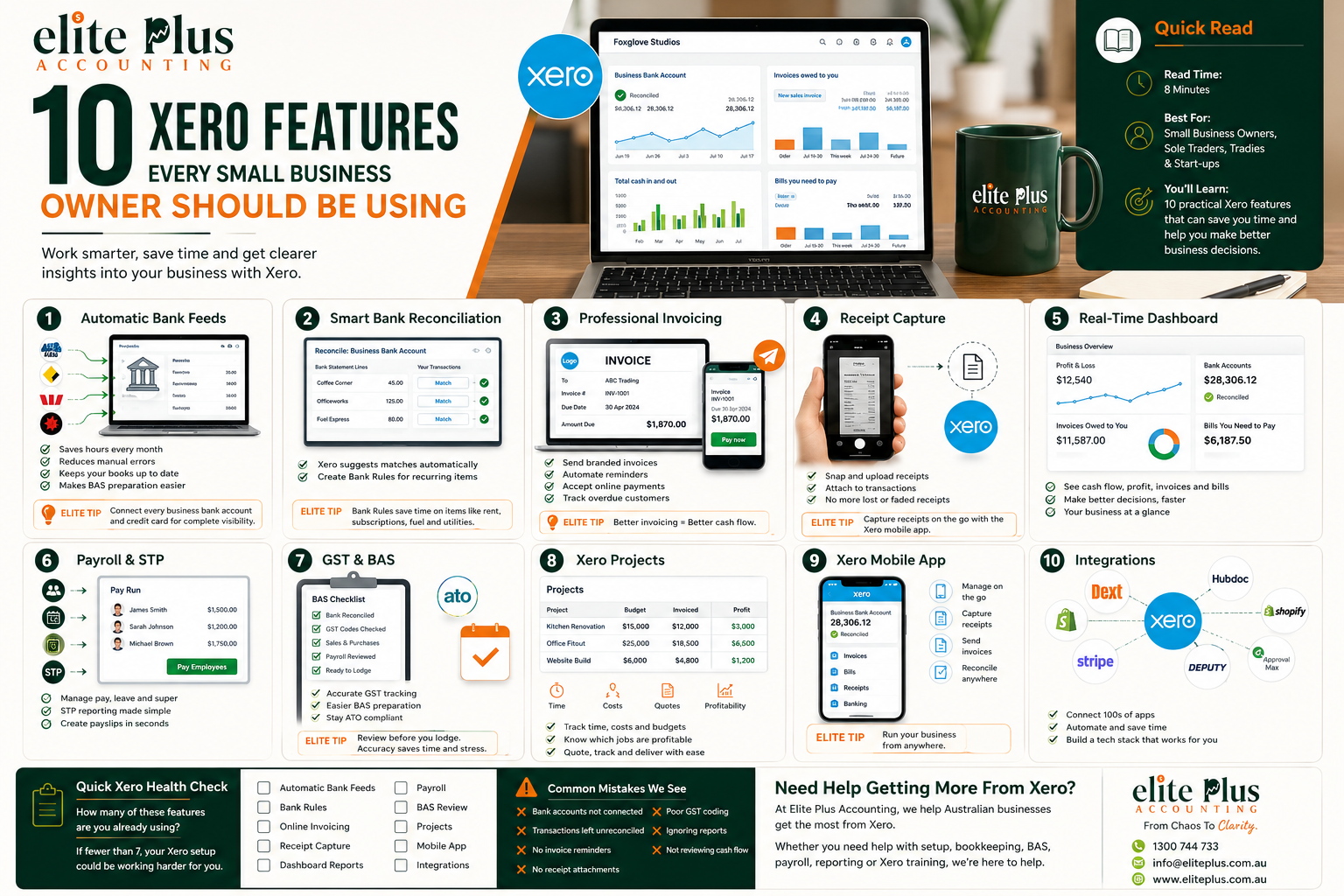
Discover 10 essential Xero features that help small business owners manage finances, save time, track expenses, improve accuracy, and make smarter business decisions with ease.
Read More