Starting a small business is exciting. But tax? Not so much. Most business owners want to know two things: what do I have to pay, and how do I avoid paying more than I should?
The answer depends on how your business is set up. A sole trader pays tax differently to a company. A company that earns most of its money from trading pays a different rate to one that earns from investments. On top of income tax, there are a few other taxes you need to know about. This guide covers all of it, simply. No accounting background needed.
Why Australia Is Actually a Pretty Good Place to Run a Small Business
Australia has one of the stronger economies in the world. The rules around running a business are stable, and there are Free Trade Agreements with many key trading partners across Asia and beyond. Small business owners get access to lower tax rates, concessions, and deductions that larger businesses do not always qualify for.
One of the biggest is the reduced company tax rate of 25% for eligible small businesses, compared to the standard 30% that larger businesses pay. We will get into the details of this shortly.
The Four Business Structures and How They Are Taxed
The structure you choose changes everything when it comes to tax. In Australia, there are four main options.
1. Sole Trader
This is the simplest setup. You run the business as an individual. There is no legal separation between you and the business. That means if the business has debts, you are personally responsible for them.
Your business profit is treated as your personal income. You pay tax at the individual income tax rates and get the tax-free threshold of $18,200. There is no need to register with ASIC. It is cheap and easy to set up, which is why most people start here.
2. Partnership
A partnership is when two or more people run a business together and share the profits, losses, and responsibilities. The partnership itself does not pay tax. Instead, each partner includes their share of the profit in their own tax return and pays tax at their individual rate.
A partnership agreement is usually required, and all partners are personally liable for the debts of the business.
3. Company
A company is a separate legal entity from its owners. It has its own rights, its own tax file number, and pays its own tax. It needs to be registered with ASIC.
The main benefit is limited liability. Your personal assets are generally protected if the business gets into financial trouble. The downside is more paperwork and higher running costs. Companies do not have a tax-free threshold. Every dollar of profit is taxed at a flat rate, either 25% or 30%, depending on eligibility.
4. Trust
A trust is a legal setup where a trustee (a person or company) manages assets or business income for the benefit of others, called beneficiaries. The trust itself usually does not pay tax. Instead, the profit is passed on to beneficiaries, who pay tax at their own rates.
Trusts need a formal trust deed and cost more to set up and run. They can offer tax benefits for families but are more complex to manage. If the trustee is a company, it also needs to be registered with ASIC.
Quick Summary: How the Four Structures Compare
| Business Structure | Sole Trader | Partnership | Company | Trust |
|---|---|---|---|---|
| Setup Cost | Low | Medium | Medium to High | High |
| Admin Complexity | Low | Moderate | Moderate to High | High |
| Personal Liability | Full | Shared | Limited | Depends on trustee |
| Who Pays the Tax | You personally | Each partner personally | The company | Each beneficiary personally |
| Tax-Free Threshold | Yes ($18,200) | Yes (each partner) | No | Depends on beneficiary |
What Taxes Does a Small Business Pay in Australia?
Most businesses need a Tax File Number (TFN) and an ABN (Australian Business Number) to operate. Depending on your structure and size, you may also need an ACN (Australian Company Number) if you are running a company.
On top of registering correctly, there are five main types of tax that can apply to small businesses.
1. Company Tax
If your business is set up as a company, it pays tax on its profits. There are two rates:
| Company Type | Tax Rate |
|---|---|
| Small business company (turnover under $50 million, mainly trading income) | 25% |
| All other companies | 30% |
The 25% rate applies to companies that are actively trading and earning less than $50 million per year. If your company earns most of its income from passive sources like investments, rent, or dividends, you may not qualify and would pay 30% instead.
If you are a sole trader or partner, you do not pay company tax. You pay personal income tax instead.
2. Capital Gains Tax (CGT)
Capital Gains Tax applies when you sell a business asset and make a profit on it. This could be property, shares, equipment, or even the business itself. The profit from the sale gets added to your taxable income for that year and taxed at your normal rate. If you have owned the asset for more than 12 months, you may only have to pay tax on 50% of the profit rather than the full amount.
Small businesses also have access to four CGT concessions that can reduce or wipe out the tax when selling business assets. These include:
- A full exemption if you have owned the asset for 15 or more years, are 55 or older, and are retiring
- Halving the taxable gain on active business assets
- A lifetime exemption of up to $500,000 when retiring
- Putting off the tax by reinvesting in a new asset
3. Goods and Services Tax (GST)
GST is a 10% tax added to most goods and services. Once your business earns $75,000 or more per year, you must register for GST. Once registered, you add 10% to your prices and collect it from your customers. You also get to claim back the 10% GST you pay on your own business costs. At the end of each quarter, you work out the difference and pay it to the ATO through your Business Activity Statement (BAS).
If your turnover is under $75,000, GST registration is optional. Some businesses register early to claim back GST on startup costs.
4. PAYG Withholding
PAYG stands for Pay As You Go. If you have employees, you are required to take a portion of tax out of their pay before it reaches their bank account and send it to the ATO.
This is not an extra cost to your business. It means your employees pay their income tax in small amounts throughout the year rather than in one large sum. The amount you withhold depends on each employee’s income and follows the individual income tax rates. The rates range from 16% up to 45%, depending on what the employee earns.
5. Payroll Tax
Payroll tax is a state-based tax. It only applies once your total wages bill crosses a certain amount, which varies by state. Here is a rough guide:
| State / Territory | Threshold | Rate |
|---|---|---|
| Victoria | $700,000 | 4.85% |
| New South Wales | $1,200,000 | 5.45% |
| Queensland | $1,300,000 | 4.75% |
| Western Australia | $1,000,000 | 5.5% |
| South Australia | $1,500,000 | 4.95% |
Most small businesses sit well under these thresholds. But as your team grows, it is worth knowing when you might cross the line.
Things That Can Reduce What You Pay
There are several legal ways to reduce your tax bill. Here are the most useful ones for small businesses:
- Claim all your business expenses. Rent, wages, insurance, software, equipment, accounting fees, vehicle costs, marketing, if it is a genuine business expense, it reduces your taxable profit. Keep receipts and records.
- Use the instant asset write-off. For 2025-26, businesses with turnover under $10 million can claim the full cost of equipment under $20,000 per item right away. Buying a $12,000 piece of machinery reduces your taxable income by $12,000 this year, not bit by bit over several years.
- Contribute to superannuation. Sole traders and eligible company directors can put money into their own super and claim it as a tax deduction. For 2025-26, the limit is $30,000. This directly reduces your taxable income.
- Prepay certain expenses before 30 June. If you pay for insurance, subscriptions, or rent in advance before 30 June, and the period covered is within the next 12 months, you can often claim it this financial year.
- Review your business structure. If you are a sole trader earning strong profits, it may be worth checking whether a company structure would cut your tax bill. The crossover point is generally around $90,000 to $100,000 in profit, but it depends on your situation.
Dates You Need to Know
Missing a deadline means the ATO can charge you penalties and interest. Here are the key ones for 2025-26:
| What | Due Date |
|---|---|
| Sole trader / individual tax return | 31 October 2025 |
| Company tax return | 15 January 2026 (or 15 May 2026 with a registered tax agent) |
| Quarterly BAS | 28 days after each quarter ends |
| Super contributions (quarterly) | 28 days after each quarter ends |
Using a registered tax agent usually gets you more time to lodge. It also means someone qualified is checking the numbers.
The Part Most Business Owners Get Wrong
Most people treat tax as something to deal with at the end of the financial year. By then, most of the decisions that could have reduced your tax are no longer available.
Things like timing a big equipment purchase, topping up your super, or prepaying a business expense all need to happen before 30 June. If your books are tidy through the year and someone is keeping an eye on your numbers, you are in a much better position to act before the deadline.
Good bookkeeping is not just about keeping the ATO happy. It tells you whether you are actually making money, and it is what makes tax planning possible rather than just reactive.
The Bottom Line
Running a small business in Australia comes with real tax obligations, but also concessions that can save you thousands of dollars each year. The difference between a business owner who manages their tax well and one who does not usually comes down to timing and preparation.
If you are not sure where you stand, or you have been managing your own returns and want a second opinion, it is worth getting a professional to take a look. At Elite Plus Accounting, we work with Melbourne business owners every day. Our services are fixed-fee with no surprise bills. Book your free consultation with our team today.
Frequently Asked Questions
What is the tax rate for a small business in Australia?
Do I have to pay GST as a small business?
What is the difference between company tax and income tax?
When does capital gains tax apply to a small business?
How can a small business legally pay less tax?
get in touch
Connect with Our Experts
Our dedicated team of accountants and bookkeepers is here to guide you toward the best financial solutions. Reach out today and speak with one of our experienced professionals to get started on the right path.


Recent Blogs
A 13-week cash flow forecast helps growing businesses identify potential cash shortages, plan upcoming expenses, manage working capital, and make informed financial decisions before problems arise.
Read More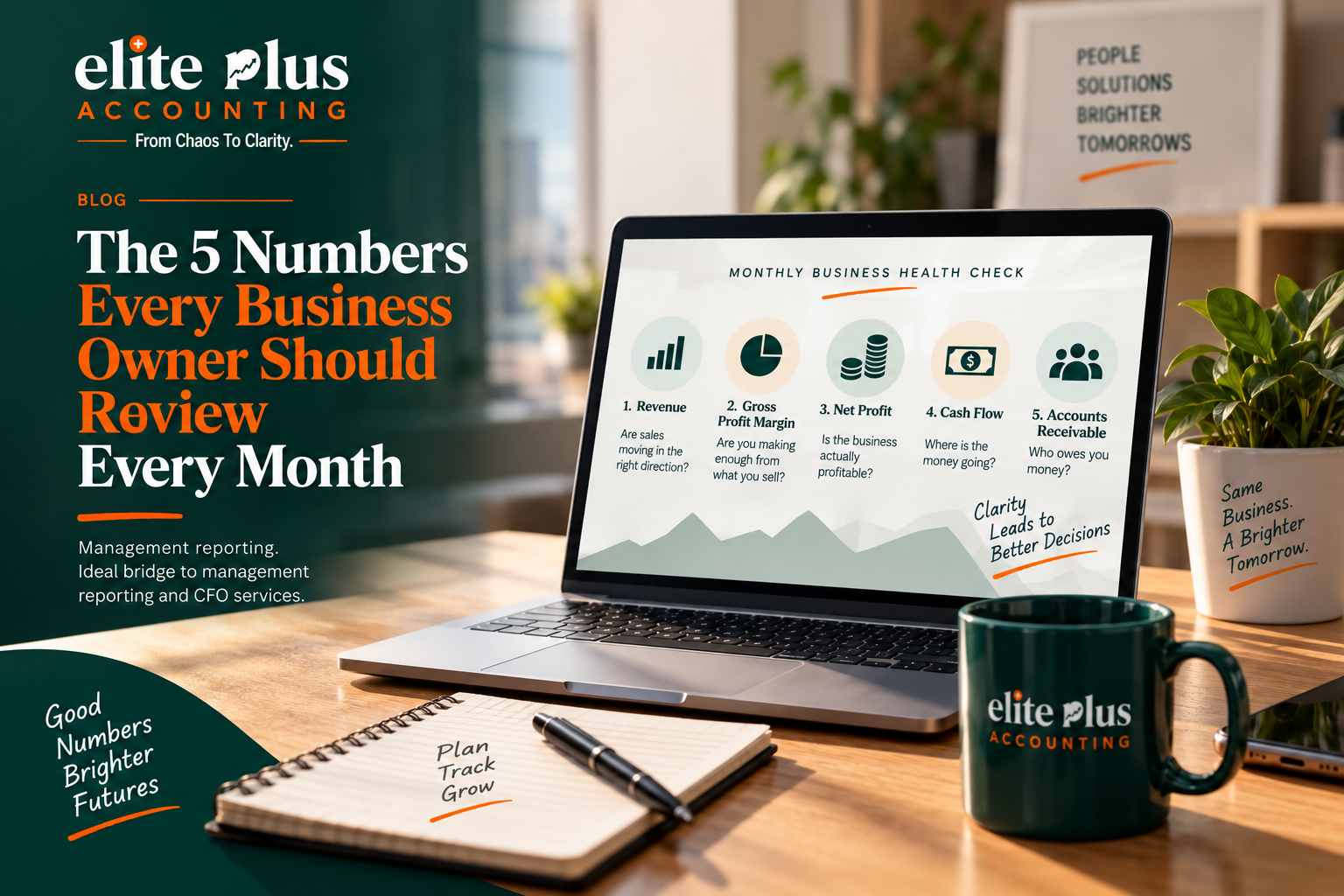
Learn the five key numbers every business owner should review monthly to understand financial performance, manage cash flow, identify issues early, and make better business decisions.
Read More
A common assumption among Australian business owners is: “They have an ABN and send me an invoice, so they are responsible for their own super.” Unfortunately, it is not always that simple. For super guarantee purposes, the ATO looks at the substance of the arrangement. Some independent contractors must still receive super where the contract is wholly […]
Read More