
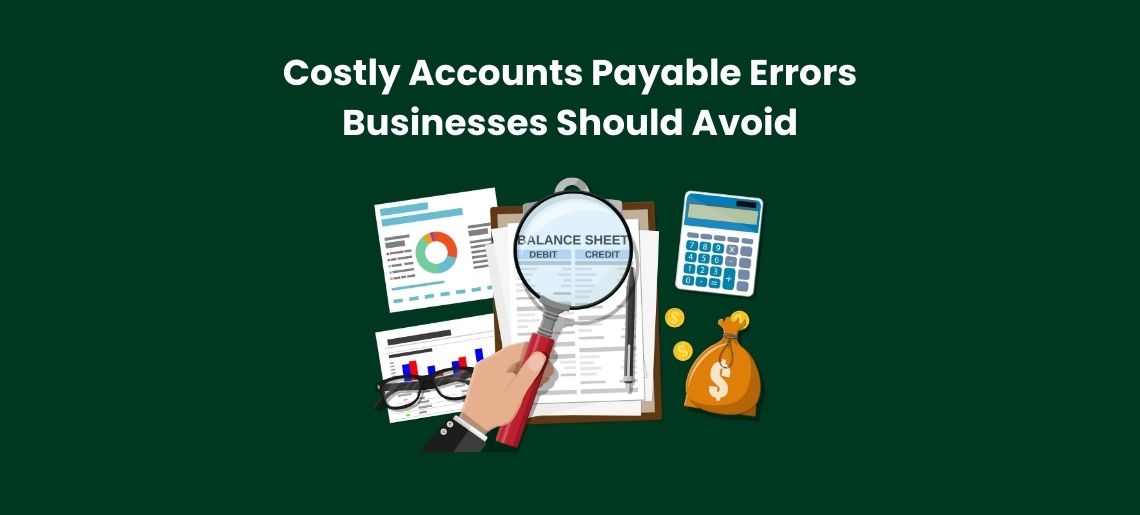
For businesses, even minor accounts payable errors can lead to distorted cash flow forecasts, inaccurate financial statements, and strained supplier relationships. Over time, these issues can compound, making it difficult for management to rely on financial data for decision-making.
This article takes a practical approach to accounts payable. It identifies the most common AP errors encountered in day-to-day operations and outlines structured, easy-to-understand prevention strategies that improve accuracy, control, and efficiency.
Common Accounts Payable Errors in Business Operations
Duplicate Payments
Duplicate payments occur when the same supplier invoice is processed and paid more than once. This is common in environments where invoices are received through multiple channels such as email, vendor portals, and paper copies.
From a technical perspective, duplicate payments typically arise due to:
- Absence of unique invoice number validation
- Inadequate matching of invoices to purchase orders or delivery records
- Lack of real-time visibility across AP workflows
The financial impact is immediate. Cash reserves are reduced unnecessarily, and recovery of overpaid amounts often requires time-consuming reconciliation and supplier follow-up.
Incorrect Data Entry
Incorrect data entry includes errors in invoice amounts, supplier details, invoice dates, or payment terms. These errors are often introduced during manual invoice processing or when controls are bypassed to meet payment deadlines.
Common consequences include:
- Overstatement or understatement of liabilities
- Payment discrepancies requiring adjustments
- Reconciliation challenges during month-end close
From a reporting standpoint, repeated data entry errors reduce confidence in the accuracy of accounts payable balances.
Missing or Unrecorded Invoices
Invoices that are not recorded in the accounting system represent an understated liability. This often occurs when invoices are misplaced, overlooked in email inboxes, or received without a structured intake process.
The technical risk associated with missing invoices includes:
- Incomplete expense recognition
- Unexpected cash outflows when invoices surface later
- Distorted accounts payable ageing reports
A lack of centralised invoice management significantly increases this risk.
Late Payments Due to Process Inefficiencies
Late payments are frequently caused by internal delays rather than cash shortages. Bottlenecks in invoice approval, unclear authorisation limits, or manual payment scheduling can all delay settlement.
Operational impacts include:
- Late payment penalties or interest charges
- Deterioration of supplier trust
- Reduced flexibility in negotiating payment terms
From a systems perspective, late payments indicate workflow inefficiencies rather than isolated errors.
Unauthorised or Inadequately Approved Payments
Unauthorised payments occur when invoices are processed without proper verification or approval. This risk is heightened in businesses without clearly defined internal controls or segregation of duties.
Key contributing factors include:
- Single-user control over invoice entry and payment
- Absence of approval thresholds
- Limited audit trails within accounting systems
Such weaknesses increase exposure to both error and fraud.
Misclassification of Accounts Payable Expenses
Expense misclassification occurs when invoices are recorded against incorrect accounts or cost centres. While this may not immediately affect cash flow, it has a significant impact on financial reporting accuracy.
Misclassification can lead to:
- Inaccurate profit and margin analysis
- Distorted departmental or project reporting
- Poor budgeting and forecasting outcomes
Technically accurate coding is essential for meaningful financial insights.
Inadequate Record Keeping and Documentation
Accounts payable relies on supporting documentation such as invoices, approvals, and supplier statements. Poor record keeping weakens audit trails and increases the time required for reconciliations and reviews.
Consequences include:
- Difficulty substantiating transactions
- Increased audit and compliance risk
- Inefficient month-end close processes
The Cost of Accounts Payable Issues
Accounts payable issues extend well beyond administrative inconvenience and result in measurable financial, operational, and reputational costs. When AP errors remain unresolved, their impact is felt across multiple areas of the business.
Financial impact
- Duplicate payments, late fees, and missed early payment discounts directly reduce profitability.
- Temporary cash outflows caused by overpayments restrict available working capital.
- Reduced liquidity can disrupt short-term cash flow planning and payment scheduling.
Operational impact
- Ongoing AP errors increase the time spent on reconciliations, corrections, and supplier follow-ups.
- Finance teams are diverted from value-added activities such as financial analysis and forecasting.
- Inefficiencies often result in delayed month-end closes and inconsistent financial reporting.
- Repeated corrections reduce confidence in accounts payable data and management reports.
Reputational and supplier-related impact
- Late or inaccurate payments damage supplier trust and reliability perceptions.
- Reduced credibility can weaken negotiation power for payment terms or pricing.
- In severe cases, payment issues may disrupt supply continuity or service delivery.
Strategic implications
- Indirect costs from inefficiencies and strained relationships can exceed the original error value.
- Persistent issues highlight weaknesses in process design and internal controls.
- Understanding these costs reinforces the importance of structured, preventative AP controls rather than reactive corrections.
The Path to Prevention: Structured Accounts Payable Controls
Implement Accounts Payable Automation
Accounts payable automation reduces reliance on manual data entry by digitally capturing invoice information, validating data, and managing approval workflows within the accounting system.
From a technical standpoint, automation supports error prevention by:
- Detecting and preventing duplicate invoice processing through invoice number and supplier matching
- Enforcing predefined approval rules and authorisation limits
- Standardising invoice data formats across suppliers and platforms
- Improving visibility into invoice status and outstanding liabilities
Automation improves both processing accuracy and operational efficiency while reducing the risk of human error.
Standardise Invoice Processing Workflows
A documented and standardised AP workflow defines each step of the invoice lifecycle, from receipt through to payment and record retention.
Effective standardisation includes:
- Centralised invoice intake, regardless of source
- Clearly defined approval stages and responsibilities
- Consistent invoice coding and recording procedures
- Secure and organised document storage for audit purposes
Standardised workflows reduce variability, improve accountability, and make exceptions and errors easier to identify and resolve.
Strengthen Internal Controls and Segregation of Duties
Strong internal controls ensure that no single individual has complete control over the accounts payable process. Separating responsibilities reduces both error and fraud risk.
Key control measures include:
- Approval hierarchies aligned with invoice value thresholds
- Segregation of invoice entry, approval, and payment execution
- Dual authorisation for high-value or sensitive payments
- Regular review and maintenance of supplier master data
These controls improve transparency and protect the integrity of the AP function.
Perform Regular Reconciliations and Reviews
Routine reconciliation is a critical control activity that ensures accounts payable records remain accurate and complete.
Regular reviews support:
- Early identification of discrepancies between sub-ledgers, supplier statements, and the general ledger
- Accurate reporting of outstanding liabilities
- Faster and cleaner month-end and year-end closes
- Reduced time spent correcting historical errors
Frequent reconciliations strengthen confidence in financial data and reporting outcomes.
Ongoing Training and Process Awareness
Systems and controls are only effective when users understand how to apply them correctly. Ongoing training ensures consistency and compliance across the AP process.
Training initiatives should focus on:
- Invoice processing procedures and approval workflows
- Proper use of accounting systems and controls
- Awareness of common AP errors and their financial impact
- Updates to processes or system changes
Consistent training reduces process drift and reinforces accountability.
Outsource Accounts Payable to Specialists
Outsourcing accounts payable provides businesses with access to experienced professionals, established controls, and scalable systems without increasing internal workload.
Key benefits of outsourcing include:
- Reduced error rates through structured, proven processes
- Improved compliance and documentation standards
- Greater efficiency during periods of growth or high transaction volume
- Management’s ability to focus on strategic and revenue-generating activities
For many businesses, outsourcing represents a practical and cost-effective solution to strengthening accounts payable controls.
| AP Error | Why It Happens | Prevention Strategy |
|---|---|---|
| Duplicate payments | Multiple invoice sources, no invoice validation | Invoice validation, PO matching, AP automation |
| Data entry errors | Manual bookkeeping, rushed processing | Automated data capture, standardised processes |
| Missing invoices | No central invoice intake, poor tracking | Centralised invoice management, regular reconciliations |
| Late supplier payments | Approval delays, inefficient workflows | Automated approvals, AP ageing monitoring |
| Unauthorised payments | Weak controls, no segregation of duties | Approval limits, segregation of duties, audit trails |
| Expense misclassification | Incorrect coding, lack of review | Standardised chart of accounts, review controls |
| Poor AP record keeping | Incomplete documentation, disorganised storage | Digital records, compliance-ready documentation |
| Limited cash flow visibility | Disconnected systems, delayed reconciliation | Real-time AP reporting, frequent reconciliations |
Practical Example: Accounts Payable Improvement in Practice
A growing Australian plumbing and maintenance business began experiencing financial control issues as transaction volumes increased. While the business expanded operationally, its accounts payable processes did not scale at the same pace, leading to recurring inaccuracies and unreliable reporting.
Key Issues Identified
A targeted review of the accounts payable function highlighted several systemic weaknesses:
- Duplicate supplier invoices recorded in the system, overstating liabilities and complicating payment runs.
- Inconsistent validation and incorrect coding of supplier invoices, distorting expense and liability reporting.
- Poor matching of invoices to purchases, limiting visibility over outstanding obligations and cash flow requirements.
These issues reduced management’s ability to confidently assess what was owed to suppliers and plan cash flow effectively.
Process Improvements Implemented
To stabilise the AP function, the business introduced a more structured and controlled approach:
- Removal of duplicate and incorrect entries, followed by reconciliation of supplier accounts.
- Standardised invoice processing to ensure consistent review, approval, and recording.
- Improved coding accuracy and preventative controls to reduce repeat entry errors.
Businesses experiencing similar challenges may benefit from reviewing their own accounts payable processes and seeking professional guidance to strengthen controls, improve reporting accuracy, and protect cash flow before issues escalate. and improve visibility
A Smarter Approach to Preventing Accounts Payable Errors
Accounts payable errors typically stem from process and control gaps rather than one-off mistakes. Over time, issues such as duplicate payments, late settlements, and incorrect coding reduce cash flow visibility, reporting accuracy, and supplier confidence. Implementing structured workflows, clear controls, regular reviews, and automation helps businesses maintain accurate, reliable AP data.
For businesses struggling with increasing AP complexity, reviewing existing processes can quickly uncover improvement opportunities. Professional support can help strengthen controls, improve visibility, and ensure accounts payable supports informed decision-making and sustainable growth.
Frequently Asked Questions
What are the most common accounts payable errors businesses make?
The most common accounts payable errors include duplicate payments, incorrect data entry, missing or unrecorded invoices, late payments caused by approval delays, unauthorised payments, expense misclassification, and inadequate record keeping. These errors usually result from manual processes and weak internal controls.
Why do duplicate payments occur in accounts payable?
Duplicate payments occur when the same invoice is received through multiple channels, invoice numbers are not properly validated, or invoice matching procedures are inconsistent. Limited visibility across the accounts payable workflow also increases the risk of paying the same invoice more than once.
What is the risk of missing or unrecorded supplier invoices?
Missing or unrecorded invoices lead to understated liabilities and incomplete expense recognition. When these invoices surface later, they can cause unexpected cash outflows, distort accounts payable ageing reports, and disrupt cash flow planning.
Can small businesses benefit from formal accounts payable processes?
Yes. Formal accounts payable processes help small businesses reduce errors, improve cash flow visibility, and maintain accurate financial records. Structured workflows also make it easier to scale operations as transaction volumes grow.
When should a business consider outsourcing accounts payable?
A business should consider outsourcing accounts payable when transaction volumes increase, error rates rise, internal controls are limited, or the finance team is spending excessive time correcting issues instead of focusing on strategic financial activities.
get in touch
Connect with Our Experts
Our dedicated team of accountants and bookkeepers is here to guide you toward the best financial solutions. Reach out today and speak with one of our experienced professionals to get started on the right path.


Recent Blogs
Choosing between cash and accrual accounting is one of the most important financial decisions for a business. Understanding their benefits, limitations, and suitability for your business can make managing finances simpler and more accurate. Explore how each method works and which one aligns with your business goals.
Read More
Running a business in Australia is rewarding but stressful, especially when it comes to finances. From separating personal and business money to tracking cash flow, small consistent habits can make a big difference. Learn how to stay organised, reduce stress, and gain real peace of mind with these essential financial practices.
Read More
From 1 July 2026, Australian employers must pay superannuation on every payday instead of quarterly. This guide explains how Melbourne businesses can prepare, update payroll systems, verify employee fund details, and follow a practical compliance checklist before the new rules begin.
Read More