
These three terms get mixed up constantly. Tax minimisation. Tax avoidance. Tax evasion. Some people use them like they all mean the same thing. They don’t. And if you run a small business in Melbourne, knowing where each one sits matters more than most people realise.
Getting this wrong has real consequences. So here is a plain-language breakdown of each one, where the boundaries are, and what it means for your tax position day to day.
What Is Tax Minimisation?
Tax minimisation means using legal methods to reduce what you owe. It is fully allowed. The ATO actually expects taxpayers to use the entitlements the law gives them. Every deduction you claim, every concessional super contribution before 30 June, every legitimate business expense you record: that is all tax minimisation.
The idea is not complicated. Tax law gives you entitlements. Using those entitlements is not just acceptable, it is good financial management. When a small business owner claims depreciation on equipment, writes off a bad debt before the end of the financial year, or prepays a business expense, they are doing exactly what those rules are there for.
Common Tax Minimisation Strategies for Australian Small Businesses
- Claiming all eligible deductions: vehicle costs, home office expenses, tools, subscriptions, professional development
- Prepaying business expenses before 30 June, where those costs relate to the next 12 months
- Writing off bad debts before EOFY to reduce assessable income and potentially claim back GST
- Making concessional superannuation contributions: these reduce your taxable income and build your retirement savings
- Using the instant asset write-off for eligible business purchases (thresholds change each year, so check current ATO guidance)
- Timing income and expenses: for example, deferring an invoice to the new financial year if your cash flow allows it
- Choosing the right business structure: a company, trust, or sole trader each carries different tax treatment
- Salary sacrifice arrangements: employees can receive part of their pay as non-cash benefits such as super contributions, which can be taxed at a lower rate than regular income
None of this is aggressive. It is using the system the way it was built to work.
What Is Tax Avoidance?
Tax avoidance sits in a grayer area. It is technically legal, but the ATO watches it closely. The ATO treats tax avoidance as arrangements that are within the letter of the law but go against the intent behind it. These are usually structured transactions built primarily to create a tax benefit, where there is no genuine commercial reason for the deal beyond reducing tax. The test is purpose. If the dominant reason for entering into an arrangement is to get a tax benefit that Parliament never intended, the ATO can step in.
Australia’s General Anti-Avoidance Rules, found in Part IVA of the Income Tax Assessment Act 1936, give the ATO the power to cancel the tax benefit from any such scheme. That means the ATO can reverse the tax saving, charge back the original amount owed, and add penalties and interest on top. Promoters of tax schemes face separate penalties as well. The ATO has become more active in this space over time, and courts have found against taxpayers in Part IVA cases even where no specific rule was clearly broken.
Signs That an Arrangement Might Be Tax Avoidance
| Feature | What It Looks Like |
|---|---|
| Artificial structure | A complex arrangement with no real business purpose beyond saving tax |
| Round-trip financing | Money moving through related entities in circles just to generate deductions |
| Changing the character of income | Converting ordinary income into capital gains to access a lower rate |
| No commercial rationale | A deal that would not make financial sense without the tax benefit |
| Income splitting without substance | Distributing income to family members with no genuine involvement in the business |
The line between minimisation and avoidance is not always obvious. That is why getting proper advice before you enter into anything unusual is worth doing.
What Is Tax Evasion?
Tax evasion is illegal. There is no gray area here. The ATO defines tax evasion as knowingly making a false statement to the ATO, or being recklessly careless about whether statements made to the tax authorities are true or false. It involves deliberately hiding income, falsifying records, or misrepresenting your tax position to reduce what you owe. The intent to deceive is what separates it from a genuine mistake or an aggressive but legal planning arrangement.
Tax evasion is a criminal offence. Penalties include large fines, back tax with interest, and in serious cases, imprisonment. Paying back the owed tax after charges are laid does not make the criminal matter go away.
Examples of Tax Evasion
- Under-reporting or not reporting cash income
- Inflating expenses or claiming deductions for things that did not happen
- Using offshore accounts or shell companies to hide income and assets from the ATO
- Using fake invoices from related parties to create false deductions
- Not lodging tax returns or BAS statements to avoid triggering an assessment
- Paying employees cash in hand without declaring it or paying their superannuation
One thing worth knowing: the ATO does distinguish between a genuine mistake and deliberate evasion. A first-time error made in good faith, corrected quickly, is treated very differently from a pattern of dishonest reporting. The ATO’s penalty relief program can reduce or waive penalties where errors were not intentional and the taxpayer comes forward voluntarily.
How the Three Compare
| Feature | Tax Minimisation | Tax Avoidance | Tax Evasion |
|---|---|---|---|
| Legal? | Yes | Technically yes, but at risk | No |
| ATO view | Acceptable | Reviewed under Part IVA | Criminal offence |
| Common examples | Deductions, super contributions, salary sacrifice | Scheme arrangements, income shifting without substance | Hiding income, false invoices, offshore concealment |
| Risk level | Low | Medium to high | Very high |
| Outcome if challenged | No issue | Tax benefit cancelled, penalties and interest possible | Fines, back tax, potential imprisonment |
Capital Gains Tax Planning
Capital gains tax (CGT) planning is one area where minimisation and avoidance can look similar but operate very differently. Holding an asset for more than 12 months before selling it to access the 50% CGT discount for individuals is legitimate tax minimisation; it is built into the law. Artificially structuring a sale to change when or how a gain is recognised, with no genuine reason other than tax, is a different matter.
If you are selling business assets, investment property, or shares, getting advice on how the transaction is structured before you sign anything matters. CGT can be significant, and the difference between a planned sale and a rushed one can affect the tax outcome considerably.
Practical Tax Minimisation for Melbourne Small Businesses
For most small businesses, the real work is in getting tax minimisation right. That means knowing what you are entitled to, keeping accurate records, and planning ahead rather than rushing at tax time.
Good bookkeeping sits under every tax strategy. If your records are incomplete or inaccurate, you will miss deductions you are legally entitled to, and you may end up with figures that create problems with the ATO later on.
Some areas where Melbourne small businesses regularly miss legitimate tax savings:
- Vehicle and travel costs: the logbook method often produces a better result than cents per kilometre for business owners who drive regularly for work
- Home office expenses: there are two calculation methods, and the right one depends on your specific setup
- Training and professional development: costs directly related to your current income-earning activity are generally deductible
- Software and subscriptions: accounting tools, cloud platforms, and project management software are often deductible
- Bank fees and interest: on business accounts and loans used for business purposes
If you are lodging your own tax returns, reviewing these areas carefully each year can make a real difference to what you owe.
What Happens If the ATO Investigates
The ATO has broad powers when it believes a taxpayer has not met their obligations. It can access bank records, contact clients and suppliers, and compel third parties to hand over information. An audit is time-consuming and expensive even when no wrongdoing occurred.
The best protection is clean records, on-time lodgement, and professional advice when things get more complex. If you have concerns about a past return, voluntary disclosure is almost always the better path. The ATO’s penalty relief program significantly reduces what you owe if you come forward before an audit starts. Keeping your BAS lodgement accurate and on time is also one of the simplest ways to stay off the ATO’s radar as a small business.
How a Tax Accountant Fits In
A good accountant does two things. They make sure you are claiming what you are entitled to, and they make sure you are not stepping into territory that creates risk. Those are not the same job, and both matter.
For businesses that have grown, or that involve trusts, investment properties, or multiple employees, the tax picture gets more layered. At Elite Plus Accounting, our CPA-qualified team works with small and medium businesses across Melbourne on year-end tax planning, business structure, and the day-to-day bookkeeping that supports the deductions you claim. The goal is always the same: keep you compliant and reduce your tax within what the law genuinely allows.
Where the Line Is, and Why It Matters
Tax minimisation is not just acceptable. For any business owner paying proper attention to their finances, it is part of running things well. Avoidance is a risk category you want to understand before you accidentally step into it. Evasion is something to stay well clear of, not only because the consequences are serious, but because it is wrong.
Most Melbourne small business owners are not trying to cheat the system. But they do sometimes miss deductions they are entitled to, or feel unsure about an arrangement without quite knowing why. Understanding these three concepts helps you ask better questions, make cleaner decisions, and feel more confident every tax time. If you want to talk through your tax position, get in touch with our team for a no-pressure conversation about what is available to you.
Frequently Asked Questions
What is the difference between tax minimisation and tax avoidance in Australia?
Is tax minimisation legal in Australia?
What are the penalties for tax evasion in Australia?
What is Part IVA and how does it apply to small businesses?
How do I know if a tax scheme is risky?
get in touch
Connect with Our Experts
Our dedicated team of accountants and bookkeepers is here to guide you toward the best financial solutions. Reach out today and speak with one of our experienced professionals to get started on the right path.


Recent Blogs
A common assumption among Australian business owners is: “They have an ABN and send me an invoice, so they are responsible for their own super.” Unfortunately, it is not always that simple. For super guarantee purposes, the ATO looks at the substance of the arrangement. Some independent contractors must still receive super where the contract is wholly […]
Read More
Working two jobs in Australia can affect how much tax is withheld from your pay. Learn how the $18,200 tax-free threshold works, when to claim it, and how claiming it from multiple employers could lead to an unexpected tax bill.
Read More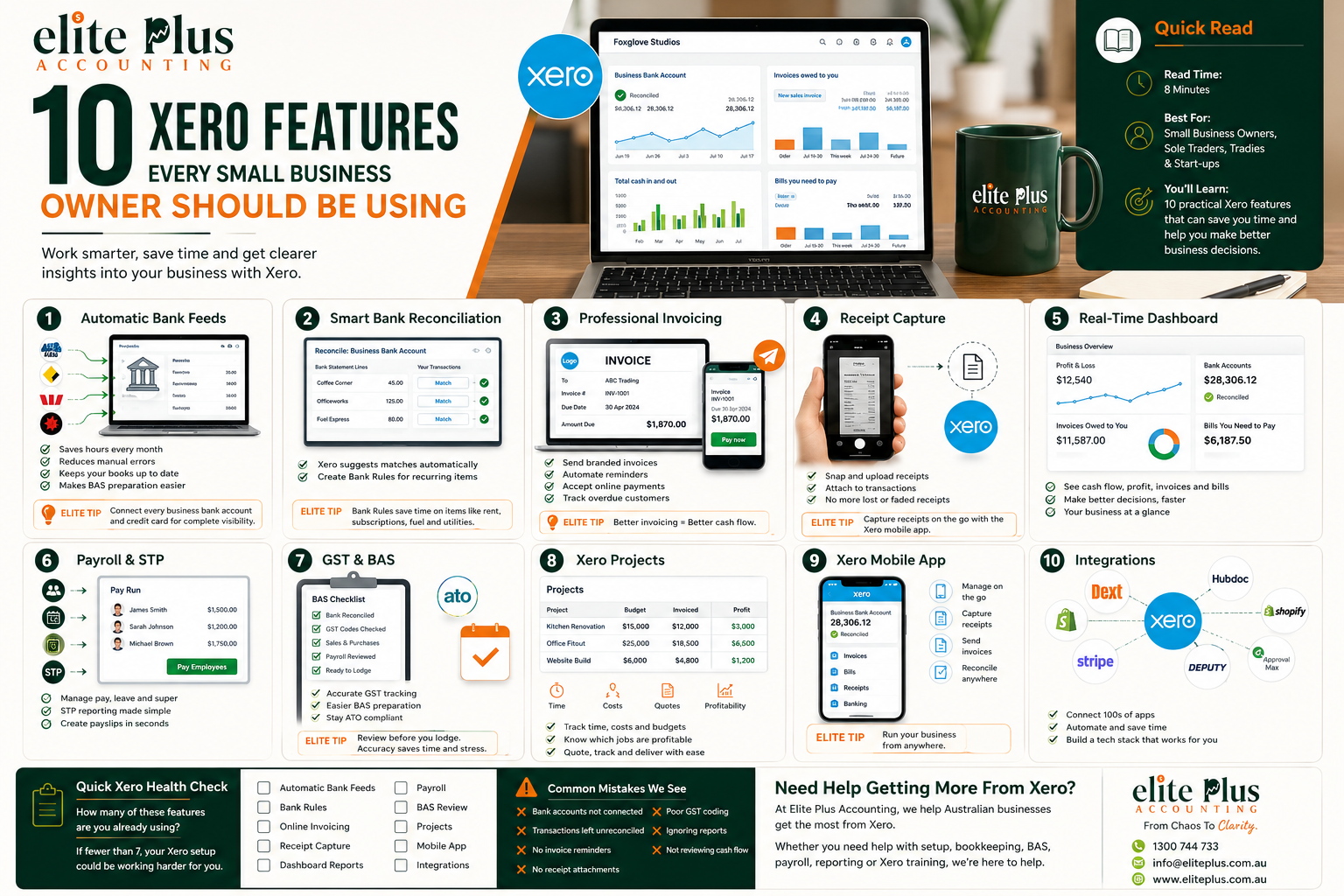
Discover 10 essential Xero features that help small business owners manage finances, save time, track expenses, improve accuracy, and make smarter business decisions with ease.
Read More