
Running a business takes up most of your time and energy. Tax is usually something you deal with when you have to, not something you think about every week. But if the ATO decides to look into your records, it can take up a lot of time and create a fair bit of stress, even if you have not done anything wrong.
Most small business audits in Australia do not happen randomly. There are specific things the ATO looks for, and when your numbers match certain patterns, a review can follow. Knowing what those patterns are means you can sort things out before they become a problem. This blog covers what you need to know, in plain language.
What an ATO Audit Actually Involves
An ATO audit means the tax office wants to check that what you reported lines up with what actually happened in your business. They look at your income, your expenses, and whether the deductions you claimed were legitimate. It does not always mean they think something is wrong. Sometimes it starts with a question about one specific claim. Other times it is a full review covering a few years of records.
A review might just be a letter asking you to explain or confirm something. A full audit usually means handing over documents and going back and forth with the ATO for a while. Either way, having your records in order makes it go a lot faster and usually leads to a better outcome.
What Triggers an ATO Audit for Small Businesses
The ATO does not wait for complaints. They use a data matching system that pulls information from banks, online platforms, property records, and share registries, then compares your numbers against what similar businesses in your industry report. When something looks out of place, it gets flagged.
These are the most common ATO audit triggers for small businesses in Australia:
- Income that looks low for your type of business: The ATO has industry benchmarks. If your numbers are well below the average for your sector, they want to know why.
- Deductions that are unusually high: Claiming expenses is fine if you can prove them. If your deductions are well above what is normal for your industry, expect questions.
- Late or missing BAS lodgements: A late Business Activity Statement once is not ideal. Doing it repeatedly signals that your records might not be in great shape.
- A high volume of cash transactions: Cash is harder to verify. Tradies, cafes, markets, and similar businesses get more attention from the ATO because of this.
- GST figures that do not match your income: The ATO cross-checks these regularly. A gap between the two will come up.
- Personal and business expenses mixed together: This is one of the most common problems for small business owners and one of the easier ones for the ATO to spot.
- Online income that was not declared: If you sell on eBay, Etsy, Amazon, or Facebook Marketplace, the ATO receives data from those platforms. Leaving that income off your return is a problem.
Business Tax Deductions: What You Can and Cannot Claim
A lot of small business owners overclaim or underclaim their deductions. Overclaiming can trigger an audit. Underclaiming means you are paying more tax than you should be.
The ATO’s position is straightforward. If the expense is for your business, you can claim it. If it is personal, you cannot. If it is partly both, you can only claim the business share. And for all of it, you need records to back it up. A rough memory of what you spent is not enough.
| Expense Type | Can You Claim It? | What You Need |
|---|---|---|
| Home office costs | Partly | Work out the exact business-use percentage |
| Business travel | Yes | Receipts and a travel diary for overnight trips |
| Personal holidays | No | Even if you took one work call on the trip |
| Car and vehicle use | Partly | A logbook or cents-per-kilometre calculation |
| Meals and entertainment | Limited | Only in specific work-related situations |
| Phone and internet | Partly | Business portion only, with a calculation to back it up |
| Training and courses | Yes | Must relate to your current business or role |
| ATO penalties and fines | No | Not claimable under any circumstances |
| Tools and equipment | Yes | Keep receipts and note what each item is used for |
BAS Lodgements and Why the ATO Watches Them
Your Business Activity Statement is the form you lodge with the ATO each quarter. It covers your GST, what you withheld from employee wages, and a few other things. Most small businesses in Australia lodge it every quarter.
The ATO tracks your BAS history. If your figures jump around without a clear reason, or you are consistently late, it suggests your records are not being maintained properly. Before you lodge each quarter, cross-check your numbers. Make sure your GST collected matches your actual sales, check that you are only claiming GST credits on genuine business purchases, and reconcile your bank account. It is straightforward but a lot of businesses skip it and end up with errors that build up over time.
Quick BAS Checklist Before You Lodge:
- Reconcile your bank account before anything else
- Check GST collected matches total sales for the period
- Only claim GST credits on actual business purchases
- Compare employee tax withholding to your payroll records
- Flag anything unusual and make sure it is categorised correctly
- Lodge by the due date, not after it
How the ATO Gets Your Data
The ATO’s data matching program collects information from Australian banks, the share registry, property settlement agencies, ride-share and delivery platforms, and online marketplaces like eBay. They match that against what you reported on your tax return.
If you sold something online and left it off your income, there is a good chance the ATO already has a record of that transaction. The same applies to property sales, investment income, and some government payments. The safer approach is to report everything. If you are unsure whether something counts as taxable income, talking to someone who handles business tax returns is worth doing before you lodge.
How Long to Keep Business Records in Australia
Under Australian tax law, you need to keep most business records for **five years** from the date you lodged the relevant return. This covers:
- Invoices you sent and received
- Bank statements
- Receipts for expenses you claimed
- Payroll and employee records
- Contracts and agreements
- Records of any asset purchases
Many small business owners use Xero or MYOB to store this digitally, which works fine. But the software is only as good as the information you put into it. If your records are behind, getting your bookkeeping sorted before tax time is much easier than trying to piece together two years of transactions while an audit is underway.
If the ATO Contacts You
Getting a letter or call from the ATO is not a good feeling, but it does not have to turn into a disaster. Here is what to do:
- Read the letter carefully: Find out exactly what they are asking about before doing anything else.
- Do not ignore it: The ATO sends follow-ups with higher stakes if you go quiet.
- Pull your records together: Find everything related to the period or claim they are looking at.
- Get help if you need it: Aregistered tax agent can respond to the ATO on your behalf and make sure nothing is said that makes things worse.
- Own any mistakes: The ATO deals with honest errors better than it deals with people who try to argue or hide things.
One thing worth knowing: the ATO has a voluntary disclosure process. If you made an error on a past return and report it yourself before the ATO finds it, the penalties are generally much lower. Going to them first is always the better option.
What a Tax Agent Actually Does for You
A registered tax agent does more than fill in your return. They know what the ATO benchmarks are for your industry and can look at your numbers before you lodge to spot anything that might raise a flag. That check alone is often what stops a review from happening.
A decent accountant also helps you understand which small business tax concessions you are entitled to, how to handle deductions properly, and how to stay on top of your obligations as the business changes. If you have been managing everything yourself and are not sure it has all been done correctly, getting small business accounting support sorted before something goes wrong is generally the better time to do it.
ATO Compliance Task Schedule
| Task | How Often |
|---|---|
| Reconcile your bank accounts | Monthly |
| Sort and file receipts | Weekly or monthly at minimum |
| Lodge your BAS | Quarterly for most businesses |
| Check payroll and employee tax | Every pay run |
| Back up your accounting records | Monthly |
| Review deductions with your accountant | Once a year before tax time |
| Update your vehicle logbook | Every 5 years or when use changes |
| Check your business registrations are current | Once a year |
Staying Organised Is Most of the Work
Most business owners who get audited are not doing anything deliberately wrong. They got busy, let things slide, or tried to manage everything themselves without a clear system. That happens to a lot of people running small businesses.
The ones who rarely hear from the ATO tend to do the same basic things consistently. They lodge on time, keep their receipts, only claim what they can actually prove, and have someone check the numbers before they go in. There is nothing complicated about it. The issue is usually not knowing what to do but finding the time and discipline to keep on top of it.
Where It Helps to Start
If you are not confident your records are in good shape, or you are unsure whether your past few returns were done correctly, sorting that out now is less stressful than sorting it out during a review. A tax agent can look at where things stand and help you fix anything that needs fixing before it becomes an issue.
Getting the basics right, lodging on time, keeping records, and claiming only what you can prove, is what keeps most businesses off the ATO’s list. It is not about being perfect. It is about being organised enough that when the ATO does check, there is nothing to worry about.
Book a consultation with Elite Plus Accounting today and take the stress out of your tax obligations.
Frequently Asked Questions
What things make the ATO look closer at my business?
How far back can the ATO check my records?
Am I allowed to keep digital receipts?
What should I do if I made a mistake on my tax return?
Is it a good idea to pay for a tax agent?
get in touch
Connect with Our Experts
Our dedicated team of accountants and bookkeepers is here to guide you toward the best financial solutions. Reach out today and speak with one of our experienced professionals to get started on the right path.


Recent Blogs
A common assumption among Australian business owners is: “They have an ABN and send me an invoice, so they are responsible for their own super.” Unfortunately, it is not always that simple. For super guarantee purposes, the ATO looks at the substance of the arrangement. Some independent contractors must still receive super where the contract is wholly […]
Read More
Working two jobs in Australia can affect how much tax is withheld from your pay. Learn how the $18,200 tax-free threshold works, when to claim it, and how claiming it from multiple employers could lead to an unexpected tax bill.
Read More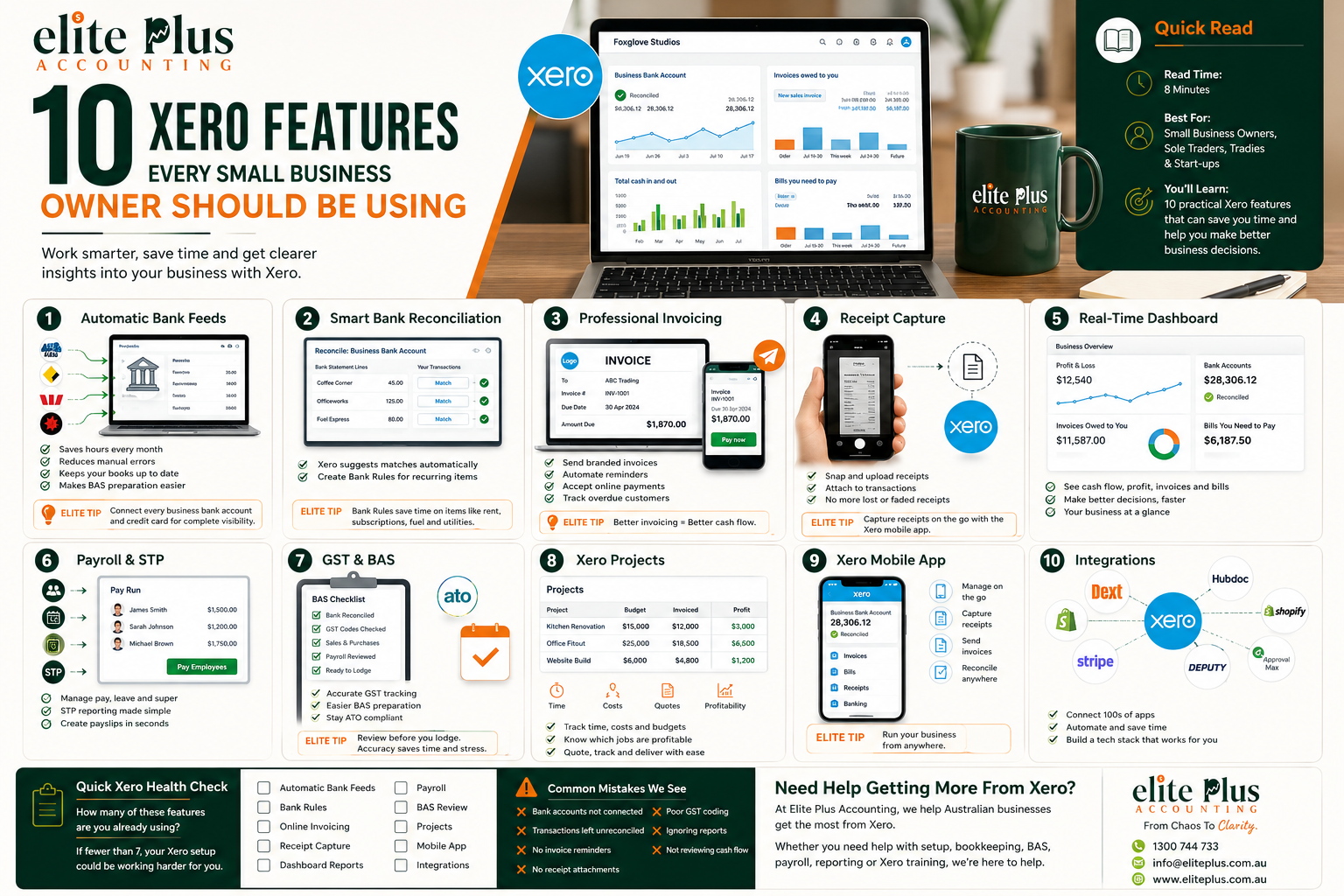
Discover 10 essential Xero features that help small business owners manage finances, save time, track expenses, improve accuracy, and make smarter business decisions with ease.
Read More