
Managing money is something most people think they can handle on their own. And for a while, maybe they can. But over time, tax obligations grow, business gets more complex, and the cost of small mistakes adds up fast. A personal accountant helps you stay on top of it all, before problems become expensive ones.
This blog covers 10 real financial challenges that a personal accountant can help you solve, especially if you are running a small business or managing your own finances in Australia.
What Does a Personal Accountant Actually Do?
A personal accountant is not just someone who files your tax return once a year. They look at the full picture of your finances. That includes income, expenses, debt, superannuation, compliance, and planning ahead. Think of them as a financial sounding board who knows the rules inside out.
For small business owners in Melbourne, working with a CPA-qualified accountant means you have someone who understands Australian tax law, ATO requirements, and what it actually takes to keep a business financially healthy.
10 Financial Challenges a Personal Accountant Can Help With
1. Getting Your Tax Return Right
Tax time trips people up more than almost anything else. Deductions get missed. Income from side work goes unreported. Depreciation is calculated wrong. These are not always deliberate mistakes but they still attract ATO attention or cost you money.
A personal accountant makes sure every deduction you are entitled to is claimed correctly. They also check that your income is reported the right way, whether that is from a salary, rental property, investments, or business. Getting your tax return right the first time saves time, stress, and sometimes a lot of money.
Common tax mistakes a personal accountant helps you avoid:
- Claiming personal expenses as business deductions
- Missing work-related deduction categories
- Forgetting to declare foreign income or investment income
- Getting depreciation schedules wrong on assets
- Filing late and copping ATO penalties
2. Understanding and Managing Cash Flow
Cash flow problems are one of the main reasons small businesses struggle, even when they are profitable on paper. Money comes in irregularly. Bills and payroll do not wait.
A personal accountant helps you track where your money is going and when. They set up reports that show your actual cash position, not just what the bank balance says. This kind of visibility lets you plan better and avoid the panic that comes with an unexpected tax bill or slow month.
| Cash Flow Problem | What It Looks Like | How an Accountant Helps |
|---|---|---|
| Late payments from clients | Constant cash shortfall | Set up accounts receivable tracking |
| Seasonal income gaps | Can't cover fixed costs in slow months | Build a cash flow forecast |
| Surprise tax bills | No funds set aside for GST or income tax | Estimate and set aside tax obligations regularly |
| Overspending on expenses | Profit disappears each month | Identify and cut non-essential spending |
3. Staying on Top of BAS and GST
If your business is registered for GST, you need to lodge a Business Activity Statement regularly. Most small businesses lodge quarterly. The numbers need to be right and lodged on time.
Errors on BAS submissions can lead to ATO audits, penalties, and repayments. A registered BAS agent knows exactly what to include, how to treat different types of income, and how to claim GST credits correctly. Having someone handle BAS lodgement for you removes a recurring headache and keeps you compliant without the guesswork.
4. Setting Up and Running Payroll Correctly
Payroll sounds simple until you are actually doing it. Award rates, superannuation contributions, Single Touch Payroll reporting, leave entitlements, and termination payments all have rules attached. Getting them wrong creates legal exposure and unhappy employees.
A personal accountant, or a firm with dedicated payroll services, makes sure your team gets paid correctly and on time. They handle super obligations and STP lodgements too, so you are not accidentally behind on compliance.
What proper payroll management covers:
- Calculating gross pay including overtime and penalties
- Applying correct superannuation rates
- Lodging STP reports with the ATO
- Managing tax file number declarations
- Processing termination pay and final entitlements
5. Sorting Out Messy or Backlogged Books
A lot of small business owners reach a point where their bookkeeping has fallen behind. Receipts are piling up, bank reconciliations have not been done in months, and there is no clear picture of what the business actually owes or owns. It happens more than people like to admit.
A personal accountant can come in, work through the backlog, and set up a clean system going forward. Accurate books are the foundation of every other financial decision you make. If the records are wrong, everything built on them is wrong too. Proper bookkeeping is not just an admin task, it is the baseline for good financial management.
6. Managing Business Debt
Debt is not always a bad thing. It funds growth, equipment, and expansion. But unmanaged debt, especially with high interest rates or poor repayment structures, drains cash flow and limits options.
A personal accountant looks at what you owe, what you are paying in interest, and whether the structure of your debt makes sense. They can help you prioritise which debts to pay down first and whether refinancing makes financial sense in your situation.
Signs your debt situation needs professional attention:
- Interest payments are a significant chunk of your monthly expenses
- You are borrowing to cover operating costs rather than growth
- You have multiple loans with different rates and no clear repayment plan
- Your credit terms with suppliers have become strained
7. Planning for Tax, Not Just Filing It
There is a big difference between lodging a tax return and actually planning your tax position. Most people only think about tax once a year, at the end. By then, the decisions that could have reduced your tax bill have already been made.
A personal accountant looks ahead. They help you time expenses, structure income, make use of superannuation contributions, and understand how decisions you make today will affect your tax next year. Tax planning is one of the highest-value things a qualified accountant does, and it is a service that pays for itself.
8. Getting Accurate Financial Reports
If you are running a business and making decisions based on gut feel rather than numbers, that is a problem. You need to know your actual profit margin, your biggest cost categories, and whether revenue is trending up or down.
Management reports turn raw financial data into something readable and useful. A personal accountant prepares these regularly so you always have a clear view of where the business stands. This matters even more when you are approaching a bank for finance or a business partner for investment.
9. Setting Up the Right Accounting Software
Choosing accounting software sounds easy. But setting it up correctly is a different story. Chart of accounts needs to match your industry. Bank feeds need to be connected. Tax codes need to be applied properly. If it is set up wrong from the start, the reports it produces will be misleading.
A qualified accountant who works with platforms like Xero, MYOB, or QuickBooks can set up your accounting software the right way and make sure it suits how your business actually operates. Some firms also offer Xero training so you or your team can manage things confidently day to day.
10. Planning for Growth Without the Financial Risk
Growth is the goal but it comes with costs. Hiring more staff, taking on bigger contracts, expanding to a second location, all of these require careful financial planning. Without it, growth can actually put a business under pressure rather than relieve it.
A personal accountant, or a firm offering virtual CFO services, helps you model out what growth will actually cost and whether the business can support it. They look at cash reserves, funding options, tax implications, and risk. That kind of strategic thinking is what separates businesses that scale sustainably from those that grow too fast and break.
Quick Reference: Challenges and Accountant Solutions
| Financial Challenge | What It Costs You Without Help | Accountant Solution |
|---|---|---|
| Incorrect tax return | Missed refunds, ATO penalties | Accurate lodgement, full deductions claimed |
| Poor cash flow visibility | Surprise shortfalls, late payments | Cash flow reports and forecasting |
| BAS errors | ATO fines, audits | Registered BAS agent handling |
| Payroll mistakes | Legal exposure, staff disputes | Compliant payroll processing and STP |
| Backlogged books | Wrong decisions based on bad data | Bookkeeping cleanup and ongoing records |
| Unmanaged debt | High interest drain, limited options | Debt review and repayment strategy |
| No tax planning | Overpaying tax year after year | Proactive tax minimisation strategies |
| No management reports | Flying blind on business performance | Regular, easy-to-read financial reports |
| Wrong software setup | Misleading data, wasted time | Proper setup and staff training |
| Unplanned growth | Cash shortfall mid-expansion | Growth modelling and CFO-level planning |
Why Getting Professional Help Earlier Matters
Most people wait until something goes wrong before they call an accountant. A missed deadline. An ATO letter. A cash crisis. By that point, fixing the problem usually costs more than preventing it would have.
Bringing in a personal accountant early means you set up the right systems, avoid the common traps, and have someone watching the numbers while you focus on running your business. The cost of professional accounting is almost always less than the cost of getting things wrong.
When Should You Hire a Personal Accountant?
There is no perfect moment, but there are clear signs it is time. If any of the following apply, it is worth having a conversation with a qualified accountant sooner rather than later.
- You are starting a new business and want to get the structure right from day one
- Your tax situation has become more complicated with investments or multiple income streams
- You are behind on BAS, payroll, or bookkeeping
- You are planning to take on staff, borrow money, or expand
- You want to understand your numbers but currently have no clear reports to look at
- You are not sure whether you are paying too much tax
Getting Your Finances in Order: Where Elite Plus Can Help
Money problems rarely fix themselves. And the longer they go unaddressed, the messier they get. Whether it is a backlogged BAS, a payroll setup that does not quite work, or a tax return that has been putting you off, there is a clear path through all of it with the right support.
Elite Plus Accounting works with small businesses across Melbourne, offering fixed-fee packages with no surprises. If you want a straightforward conversation about your financial situation, the team at Elite Plus Accounting is easy to reach and happy to take a look at what you are dealing with.
Frequently Asked Questions
What is the difference between a bookkeeper and a personal accountant?
A bookkeeper records and organises your financial transactions day to day. A personal accountant takes that data further, using it for tax planning, financial reporting, strategic advice, and compliance. Many small businesses use both, with a bookkeeper handling the ongoing work and an accountant stepping in for higher-level decisions and lodgements.
How much does a personal accountant cost in Australia?
Costs vary depending on the complexity of your situation and what services you need. Some firms charge hourly rates while others offer fixed monthly fees. For small businesses, a fixed-fee arrangement is usually easier to budget for. It is worth comparing a few options and asking what is included before committing.
Do I need a personal accountant if I already use Xero or MYOB?
Accounting software helps you record and organise your data but it does not interpret it for you. It also does not lodge BAS returns correctly by default, plan your taxes, or flag compliance issues. A personal accountant works alongside your software, not instead of it.
How often should I meet with my accountant?
At a minimum, most small business owners should connect with their accountant quarterly, around BAS time. More regular check-ins make sense if you are going through a growth phase, dealing with a tax issue, or making significant financial decisions. Good accountants tend to be proactive about flagging when you should talk.
Can an accountant help me if my books are already a mess?
Yes. Getting behind on bookkeeping or having disorganised records is more common than most people admit. A good accounting firm can work through the backlog, reconcile what needs reconciling, and set up a system that keeps things clean going forward. Starting from a messy base is not a barrier to getting help, it is usually the reason people reach out in the first place.
get in touch
Connect with Our Experts
Our dedicated team of accountants and bookkeepers is here to guide you toward the best financial solutions. Reach out today and speak with one of our experienced professionals to get started on the right path.


Recent Blogs
A common assumption among Australian business owners is: “They have an ABN and send me an invoice, so they are responsible for their own super.” Unfortunately, it is not always that simple. For super guarantee purposes, the ATO looks at the substance of the arrangement. Some independent contractors must still receive super where the contract is wholly […]
Read More
Working two jobs in Australia can affect how much tax is withheld from your pay. Learn how the $18,200 tax-free threshold works, when to claim it, and how claiming it from multiple employers could lead to an unexpected tax bill.
Read More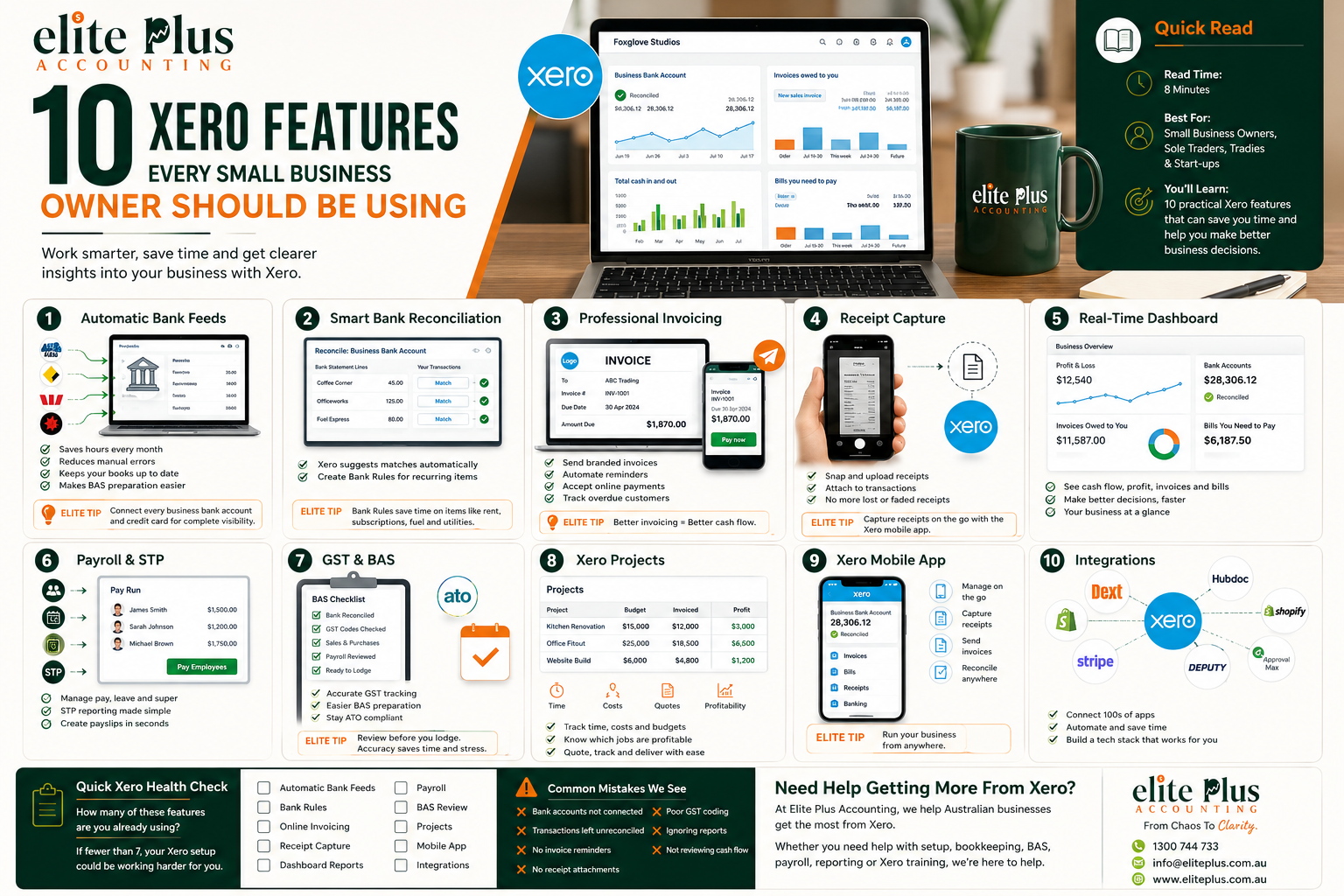
Discover 10 essential Xero features that help small business owners manage finances, save time, track expenses, improve accuracy, and make smarter business decisions with ease.
Read More