
From 1 July 2026, every business in Australia must pay superannuation on each payday. This replaces the current system where employers pay super once every three months. The change affects how payroll is processed, how cash flow is managed, and what records need to be kept. Employers who understand the new requirements and prepare their systems in advance will be in a better position to meet their obligations from day one.
This guide explains what needs to be set up before 1 July 2026 and includes a compliance checklist that Melbourne employers can use to confirm they are ready.
What Payday Super Requires Your Payroll System to Do
Before working through the setup steps, it is useful to understand what the new rules actually require.
Under Payday Super, your payroll system needs to complete three tasks on every pay run:
- Calculate the correct super amount for each employee
- Send that super to the right fund on time
- Keep a record of every payment for ATO reporting
Right now, most Melbourne businesses do this four times a year. From 1 July 2026, it happens every week, fortnight, or month, depending on your pay cycle. That means your systems need to handle a much higher volume of super transactions. Reviewing and updating your payroll setup before the deadline gives you time to identify and resolve any issues.
Step 1: Audit Your Current Payroll System
Start by looking at what you already have.
Ask yourself these questions:
- What payroll software do you use?
- Does it connect to SuperStream or a super clearing house?
- Is it cloud-based or desktop?
- How often is it updated?
Why this matters: Older or manual payroll setups will not cope with Payday Super. If your current system cannot automate super payments, you will need to upgrade before 1 July 2026.
What to do: Contact your payroll provider. Ask them directly: “Will you be ready for Payday Super from 1 July 2026?” Get the answer in writing if you can.
Most major platforms like Xero, MYOB, and QuickBooks Online are actively preparing updates. But you still need to confirm your specific version is covered.
Step 2: Enable SuperStream or Set Up a Clearing House
SuperStream is the system employers use to send super contributions to funds electronically. It is already the standard method in Australia. But you need to make sure it is correctly set up for more frequent payments.
- If you already use SuperStream: Check that your clearing house can handle weekly or fortnightly transactions. Some older clearing house setups were built around quarterly batches. You may need to adjust processing settings.
- If you use the ATO Small Business Clearing House (SBSCH): Log into the Business Portal and check your account settings. The ATO is updating the SBSCH for Payday Super. Make sure your contact details and bank account are current.
- If you do not use SuperStream yet: Set it up now. It is free through the ATO for businesses with 19 or fewer employees. Larger businesses will need a commercial clearing house. Your payroll software provider can guide you through this.
Step 3: Collect and Verify All Employee Super Fund Details
Accurate super fund details are required for every employee before Payday Super payments can be processed correctly.
For every employee, you need four pieces of information:
- The name of their super fund
- The fund’s Unique Superannuation Identifier (USI)
- The employee’s member number
- The fund’s bank account details (for SuperStream payments)
How to collect this information:
Ask employees to complete a Superannuation Standard Choice Form. This is the official ATO form employees use to nominate their fund. If an employee does not choose a fund, you must check their stapled fund through the ATO. A stapled fund is an existing fund already linked to that employee from a previous job.
How to verify the details are correct:
Cross-check each USI against the Australian Taxation Office’s Super Fund Lookup tool. This is a free online tool at superfundlookup.gov.au. It confirms whether a fund is active and registered. Incorrect fund details will result in rejected payments. Rejected payments can result in non-compliance with the new rules.
Step 4: Update Your Payroll Software Settings
Once your fund details are verified, enter them into your payroll software. Here is how to approach this step:
- Go to each employee profile in your payroll system
- Update the super fund name, USI, and member number
- Check that the contribution rate is set correctly (11.5% for 2025-26, rising to 12% from 1 July 2026)
- Set the payment frequency to match your pay cycle
Test the data before it goes live. Run a dummy pay cycle in your software if your system allows it. Check that super calculations are correct for a range of employees. Identifying errors before the go-live date is easier than correcting them after.
Step 5: Adjust Your Cash Flow Plan
Payday Super changes how much cash you need available every pay run. Before, you held that money in your business account for up to three months before sending it out. From July 2026, it needs to go out much sooner.
Here is a simple way to plan for this:
- Look at your total quarterly super bill from last year
- Divide it by the number of pay runs you had in that quarter
- That figure is roughly how much extra cash you need on each payday
For example, if you paid $18,000 in super over a quarter with 6 fortnightly pay runs, that is about $3,000 per pay run. Make sure your business bank account holds that amount before each payroll date. If managing cash flow is a challenge, an accountant or bookkeeper can help you model what the per-pay-run super liability looks like across the financial year.
Step 6: Train Your Payroll Team
If someone else runs payroll in your business, they need to know what is changing.
Train them on the following:
- The new payment timing rules
- How to process super through your updated system
- What to do if a payment is rejected by a super fund
- How to keep payment records for ATO reporting
If you use an external bookkeeper or payroll service, confirm they are already prepared for Payday Super. Ask what changes they are making to their own processes.
Step 7: Run a Test Pay Cycle Before 1 July 2026
Do a full dry run before the new rules kick in. Process a pay cycle in your updated system exactly as you will from July 2026 onward.
Check the following:
- Are super amounts calculated correctly?
- Does the payment go through SuperStream without errors?
- Is the timing right (super sent on the same day as wages)?
- Are records created automatically for ATO reporting?
Completing a test run in May or June 2026 allows enough time to identify and resolve any issues before the new rules take effect.
Payday Super Compliance Checklist for Melbourne Employers
Use this checklist to confirm you are ready before 1 July 2026.
Payroll System
- Confirmed payroll software will be updated for Payday Super
- Software is cloud-based or on the latest version
- Auto super calculation is turned on
- Payment frequency matches your pay cycle
SuperStream and Clearing House
- SuperStream is active and connected to your payroll software
- Clearing house can process weekly or fortnightly transactions
- Bank account linked to clearing house is correct and current
- ATO Business Portal access is confirmed (for SBSCH users)
Employee Super Fund Details
- All employees have submitted a Superannuation Standard Choice Form
- Stapled fund checked for any employee who did not nominate a fund
- All fund names, USIs, and member numbers entered into payroll system
- All fund details verified through Super Fund Lookup (superfundlookup.gov.au)
Contribution Rate
- Super rate updated to 12% from 1 July 2026
- Ordinary Time Earnings calculated correctly per employee
Cash Flow
- Per-pay-run super liability calculated
- Business account has sufficient funds on each payroll date
- Cash flow plan reviewed with accountant or bookkeeper
Record Keeping
- System creates automatic payment records for each super transaction
- Records include employee name, fund, amount, and payment date
- Records are stored in a secure, accessible location
Testing
- Test pay cycle completed in updated system
- No errors in super calculation or payment processing
- Payroll team trained on new process
Professional Support
- Accountant or payroll advisor has reviewed your setup
- Contact details for your super clearing house are saved
- ATO contact details on hand in case of disputes
What Happens on Your First Payday After 1 July 2026?
On your first payday under the new rules, run payroll as normal. But now, the super payment should go out at the same time as wages. Your updated payroll software should trigger this automatically if set up correctly.
After the pay run, check that the super payment has been sent. Log into your clearing house account and confirm the transaction is processing. Keep a copy of the confirmation for your records. If a payment is rejected (due to wrong fund details, for example), fix it immediately. The ATO expects timely payments. Delays, even short ones, can attract penalties under the new rules.
When Professional Support May Be Useful
Some payroll situations are more straightforward to prepare than others. In cases where the setup is more complex, working with a payroll professional or accountant can help ensure the transition is handled correctly.
Situations where professional guidance is commonly needed include:
- Payroll software that is outdated or not connected to SuperStream
- Employees with incomplete or unverified super fund details
- Businesses with multiple pay cycles or varied employment arrangements
- Cash flow structures that need adjusting to accommodate more frequent super payments
An accountant or registered bookkeeper can review your current payroll setup, help update employee fund details, and confirm that your system meets the ATO’s requirements before 1 July 2026.
Frequently Asked Questions
Do I need new payroll software for Payday Super?
My business pays wages fortnightly. Will I pay super fortnightly too?
Can I still use the ATO Small Business Clearing House?
What is the super contribution rate from 1 July 2026?
How do I find out if a super fund is active and legitimate?
get in touch
Connect with Our Experts
Our dedicated team of accountants and bookkeepers is here to guide you toward the best financial solutions. Reach out today and speak with one of our experienced professionals to get started on the right path.


Recent Blogs
A common assumption among Australian business owners is: “They have an ABN and send me an invoice, so they are responsible for their own super.” Unfortunately, it is not always that simple. For super guarantee purposes, the ATO looks at the substance of the arrangement. Some independent contractors must still receive super where the contract is wholly […]
Read More
Working two jobs in Australia can affect how much tax is withheld from your pay. Learn how the $18,200 tax-free threshold works, when to claim it, and how claiming it from multiple employers could lead to an unexpected tax bill.
Read More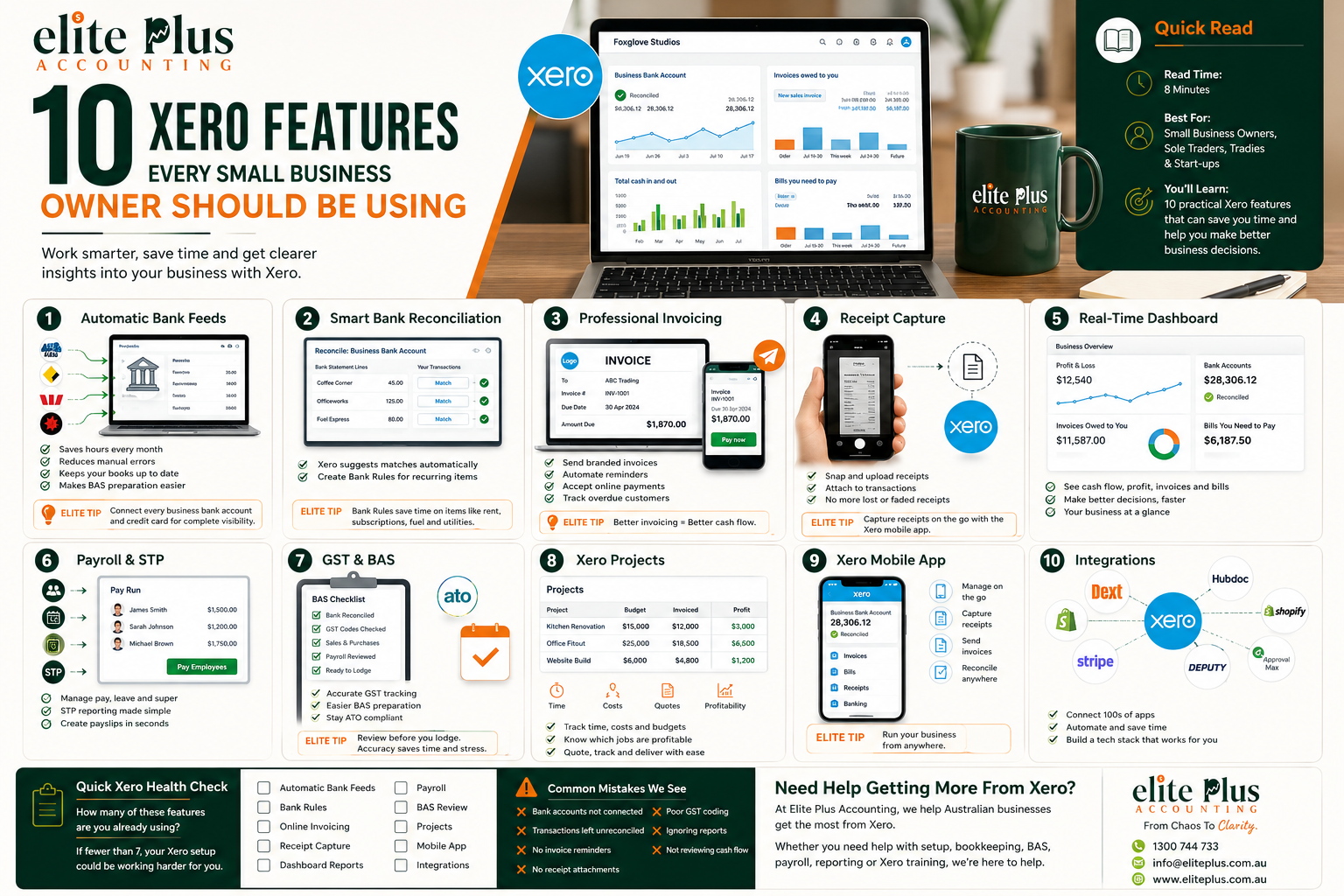
Discover 10 essential Xero features that help small business owners manage finances, save time, track expenses, improve accuracy, and make smarter business decisions with ease.
Read More