
Operating an online shop is thrilling, yet expansion brings obligations particularly regarding financial management. E-commerce accounting goes beyond simply monitoring sales and expenses; it involves grasping your financial data, enhancing profitability, and ensuring legal compliance. Selling on platforms like Shopify, WooCommerce, Amazon, Etsy, eBay, or various marketplaces requires an effective accounting system for lasting success.
This comprehensive guide details what e-commerce accounting entails, its significance, and how online entrepreneurs can optimize financial management through tools, strategies, and best practices.
What Is E-Commerce Accounting?
E-commerce accounting refers to the process of recording, organising, and analysing all financial data related to an online business. It involves tracking sales, expenses, inventory, payment processing fees, shipping costs, taxes, refunds, and other transactions that occur across digital platforms.
Unlike traditional accounting, e-commerce accounting must handle high transaction volumes, multiple sales channels, various payment gateways, and real-time financial reporting. Its purpose is to give online store owners accurate insights into their profitability, cash flow, and overall financial health so they can make informed decisions and ensure long-term business growth.It includes:
- Tracking sales and revenue
- Managing invoices and payments
- Recording fees and returns
- Monitoring inventory costs
- Preparing financial statements
- Managing taxes (GST, VAT, sales tax)
- Forecasting cash flow and profitability
Because e-commerce involves higher transaction volumes, multiple payment platforms, and complex fulfillment workflows, the accounting process is often more detailed than for traditional retail stores.
Why E-commerce Accounting Is Important
Many online retailers focus heavily on marketing and sales—but without understanding their numbers, they risk cash flow problems or compliance issues. Proper e-commerce accounting helps you:
1. Understand True Profitability
Marketplace fees, payment gateway charges, shipping costs, and returns can quickly eat into profits. Good accounting helps you identify your real margins.
2. Make Data-Driven Business Decisions
Financial reports show which products generate the most revenue, what expenses can be reduced, and how your inventory is performing.
3. Maintain Cash Flow Stability
Many businesses fail because of poor cash flow, not poor sales. E-commerce accounting helps predict when money will enter and leave the business.
4. Stay Compliant With Tax Laws
Sales tax, GST, VAT, and cross-border transactions are complicated. Accurate accounting reduces mistakes and avoids penalties.
5. Scale Your Online Store Efficiently
With clean, organised financial records, you can make strategic decisions around hiring, inventory investment, marketing budgets, and expansion into new markets.
Key Components of E-commerce Accounting
To manage finances efficiently, every online store owner must understand the core elements of e-commerce accounting.
1. Bookkeeping
Bookkeeping is the daily process of recording transactions such as:
- Sales
- Purchases
- Refunds
- Shipping charges
- Subscription fees
- Inventory adjustments
Using cloud-based accounting software—like Xero, QuickBooks Online, or Zoho Books—makes bookkeeping easier, especially when integrated with ecommerce platforms.
2. Cost of Goods Sold (COGS)
COGS includes all expenses required to produce or purchase the items you sell. It typically includes:
- Product cost
- Shipping from supplier
- Packaging
- Warehouse and fulfilment costs
Calculating COGS correctly is essential for determining product profitability.
3. Inventory Accounting
Inventory changes constantly in ecommerce. You must track:
- Inventory purchases
- Stock movement
- Warehouse transfers
- Returns and damaged goods
Accurate inventory accounting prevents overselling and helps maintain healthy cash flow.
4. Sales Tracking Across Multiple Channels
Many online stores sell on multiple platforms, each with its own fee structure:
- Shopify
- Amazon
- Etsy
- eBay
- WooCommerce
- Walmart Marketplace
Ecommerce accounting consolidates these sales channels so you have one source of truth for your revenue.
5. Managing Fees and Deductions
Payment gateways and marketplaces charge various fees including:
- Transaction fees
- Listing fees
- Referral fees
- Subscription charges
- Currency conversion fees
Tracking these fees accurately helps maintain clean financial records and identify hidden costs.
6. Taxes for Ecommerce Businesses
Tax obligations vary depending on your country, state, and the marketplaces you use. Key tax areas include:
- GST/VAT/Sales Tax collection
- Income tax reporting
- International tax compliance
- Marketplace facilitator laws
Using automated tax tools can significantly reduce errors and improve compliance.
The Role of an Accountant for E-commerce Business
An accountant plays a crucial role in helping e-commerce businesses navigate the financial complexities that come with online selling. Unlike traditional retail, e-commerce involves multiple platforms, high transaction volume, cross-border sales, automated payment systems, and complex fee structures. An accountant ensures everything is accurately managed, streamlined, and fully compliant.
Key responsibilities of an e-commerce accountant include:
1. Managing Multi-Channel Financial Data
E-commerce accountants consolidate financial data from platforms like Shopify, Amazon, Etsy, WooCommerce, eBay, and other marketplaces into a unified accounting system. This helps business owners maintain clean and reliable books.
2. Tracking Fees, Commissions & Adjustments
Payment gateways and marketplaces charge various fees—transaction fees, referral fees, subscription charges, chargeback fees, and more. Accountants accurately record and categorize these deductions to prevent hidden cost leaks.
3. Ensuring Accurate Inventory Accounting
Accountants track inventory purchases, COGS, stock adjustments, wastage, transfers, and returns. This prevents discrepancies and ensures healthy cash flow.
4. Handling Tax Compliance
E-commerce involves multiple tax obligations including GST, VAT, sales tax nexus rules, and international tax requirements. Accountants ensure the correct taxes are collected, filed, and reported.
5. Providing Financial Insights for Growth
With clear financial reports, accountants help identify profitable products, optimize spending, forecast cash flow, and support decision-making. Their strategic guidance becomes essential as a business scales.
What Methods of Accounting Are Used for E-commerce Businesses?
E-commerce businesses typically choose between two primary accounting methods depending on their size, transaction volume, and reporting needs:
Cash Basis Accounting
Cash basis accounting is the simplest and most straightforward method used by small and growing e-commerce businesses. Under this method, income and expenses are recorded only when money actually enters or leaves your bank account. Nothing is recorded until cash is received from a customer or paid to a supplier.
How Cash Basis Accounting Works for E-commerce Businesses
- You record a sale when the payout arrives from Shopify, Amazon, Etsy, or your payment gateway.
- Expenses such as software subscriptions, shipping labels, or supplier invoices are counted only when paid.
- There is no tracking of accounts receivable or accounts payable, making this method extremely simple for beginners.
Accrual Basis Accounting
Accrual basis accounting is considered the gold standard for e-commerce and is used by most established stores. Under this method, revenue and expenses are recorded when they are earned or incurred, not when money moves.
How Accrual Accounting Works for E-commerce Businesses
- Sales are recorded as soon as an order is created on Shopify, Amazon, Etsy, etc.
- Inventory is adjusted when items are purchased or sold.
- Supplier invoices are recorded as expenses even if payment is pending.
- Fees such as marketplace commissions are recorded at the time of sale, not payout.
- Returns, refunds, and chargebacks are tracked accurately when they occur, not when cash is processed.
What Is the Difference Between Traditional Accounting and e-commerce accounting?
| Aspect | Traditional Accounting | E-commerce Accounting |
|---|---|---|
| Sales Channels | Single-store or limited sales points | Multiple online platforms (Shopify, Amazon, Etsy, etc.) |
| Transaction Volume | Moderate, predictable | High volume with micro-transactions |
| Payment Methods | Mostly cash & card payments | Payment gateways (PayPal, Stripe), marketplace payouts |
| Revenue Components | Direct product sales | Discounts, taxes, shipping, gift cards, platform fees |
| Fee Structure | Limited fees | Transaction fees, referral fees, currency conversion fees, chargebacks |
| Inventory Management | Manual or periodic | Real-time, multi-location, automated systems |
| Returns & Refunds | Lower return rates | High return/refund requests with multiple adjustments |
| Tax Compliance | Local or regional taxes | Multi-state, GST/VAT, international tax rules |
| Reconciliation | Bank-based reconciliation | Multi-channel reconciliation + payment gateway settlement |
| Reporting | Basic financial statements | SKU-level profitability, marketplace reports, automation dashboards |
| Automation Level | Moderate | High reliance on accounting apps & integrations |
Common Ecommerce Accounting Challenges
Online store owners often face challenges that don’t exist in traditional retail businesses:
1. High Transaction Volume
Ecommerce businesses typically handle hundreds—or even thousands—of small transactions every month. Each sale may include multiple components like product price, discounts, taxes, shipping fees, and payment processing charges.
Manually recording all of these quickly becomes overwhelming and increases the risk of errors. High transaction volume also makes it harder to track real-time cash flow, reconcile accounts, and maintain accurate financial records. Without proper tools or automated accounting systems, this workload can take valuable time away from core business activities.
2. Multi-Channel Reconciliation
Most online stores sell across several platforms such as Shopify, Amazon, Etsy, eBay, and social commerce channels. Each platform records sales differently and uses its own fee structure, payout schedule, and reporting format.
Reconciling all these numbers to ensure the accounting records match actual bank deposits becomes a complex, time-consuming task. Missing data, inconsistent formats, and platform-specific adjustments often cause errors. Without automation or professional accounting support, keeping multi-channel records accurate can be incredibly difficult.
3. Managing Returns
Ecommerce returns are significantly higher than traditional retail due to size issues, customer expectations, product dissatisfaction, and the convenience of online refund policies.
4. Foreign Currency Payments
Online stores that sell internationally deal with multiple currencies. This introduces challenges like fluctuating exchange rates, conversion fees, and international payment gateway charges.
Every foreign transaction may result in:
Gains or losses due to currency movement
Variation between sale value and actual payout
Additional bank or merchant fees
Accounting for these variations is essential for maintaining accurate profit margins. Without proper tracking, businesses may unknowingly underprice products, lose money on international sales, or misreport revenue.
5. Handling Subscription Models
Subscription-based ecommerce (like monthly boxes, software services, or auto-renewal products) adds another layer of complexity. Businesses must track:
Recurring billing cycles
Automatic renewals
Failed payments
Proration adjustments
Cancellations and refunds
Subscription revenue must also be recognised correctly under accounting rules, which can be challenging without the right systems. Inaccurate subscription accounting can lead to misstated revenue and confusion about monthly cash flow.
Best Tools for Ecommerce Accounting
To simplify accounting tasks, you should integrate your online store with the right tools.
1. Accounting Software
- Xero – Popular for ecommerce automation
- QuickBooks Online – Great for small businesses
- Zoho Books – Affordable and efficient
2. Inventory Management Tools
- Cin7
- DEAR Systems
- Unleashed
- TradeGecko
These tools sync inventory across marketplaces in real time.
3. Ecommerce Automation Tools
- A2X Accounting
- LinkMyBooks
- Webgility
These apps automate sales reconciliation and fee tracking from Shopify, Amazon, Etsy, and others.
4. Payment Processors
- Stripe
- PayPal
- Square
Using integrated payment gateways ensures clean financial data flow.
How to Set Up a Proper Ecommerce Accounting System
Here’s a step-by-step process to create a strong accounting foundation for your online store:
Step 1: Separate Your Business and Personal Finances
Open a business bank account and payment gateway accounts to avoid mixing personal expenses with business operations.
Step 2: Choose Accounting Software
Select cloud-based accounting software that integrates with your ecommerce platforms. Automation reduces errors and saves hours of manual work.
Step 3: Integrate Your Store
Connect Shopify, Amazon, WooCommerce, etc., with tools like A2X or LinkMyBooks for automated transaction syncing.
Step 4: Set Up Your Chart of Accounts
Organise the categories for income, expenses, assets, liabilities, and equity. A well-structured chart of accounts leads to cleaner reporting.
Step 5: Track COGS Correctly
Record inventory purchases, supplier invoices, shipping fees, and packaging costs accurately.
Step 6: Reconcile Accounts Monthly
Ensure your bank statements, payment gateways, and marketplace reports match your accounting software.
Step 7: Manage Inventory Regularly
Perform stock counts, update inventory levels, and track returns.
Step 8: Stay on Top of Taxes
Use automated tax tools, submit filings on time, and keep proper documentation.
Step 9: Generate Monthly Financial Reports
Key ecommerce reports include:
- Profit and Loss Statement
- Balance Sheet
- Cash Flow Statement
- Inventory Valuation Report
- Sales by Product Report
Regular reporting keeps your business on the right track.
Step 10: Work With an Ecommerce Accountant (Optional but Recommended)
As your business grows, professional help can save time, ensure compliance, and provide strategic financial insights.
Tips to Improve Profitability With Ecommerce Accounting
Accounting is more than record-keeping—it’s a tool to grow your online store.
1. Analyse Product-Level Profitability
Identify products with low margins and adjust pricing or discontinue them.
2. Reduce Unnecessary Expenses
Review software subscriptions, shipping charges, and fulfillment costs regularly.
3. Forecast Cash Flow
Plan ahead for inventory purchases, tax payments, and marketing campaigns.
4. Track Customer Acquisition Costs (CAC)
Knowing how much you spend to acquire a customer helps you price more effectively.
5. Optimise Inventory Turnover
Avoid overstocking or stockouts by monitoring demand and sales history.
Ready to Take Control of Your Ecommerce Finances?
Ecommerce accounting may seem overwhelming, especially with multiple sales channels, fees, and tax rules. However, the right systems, tools, and strategies can simplify the entire process. By understanding your financial data, you can improve cash flow, increase profitability, and scale your online store with confidence.
Whether you’re just starting out or running an established ecommerce brand, proper accounting is the foundation of smarter decision-making and long-term success.
Need help managing your ecommerce accounting? Get expert support today and streamline your entire financial workflow.
Frequently Asked Questions
What is e-commerce accounting?
E-commerce accounting involves recording, organising, and analysing financial transactions for an online store, including sales, fees, taxes, inventory, and cash flow management.
Why is accounting important for online stores?
Proper accounting helps you understand true profitability, track expenses, stay tax-compliant, manage inventory, and make smart business decisions.
Which accounting software is best for e-commerce?
Popular choices include Xero, QuickBooks Online, and Zoho Books—all of which integrate smoothly with platforms like Shopify, Amazon, and WooCommerce.
How does automation help with e-commerce accounting?
Automation tools like A2X and LinkMyBooks sync sales, fees, and payouts automatically, reducing errors and saving hours of manual work.
What financial reports should an online store monitor?
Key reports include the Profit & Loss Statement, Balance Sheet, Cash Flow Statement, Inventory Valuation Report, and Sales by Product Report.
get in touch
Connect with Our Experts
Our dedicated team of accountants and bookkeepers is here to guide you toward the best financial solutions. Reach out today and speak with one of our experienced professionals to get started on the right path.


Recent Blogs
A common assumption among Australian business owners is: “They have an ABN and send me an invoice, so they are responsible for their own super.” Unfortunately, it is not always that simple. For super guarantee purposes, the ATO looks at the substance of the arrangement. Some independent contractors must still receive super where the contract is wholly […]
Read More
Working two jobs in Australia can affect how much tax is withheld from your pay. Learn how the $18,200 tax-free threshold works, when to claim it, and how claiming it from multiple employers could lead to an unexpected tax bill.
Read More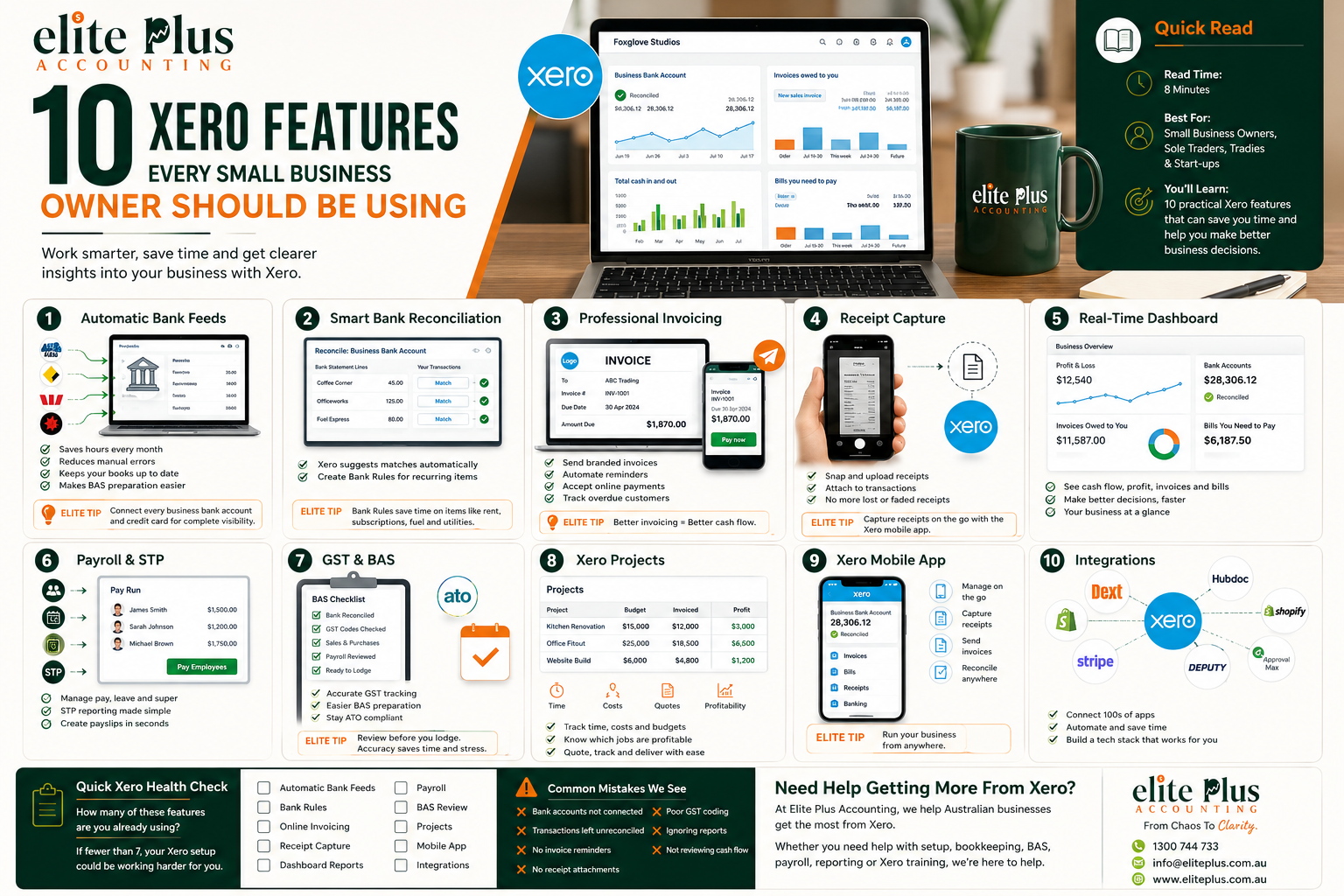
Discover 10 essential Xero features that help small business owners manage finances, save time, track expenses, improve accuracy, and make smarter business decisions with ease.
Read More