
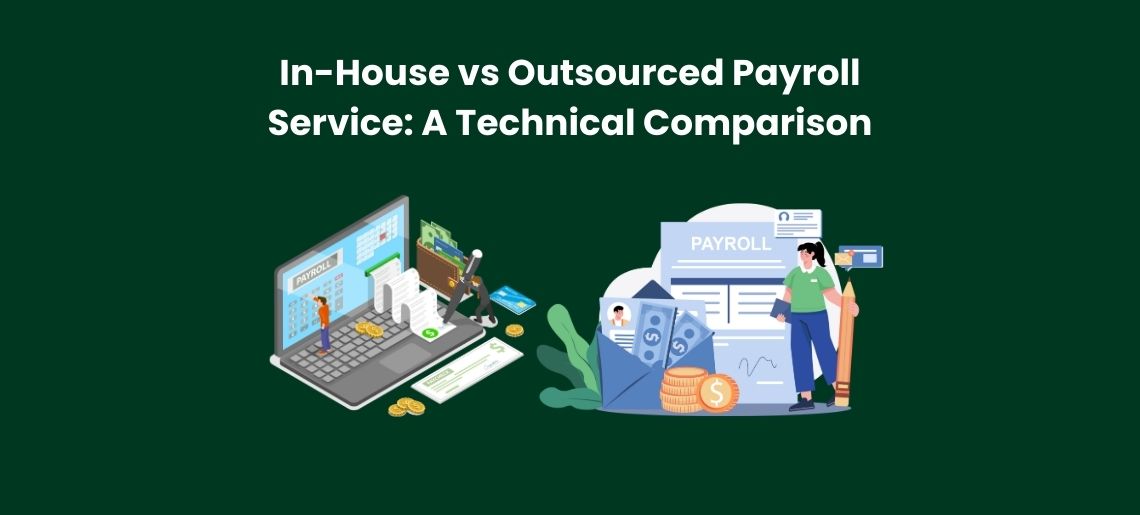
Payroll management is one the most important administrative task of business. Payroll management is not only paying people but it also includes increasing efficiency and reliability. In today’s Australian business environment, only around 43% of companies employ dedicated payroll professionals, and more than a third admit that a lack of automation contributes significantly to payroll inaccuracies.
In fact, many organisations still perform manual data entry across multiple disconnected systems, which not only consumes time but increases the risk of miscalculations, delays and employee dissatisfaction.
This article provides a technical comparison of in-house versus outsourced payroll services, focusing on systems, processes, accuracy, security, and scalability. The goal is to help businesses make an informed decision based on operational needs rather than assumptions.
Understanding Payroll: Core Functions and Technical Requirements
Payroll is much more an administrative task, it has many technical aspects to it as well, that need to be performed precisely for an efficient pay day cycle.
To run payroll effectively, businesses must maintain several critical technical foundations that support accuracy, reliability, and compliance across every pay cycle.
- Reliable payroll software and system architecture: Payroll systems must be stable, regularly updated, and capable of handling pay calculations, entitlements, and reporting without failures or performance issues that could delay employee payments.
- Integration with time and attendance or HR systems: Seamless integration ensures that hours worked, leave taken, and employee data flow accurately into payroll, reducing manual data entry and minimising the risk of discrepancies.
- Automated calculations to reduce manual errors: Automation applies predefined rules for wages, penalties, overtime, and allowances consistently, significantly lowering the likelihood of human error during repetitive payroll tasks.
- Audit trails and reporting capabilities: Detailed logs of changes, approvals, and payroll runs provide transparency, support internal reviews, and allow businesses to trace and resolve discrepancies efficiently.
- Strong data security and access controls: Payroll systems must protect sensitive employee information through role-based access, encryption, and authentication measures to prevent unauthorized access or data breaches.
- Backup and disaster recovery mechanisms: Regular backups and recovery plans ensure payroll data remains accessible and intact in the event of system failures, cyber incidents, or operational disruptions.
Whether payroll is managed internally or outsourced, these technical foundations are essential to maintaining accurate and dependable payroll operations. The key difference lies in who is responsible for implementing, maintaining, and monitoring these systems: the business itself or a specialist payroll provider.
In-House Payroll: Structure and Operations
In an in-house payroll model, all payroll responsibilities are handled internally by the business, typically through HR, finance, or administrative staff. Because payroll is managed internally, the effectiveness of this model depends heavily on staff expertise, system reliability, and the organisation’s ability to maintain consistent payroll processes across every pay cycle.
Payroll Workflow in an In-House Model
Internal payroll teams are responsible for managing the full payroll cycle, from collecting employee information through to final payment and reporting. Each stage requires careful coordination to ensure accuracy and timeliness.
- Data collection and payroll input: Payroll teams gather employee timesheets, approved leave, and any changes to personal or employment details, then enter hours worked, allowances, deductions, and adjustments into the payroll system.
- Application of awards and pay rules: Internal staff interpret and apply relevant award conditions, penalty rates, overtime rules, and entitlements within the payroll software to ensure employees are paid correctly.
- Payroll review and discrepancy management: Calculations are reviewed before processing, with any errors or inconsistencies investigated and corrected to avoid incorrect payments.
- Pay run processing and reporting: Once approved, payroll is processed according to the organisation’s pay cycle, generating payslips, payment files, and required payroll reports.
- Employee payroll support: Internal teams manage employee enquiries related to pay amounts, leave balances, deductions, and payroll adjustments.
This workflow relies heavily on internal expertise, staff availability, and consistent processes, which can make in-house payroll vulnerable to disruption during staff absences, turnover, or periods of increased workload.
Technology and Systems
Most businesses running in-house payroll rely on commercial payroll platforms such as Xero Payroll, MYOB, or KeyPay. While these systems offer robust functionality, they still require active management and oversight.
- Correct configuration: Payroll software must be accurately configured to reflect the organisation’s pay structures, awards, and entitlements.
- Ongoing updates: Systems require regular updates to accommodate changes in awards, entitlements, and reporting requirements.
- Manual checks and validations: Despite automation, internal teams must still perform manual reviews to ensure calculations and data entries are correct.
In addition, businesses must manage user access, software upgrades, data security settings, and integration with other internal systems such as HR or time-tracking tools.
Outsourced Payroll Services: How They Work
Outsourced payroll services shift the operational responsibility for payroll processing to a specialist provider, while the business retains oversight and decision-making authority. This model is designed to simplify payroll operations and reduce the administrative load on internal teams.
Rather than managing payroll execution internally, businesses rely on experienced payroll professionals to process payroll accurately and consistently.
How Outsourced Payroll Operates
In an outsourced model, payroll processes are clearly defined and managed through structured workflows.
- Payroll processing handled by an external payroll team: Specialist payroll professionals manage calculations, processing, and reporting on behalf of the business.
- Clear workflows, timelines, and responsibilities: Defined processes ensure payroll is completed consistently and within agreed timeframes.
- Payroll processed based on approved inputs: The provider processes payroll using data supplied and approved by the business.
- Reports and payslips delivered to the business and employees: Payroll outputs are shared for review, record-keeping, and employee access.
This approach allows businesses to focus on core operations while payroll specialists manage execution and accuracy.
Payroll Technology and Infrastructure
Outsourced payroll providers typically operate using enterprise-grade payroll platforms designed to handle complex payroll requirements efficiently.
- Advanced automation and validation rules: Automated calculations and system checks help reduce manual intervention and error rates.
- Secure cloud-based access: Payroll data is processed and stored in secure cloud environments with controlled access.
- Regular system updates: Platforms are continuously updated to reflect current payroll rules and reporting standards.
- Built-in compliance reporting: Reporting functions are integrated into the system to support timely and accurate submissions.
- Integration capabilities with HR and time-tracking systems: Systems are designed to connect seamlessly with existing business tools.
These platforms are maintained and monitored by dedicated payroll professionals to ensure reliability and performance.
In-House vs Outsourced Payroll: Technical Comparison
This comparison outlines how in-house and outsourced payroll models differ across key operational and technical areas, helping businesses assess which approach best aligns with their needs.
Cost Structure and Resource Allocation
- In-house payroll: Requires ongoing investment in payroll software, system upgrades, staff training, and internal processing time, with costs increasing as payroll complexity grows.
- Outsourced payroll: Operates on a predictable service-fee model, removing the need for internal infrastructure investment and reducing indirect costs associated with errors and rework.
Accuracy and Error Management
- In-house payroll: Accuracy depends on internal expertise, correct system configuration, and manual checks, making it more susceptible to errors during busy periods or staff absences.
- Outsourced payroll: Uses automated calculation rules and structured review processes designed to detect inconsistencies before payroll is finalised.
Compliance Administration
- In-house payroll: Requires continuous monitoring of award changes, entitlements, and reporting obligations, placing responsibility for compliance administration entirely on internal teams.
- Outsourced payroll: Providers manage award interpretations, rule updates, and payroll reporting, reducing the compliance workload for the business.
Security and Data Protection
- In-house payroll: Places responsibility for payroll data security, access controls, backups, and recovery processes on the organisation’s internal systems and policies.
- Outsourced payroll: Providers invest in secure, cloud-based infrastructure with encryption, restricted access, and regular backups to protect sensitive payroll data.
Scalability and Flexibility
- In-house payroll: Often requires additional staff or system upgrades as employee numbers grow or pay structures become more complex.
- Outsourced payroll: Is designed to scale efficiently, adapting to workforce growth and changing payroll requirements without disrupting operations.
Continuity and Reliability
- In-house payroll: Can be affected by staff turnover, leave, or internal system downtime, increasing the risk of payroll delays.
- Outsourced payroll: Ensures continuity through dedicated payroll teams, standardised processes, and service-level commitments that support reliable payroll delivery.
| Area | In-House Payroll | Outsourced Payroll |
|---|---|---|
| Cost & Resources | Ongoing costs for software, updates, training, and internal staff time. | Predictable service fees with no internal system or training overhead. |
| Execution & Accuracy | Managed internally alongside other duties, relying on manual checks and internal expertise. | Processed by dedicated payroll specialists using automated rules and structured reviews. |
| Compliance Administration | Internal teams monitor awards, entitlements, and reporting requirements. | Provider manages award interpretation, updates, and payroll reporting. |
| Technology & Security | Payroll software, access controls, and data security managed internally. | Enterprise-grade, cloud-based systems with encryption and regular backups. |
| Scalability & Continuity | Growth or staff absences may require added resources or system changes. | Designed to scale easily with dedicated teams and service-level commitments. |
| Oversight & Control | Full operational control with full responsibility. | Business retains approval while payroll execution is outsourced. |
How to Choose the Right Payroll Model
When deciding between in-house and outsourced payroll, consider:
- Workforce size and complexity
- Internal payroll expertise and capacity
- Risk tolerance for errors and disruptions
- Technology and integration requirements
- Future growth plans
A thorough assessment of these factors helps ensure the payroll model supports long-term business
In-House vs Outsourced Payroll: Which Is Right for Your Business?
| In-House Payroll Makes Sense When… | Outsourced Payroll Is Better When… |
|---|---|
| The business is very small with minimal payroll complexity | The business is growing or workforce needs are changing |
| Teams are stable with standard pay structures | Multiple awards or complex pay rules apply |
| Experienced payroll staff are already in place | Payroll errors or compliance concerns have occurred |
| The business is comfortable managing compliance internally | Reducing internal administrative workload is a priority |
| Payroll requirements change infrequently | Accuracy, security, and scalability are critical |
Quick decision guide:
If payroll is simple and stable, in-house may be sufficient. If payroll is growing, complex, or time-consuming, outsourcing offers consistency and peace of mind.
A Strategic Approach to Payroll Management
Choosing between in-house and outsourced payroll is not just a cost decision — it’s a decision about accuracy, reliability, and how much operational risk your business is willing to manage internally. While in-house payroll can work well for small, stable teams with simple requirements, outsourced payroll offers structured processes, specialist oversight, and scalability for businesses facing growth or complexity.
The right payroll model is the one that supports your operations today while remaining dependable as your business evolves.
Need Expert Payroll Support?
If you’re unsure whether your current payroll approach is still the right fit, Elite Plus Accounting can help you assess your needs and implement a payroll solution that delivers accuracy, continuity, and confidence.
Contact our team to discuss a payroll setup that works for your business.
Frequently Asked Questions
Can small businesses in Australia benefit from outsourcing payroll?
Yes. Outsourcing payroll allows small businesses to access structured processes and specialist support without needing internal payroll staff, helping reduce errors and administrative pressure as the business grows.
How secure is outsourced payroll data?
Professional payroll providers use secure, cloud-based systems with encryption, controlled access, and regular backups. This ensures employee payroll data is protected and managed in line with best-practice security standards.
Can small businesses afford outsourced payroll services?
In many cases, outsourcing is cost-effective. Predictable service fees often replace the combined cost of payroll software, staff training, internal processing time, and correcting payroll errors.
How do I decide whether to outsource payroll or keep it in-house?
The right choice depends on payroll complexity, internal capacity, and risk tolerance. If payroll is becoming time-consuming, error-prone, or difficult to manage internally, outsourcing can provide greater consistency and confidence.
get in touch
Connect with Our Experts
Our dedicated team of accountants and bookkeepers is here to guide you toward the best financial solutions. Reach out today and speak with one of our experienced professionals to get started on the right path.


Recent Blogs
Choosing between cash and accrual accounting is one of the most important financial decisions for a business. Understanding their benefits, limitations, and suitability for your business can make managing finances simpler and more accurate. Explore how each method works and which one aligns with your business goals.
Read More
Running a business in Australia is rewarding but stressful, especially when it comes to finances. From separating personal and business money to tracking cash flow, small consistent habits can make a big difference. Learn how to stay organised, reduce stress, and gain real peace of mind with these essential financial practices.
Read More
From 1 July 2026, Australian employers must pay superannuation on every payday instead of quarterly. This guide explains how Melbourne businesses can prepare, update payroll systems, verify employee fund details, and follow a practical compliance checklist before the new rules begin.
Read More