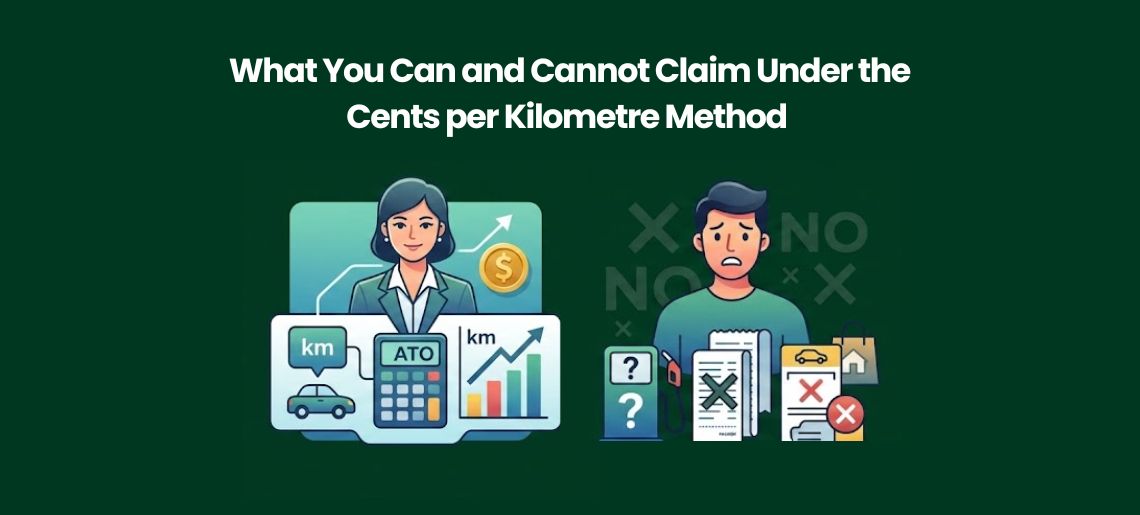

What You Can and Cannot Claim Under the Cents per Kilometre Method

Work-related car expense claims are one of the most common deductions claimed in Australian tax returns each year. However, they are also one of the areas most closely reviewed by the Australian Taxation Office (ATO). 

Many taxpayers incorrectly assume that simply using their vehicle for work means all travel is deductible. Unfortunately, this is not always the case. 

Understanding the rules around the Cents per Kilometre Method is essential to ensuring your claim is both accurate and compliant. 

At Elite Plus Accounting, we regularly assist individuals and businesses with tax returns, financial reporting, advisory services, and strategic insights to help clients maximise legitimate deductions while remaining compliant with Australian taxation laws. 

This guide explains: 

  • what the cents per kilometre method is,  
  • what travel may be claimable,  
  • what cannot generally be claimed,  
  • common mistakes taxpayers make,  
  • and the records you should keep.

What is the Cents per Kilometre Method?

The cents per kilometre method is a simplified way of claiming work-related car expenses in your Australian tax return. 

Rather than separately claiming: 

  • fuel,  
  • registration,  
  • insurance,  
  • servicing,  
  • depreciation,  
  • and repairs,  

the ATO allows eligible taxpayers to claim a fixed rate for each work-related kilometre travelled. 

Deduction=Business Kilometres×ATO Rate per km\text{Deduction} = \text{Business Kilometres} \times \text{ATO Rate per km}Deduction=Business Kilometres×ATO Rate per km 

The ATO rate is designed to cover the general running costs of operating a vehicle. 

Because these costs are already included in the rate, taxpayers generally cannot separately claim: 

  • petrol,  
  • insurance,  
  • servicing,  
  • tyres,  
  • or depreciation again under this method.

Maximum Kilometres You Can Claim

Under the cents per kilometre method: 

  • taxpayers may generally claim up to 5,000 business kilometres per vehicle, per financial year.  

Importantly, this does not mean: 

  • everyone is automatically entitled to claim 5,000 kilometres.  

Taxpayers should still be able to reasonably explain: 

  • how the kilometres were calculated,  
  • why the travel was work-related,  
  • and how the estimate was determined.  

The ATO may request supporting information if a claim is reviewed.

What You May Be Able to Claim

The deductibility of travel depends heavily on the individual circumstances of each taxpayer and the nature of the travel undertaken. 

Examples of travel that may generally qualify include: 

Travel Between Work Locations 

Travel between separate workplaces during the day may be deductible. 

Examples may include: 

  • travelling from the office to a client site,  
  • attending external meetings,  
  • travelling between multiple worksites,  
  • or visiting suppliers and customers.  

Example 

An employee travels: 

  • from their office,  
  • to a client meeting,  
  • then to another work location.  

The travel between those locations may generally qualify as deductible. 

Client Visits and Business Appointments 

Taxpayers whose work requires them to travel to clients or customers may potentially claim those kilometres. 

This commonly applies to: 

  • consultants,  
  • tradies,  
  • sales representatives,  
  • mobile service providers,  
  • real estate professionals,  
  • and accountants attending client meetings.  

Travel Between Two Separate Jobs 

Travel directly between two unrelated jobs may generally be deductible. 

Example 

A taxpayer: 

  • works at one employer during the day,  
  • then travels directly to another employer for an evening shift.  

The travel between the two workplaces may qualify. 

Carrying Bulky Equipment 

In limited situations, home-to-work travel may become deductible where: 

  • bulky tools or equipment are essential,  
  • transportation is necessary,  
  • and secure storage is unavailable at the workplace.  

This exception is interpreted narrowly and should not automatically be assumed. 

What Generally Cannot Be Claimed

Understanding what cannot be claimed is equally important. 

Normal Home to Work Travel 

Ordinary travel between home and a regular workplace is generally considered private in nature and is typically not deductible. 

This remains the case even where: 

  • the commute is long,  
  • overtime is worked,  
  • or minor work items are carried.  

Example 

Driving: 

  • from home to your regular office,  
  • then returning home,  

will generally not qualify as deductible travel. 

Personal or Domestic Travel 

Private travel is generally not deductible. 

Examples include: 

  • shopping trips,  
  • school drop-offs,  
  • holidays,  
  • personal errands,  
  • and family-related travel.  

Only genuine income-producing travel may potentially qualify. 

Reimbursed Expenses 

If an employer has already reimbursed a taxpayer for travel expenses, those same expenses generally cannot also be claimed as a tax deduction. 

Parking and Traffic Fines 

Fines and penalties are generally not deductible under Australian taxation law. 

This includes: 

  • speeding fines,  
  • parking infringements,  
  • toll penalties,  
  • and traffic-related fines.

Do You Need Receipts?

One of the advantages of the cents per kilometre method is that detailed receipts for: 

  • fuel,  
  • servicing,  
  • registration,  
  • and insurance  

are generally not required. 

However, taxpayers should still maintain records supporting: 

  • how business kilometres were calculated,  
  • the purpose of the travel,  
  • and how the estimate was determined.  

Supporting evidence may include: 

  • diaries,  
  • appointment books,  
  • calendars,  
  • spreadsheets,  
  • odometer readings,  
  • or work schedules.

Common Mistakes Taxpayers Make

The ATO regularly reviews work-related car expense claims and may closely examine claims that appear excessive or unsupported. 

Common mistakes include: 

  • claiming exactly 5,000 kilometres every year without evidence,  
  • incorrectly claiming home-to-work travel,  
  • claiming private trips as work-related,  
  • or attempting to separately claim fuel and servicing costs under this method.  

Taxpayers should ensure claims are: 

  • reasonable,  
  • properly substantiated,  
  • and consistent with their occupation and work duties.

Example Calculation

If a taxpayer travelled 2,500 genuine work-related kilometres during the financial year, the deduction may generally be calculated as follows: 

2500×ATO Rate per km2500 \times \text{ATO Rate per km}2500×ATO Rate per km 

The final deductible amount will depend on the applicable ATO rate for the relevant financial year.

Why Professional Advice Matters

Work-related vehicle deductions can become more complex where taxpayers: 

  • work from home,  
  • operate a business,  
  • receive travel allowances,  
  • use multiple vehicles,  
  • or have novated lease arrangements.  

Obtaining advice from a qualified tax professional can help ensure: 

  • deductions are correctly claimed,  
  • risks are minimised,  
  • and compliance obligations are properly managed.  

At Elite Plus Accounting, our CPA-led finance team provides tax returns, bookkeeping, financial services, virtual CFOs, financial reporting, financial planning, and CFO services tailored to businesses and individuals across Australia and New Zealand. 

From strategic insights and cash flow management to international finance and long term business growth planning, we help clients move from chaos to clarity with practical and commercially focused support.

Important Disclaimer

This article contains general information only and does not constitute taxation, financial, or legal advice. The deductibility of car expenses depends on each taxpayer’s individual circumstances, employment arrangements, and the specific nature of the travel undertaken. 

While every effort has been made to ensure the accuracy of the information provided, taxation laws and ATO interpretations may change over time and may differ based on individual circumstances. Readers should seek professional advice tailored to their specific situation before relying on or acting upon any information contained in this article. 

Elite Plus Accounting accepts no liability for any loss, damage, or decisions made as a result of reliance on this content. Taxpayers remain responsible for ensuring that all deductions claimed are accurate, properly substantiated, and compliant with Australian taxation laws and ATO requirements. 

Liability limited by a scheme approved under Professional Standards Legislation.

get in touch

Connect with Our Experts

Our dedicated team of accountants and bookkeepers is here to guide you toward the best financial solutions. Reach out today and speak with one of our experienced professionals to get started on the right path.