
In today’s competitive business landscape, small and growing businesses are constantly challenged to achieve more with limited resources. Tight budgets, small teams, and the need for accurate financial information often make day-to-day operations more complex than they should be. This is where outsourced accounting comes in.
In this blog, we’ll explore what outsourced accounting is, how it works, and why it has become a practical, win-win choice for small and growing businesses.
What Is Outsourced Accounting?
Outsourced accounting refers to the practice of hiring an external firm or professional service provider to handle some or all of a company’s accounting and financial management functions. These services can range from basic bookkeeping to advanced financial planning and analysis.
Unlike traditional in-house accounting, outsourced accounting allows businesses to access skilled professionals, advanced tools, and industry best practices without the overhead costs of maintaining a full-time internal team.
The Rise of Outsourced Accounting Services
Traditionally, outsourcing was viewed primarily as a way to reduce costs. While cost efficiency remains an important benefit, modern outsourced accounting focuses equally on value creation.
Advancements in cloud accounting software, secure data sharing, and real-time reporting have made it possible for outsourced teams to act as true extensions of internal finance departments.
Key Benefits of Outsourced Accounting
Outsourced accounting has become a strategic advantage for businesses looking to optimize operations, reduce costs, and gain access to high-level financial expertise. Below are the key benefits that make outsourced accounting an increasingly popular choice for small and growing organizations.
Cost Efficiency and Predictable Pricing
One of the most compelling advantages of outsourced accounting is its ability to significantly reduce operational costs while improving financial control. Maintaining an in-house accounting team involves expenses that go far beyond salaries, including recruitment, training, employee benefits, office infrastructure, and ongoing software investments.
By outsourcing accounting functions, businesses eliminate costs related to:
- Hiring, onboarding, and training accounting staff
- Salaries, bonuses, health benefits
- Office space, equipment, and accounting software licenses
Most outsourced accounting firms operate on fixed-fee or subscription-based pricing models. This ensures predictable monthly costs, making budgeting and financial planning easier. Businesses can choose service packages that align with their needs, avoiding the inefficiencies of paying for underutilized internal resources.
Access to Specialized Expertise
Outsourced accounting firms provide access to a broad pool of financial professionals with specialized skills and industry experience. Instead of relying on a single in-house accountant, businesses benefit from a team-based approach that includes:
- Certified public accountants
- Payroll and compliance experts
- Financial analysts and virtual CFOs
- Industry-specific accounting professionals
This depth of expertise allows businesses to address complex financial challenges, stay compliant with regulations, and receive strategic guidance that supports long-term growth. Acquiring this level of talent internally would be both expensive and difficult, particularly for small and mid-sized organizations.
Improved Accuracy and Regulatory Compliance
Accuracy and compliance are critical components of effective financial management. Outsourced accounting providers follow standardized processes, internal controls, and multi-level quality checks to ensure that financial data is accurate and reliable.
These firms stay current with evolving laws, accounting standards, and regulatory requirements, reducing the risk of errors, late filings, or penalties. Their structured approach enhances consistency in financial reporting and minimizes the likelihood of discrepancies.
This level of reliability is especially valuable during audits, filings, investor reviews, and regulatory inspections, where accurate documentation and compliance are essential.
Scalability and Operational Flexibility
As businesses grow, their accounting requirements become more complex. Outsourced accounting offers the flexibility to scale services up or down without the disruption associated with hiring, restructuring, or layoffs.
Whether a company is:
- Expanding into new markets
- Launching new products or services
- Managing seasonal or cyclical business fluctuations
- Preparing for mergers, acquisitions, or funding rounds
Outsourced accounting services can be adjusted to meet changing demands. This scalability ensures that businesses receive the right level of support at every stage of growth without incurring unnecessary fixed costs.
Focus on Core Business Activities
Accounting is a critical function, but it is not a core revenue-generating activity for most businesses. When business owners and managers spend excessive time on financial tasks, it can distract them from strategic initiatives and operational priorities.
By delegating accounting responsibilities to experienced professionals, leadership teams can focus on:
- Business development and customer relationships
- Product innovation and market expansion
- Strategic planning and performance optimization
This shift in focus often leads to increased productivity, faster decision-making, and improved overall performance. With accurate financial data and expert insights readily available, businesses are better equipped to pursue growth opportunities with confidence.
Enhanced Decision-Making Through Financial Insights
Beyond transactional accounting, outsourced providers deliver meaningful financial insights that support informed decision-making. Through timely reporting, cash flow analysis, and performance metrics, businesses gain greater visibility into their financial health.
These insights enable leaders to anticipate challenges, identify growth opportunities, and make proactive decisions rather than reacting to financial issues after they arise.
| Area of Impact | How Outsourced Accounting Helps | Time & Cost Benefit |
|---|---|---|
| Labor Costs | Eliminates the need for hiring, training, salaries, and employee benefits | Reduces fixed overhead and long-term staffing expenses |
| Management Time | Handles routine tasks such as bookkeeping, payroll, and reconciliations | Frees leadership time for strategic decision-making |
| Technology Investment | Provides access to advanced accounting software and tools | Avoids upfront and ongoing software and infrastructure costs |
| Accuracy & Compliance | Uses standardized processes and compliance expertise | Minimizes costly errors, penalties, and rework |
| Financial Insights | Delivers timely reports and real-time financial visibility | Enables faster, better-informed business decisions |
| Scalability | Adjusts services based on business needs without staffing changes | Prevents disruption and controls costs during growth or fluctuations |
Outsourced Accounting vs. In-House Accounting: Comparison Table
| Criteria | Outsourced Accounting | In-House Accounting |
|---|---|---|
| Cost Structure | Fixed or subscription-based pricing with predictable monthly costs | High fixed costs including salaries, benefits, and bonuses |
| Hiring & Training | No recruitment, onboarding, or training required | Time-consuming and expensive hiring and ongoing training |
| Access to Expertise | Team of specialists including accountants, payroll professionals, and virtual CFOs | Limited to the skills and experience of one or two employees |
| Scalability | Easily scalable up or down based on business needs | Scaling requires hiring or downsizing, which is costly and disruptive |
| Technology & Tools | Access to modern accounting software and automation tools | Business must purchase, maintain, and upgrade accounting software |
| Compliance & Regulations | Providers stay updated on laws and regulatory changes | Requires continuous internal effort to track changing regulations |
| Accuracy & Quality Control | Standardized processes with multiple review layers | Depends heavily on individual employee performance |
| Business Continuity | Uninterrupted service despite vacations, resignations, or absences | Risk of disruption due to employee turnover or leave |
| Time to Implement | Quick onboarding and immediate operational support | Long setup time due to hiring and system implementation |
| Management Oversight | Reduced management effort and supervision | Requires direct oversight and performance management |
| Strategic Insights | Access to financial analysis, reporting, and advisory services | Strategic insight depends on employee seniority and experience |
| Data Security | Robust security protocols and controlled access systems | Security depends on internal policies and infrastructure |
| Focus on Core Business | Frees leadership to focus on growth and strategy | Management time often spent on accounting supervision |
| Best Suited For | Small to growing businesses seeking flexibility and expertise | Large organizations with complex internal finance structures |
How to Choose a Firm for Outsourcing Accounting Services
Choosing the right accounting firm is essential for a successful outsourcing partnership. The ideal provider should manage your financial operations efficiently while supporting long-term business growth.
Define Your Business Needs
Start by identifying your accounting requirements—such as bookkeeping, payroll, financial reporting, or advisory services. Clear goals help ensure alignment with the right service provider.
Check Industry Experience
Select a firm with experience in your industry and with businesses of similar size. Industry knowledge ensures familiarity with regulations, reporting standards, and common financial challenges.
Ensure Scalability and Service Coverage
Look for a provider that offers flexible, scalable services. A firm with end-to-end accounting capabilities can support your business as it grows.
Review Technology and Data Security
Choose a firm that uses modern cloud-based accounting tools and follows strict data security protocols to protect sensitive financial information.
Evaluate Communication and Pricing
Effective communication, transparent reporting, and clear pricing models are critical. Focus on overall value, not just cost, when comparing providers.
A Smarter Approach to Financial Management
Outsourced accounting has become a strategic solution for small and growing businesses seeking efficiency, accuracy, and cost control. By outsourcing accounting functions, businesses gain access to expert talent, scalable support, and reliable financial insights—without the burden of maintaining an in-house team.
More than a cost-saving measure, outsourced accounting enables better decision-making and allows business leaders to focus on growth-driven priorities. With the right partner, outsourcing transforms accounting into a value-added function that supports long-term success.
If you’re looking to streamline your financial operations and gain expert support without increasing overheads, consider partnering with a trusted outsourced accounting provider. Take the next step today to simplify your accounting and focus on growing your business with confidence.
Frequently Asked Questions
How does outsource accounting help small businesses ?
Outsourced accounting helps small businesses reduce costs, improve financial accuracy, and gain access to expert accounting support without hiring a full-time team. It also saves time by handling routine financial tasks, allowing business owners to focus on growth, customers, and strategic decision-making.
Is it cheaper to outsource accounting?
Yes, outsourcing accounting is usually cheaper because it removes costs for salaries, benefits, training, and software while providing expert support at a predictable price.
What are the common outsourcing mistakes?
Common outsourcing mistakes include choosing a provider based solely on low cost, which can compromise quality, and failing to clearly define expectations, roles, and deliverables. Other frequent mistakes are poor communication, overlooking data security measures, and not selecting a partner with relevant industry experience.
Why should small businesses prefer outsource accounting over in house?
Small businesses should prefer outsourced accounting over in-house accounting because it is more cost-effective, provides access to experienced professionals, and offers scalable support as the business grows. It also reduces compliance risks and frees up time for business owners to focus on core operations and growth instead of managing accounting tasks.
get in touch
Connect with Our Experts
Our dedicated team of accountants and bookkeepers is here to guide you toward the best financial solutions. Reach out today and speak with one of our experienced professionals to get started on the right path.


Recent Blogs
A common assumption among Australian business owners is: “They have an ABN and send me an invoice, so they are responsible for their own super.” Unfortunately, it is not always that simple. For super guarantee purposes, the ATO looks at the substance of the arrangement. Some independent contractors must still receive super where the contract is wholly […]
Read More
Working two jobs in Australia can affect how much tax is withheld from your pay. Learn how the $18,200 tax-free threshold works, when to claim it, and how claiming it from multiple employers could lead to an unexpected tax bill.
Read More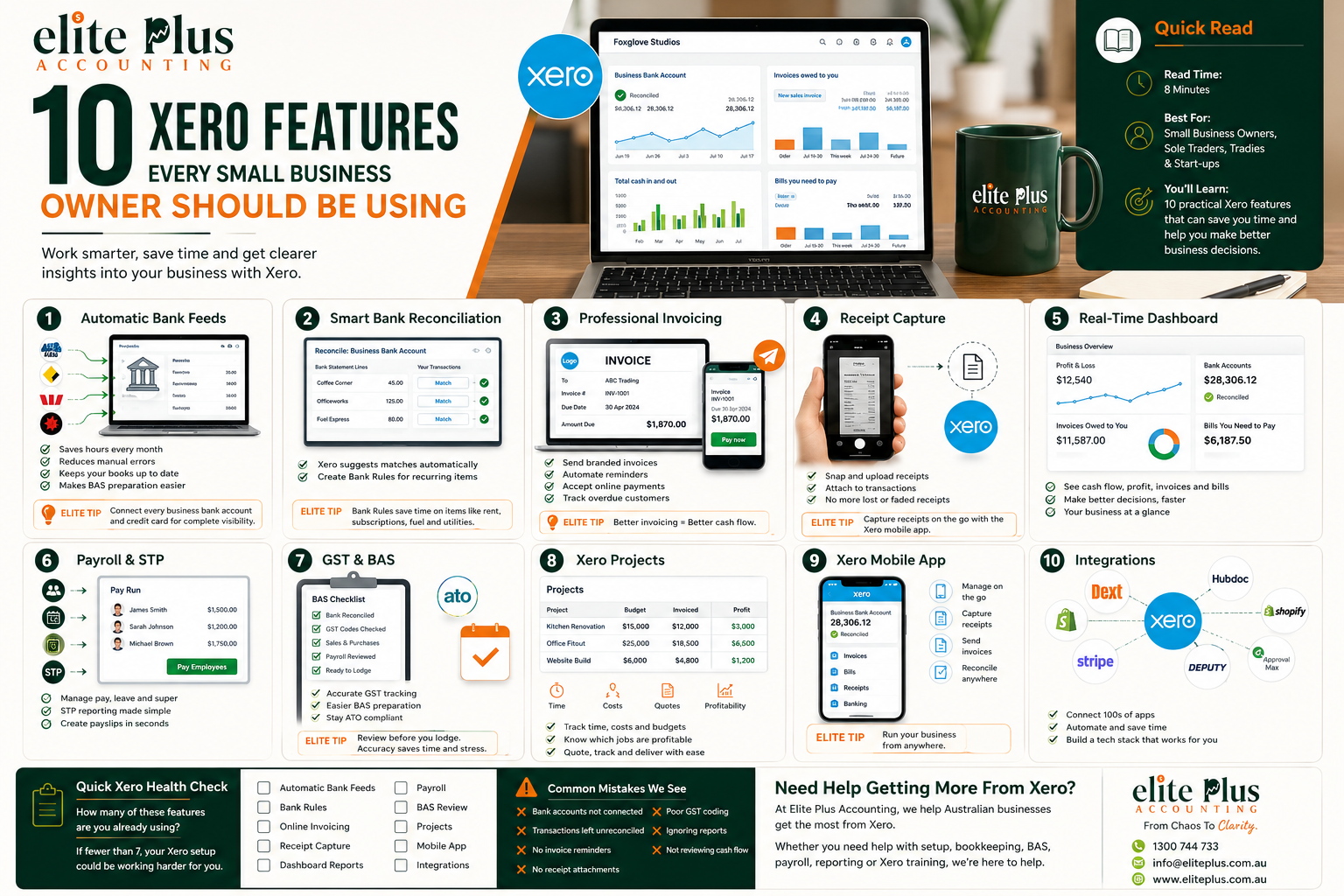
Discover 10 essential Xero features that help small business owners manage finances, save time, track expenses, improve accuracy, and make smarter business decisions with ease.
Read More