
Starting a business is exciting, challenging, and full of opportunities. Entrepreneurs often focus on product development, customer acquisition, marketing strategies, and funding. However, one of the most critical aspects that many startups overlook in their early stages is bookkeeping and accounting. Proper bookkeeping is not just about recording numbers; it is the backbone of financial stability, compliance, and long-term growth for startups.
In this blog, we will explore the importance of bookkeeping and accounting for startups, explain how bookkeeping supports business decision-making, and highlight why every startup regardless of size must prioritize accurate financial management from day one.
What Is Bookkeeping?
Bookkeeping is the systematic process of recording, organizing, and maintaining a company’s financial transactions. These transactions include sales, purchases, receipts, payments, payroll, and expenses. Bookkeeping ensures that financial data is accurate, up to date, and easily accessible.
For startups, bookkeeping forms the foundation of financial management. Without proper bookkeeping, business owners risk losing control over cash flow, and overall financial health.
What Is Accounting?
While bookkeeping focuses on recording transactions, accounting involves analyzing, interpreting, and summarizing financial data. Accounting uses bookkeeping records to generate financial statements such as income statements, balance sheets, and cash flow statements.
Why Bookkeeping Is Crucial for Startups
1. Provides Financial Clarity from Day One
One of the biggest challenges startups face is uncertainty. Proper bookkeeping gives founders a clear picture of:
- How much money is coming in
- How much money is going out
- Where the money is being spent
Accurate bookkeeping eliminates guesswork and allows startup owners to understand their financial position at any given time.
2. Helps Manage Cash Flow Effectively
Cash flow is the lifeblood of any startup. Many profitable startups fail simply because they run out of cash. Bookkeeping plays a critical role in cash flow management by tracking:
- Accounts receivable
- Accounts payable
- Operating expenses
- Revenue cycles
With consistent bookkeeping, startups can identify cash shortages early and take corrective action before problems escalate.
3. Supports Better Business Decision-Making
Startups must make quick and informed decisions. Whether it’s hiring new employees, investing in marketing, or launching a new product, decisions should be backed by financial data.
Bookkeeping provides reliable data that helps founders:
- Evaluate profitability
- Identify cost-saving opportunities
- Measure return on investment
- Plan future growth
Without accurate bookkeeping, decisions are based on assumptions rather than facts.
4. Helps Track Business Performance
Bookkeeping allows startups to measure financial performance over time. By comparing monthly or quarterly financial reports, startups can:
- Identify growth trends
- Spot declining revenues
- Monitor operating margins
This insight is crucial for scaling operations and refining business strategies.
5. Builds Investor and Lender Confidence
Investors and lenders rely heavily on financial data when evaluating startups. Clean and accurate bookkeeping demonstrates professionalism, transparency, and reliability.
Proper bookkeeping helps startups:
- Prepare financial statements
- Support funding applications
- Answer investor questions confidently
Without organized bookkeeping, securing funding becomes significantly more difficult.
6. Enables Budgeting and Financial Planning
Startups operate with limited resources. Bookkeeping provides historical data that helps create realistic budgets and financial forecasts.
With effective bookkeeping, startups can:
- Control unnecessary spending
- Allocate resources efficiently
- Prepare for future expenses
Budgeting without bookkeeping is like navigating without a map.
7. Accurate Financial Statements
Accounting relies on bookkeeping records to prepare financial statements. These statements include:
- Profit and loss statement
- Balance sheet
- Cash flow statement
Accurate bookkeeping ensures these reports reflect the true financial position of the startup.
8. Identifies Profitability and Cost Issues
Through accounting analysis based on bookkeeping data, startups can determine:
- Which products or services are profitable
- Which expenses are too high
- Where inefficiencies exist
This insight allows startups to optimize operations and improve margins.
9. Saves Time and Reduces Stress
Startups often operate in high-pressure environments. Disorganized finances create unnecessary stress. Proper bookkeeping simplifies financial management and allows founders to focus on core business activities.
Using bookkeeping systems or professional bookkeeping services reduces manual errors and saves valuable time.
10. Prevents Financial Fraud and Errors
Regular bookkeeping helps detect discrepancies, unauthorized transactions, and errors early. This internal control is essential for startups as they grow and handle larger financial volumes.
Strong bookkeeping practices protect startups from financial losses and internal risks.
Consequences of Poor Bookkeeping in Startups
1. Financial Mismanagement and Losses: Without proper bookkeeping, startups risk:
- Overspending
- Missing payments
- Incorrect pricing
- Cash shortages
These issues can quickly spiral out of control and threaten business survival.
2. Missed Growth Opportunities
Poor bookkeeping limits visibility into financial performance, causing startups to miss opportunities for growth, investment, or expansion.
Good bookkeeping ensures startups are always ready to act on opportunities.
Outsourcing Bookkeeping vs. In-House Bookkeeping: Choosing the Right Bookkeeping Approach
As startups grow, managing financial records becomes more complex and time-consuming. One of the most important decisions founders must make is how to handle bookkeeping. The right bookkeeping approach can save time, reduce costs, and improve financial accuracy, while the wrong choice can create inefficiencies and compliance risks.
Startups typically choose between in-house bookkeeping, outsourced bookkeeping services. Each option has distinct advantages and challenges, and the best choice depends on the startup’s size, budget, industry, and long-term goals.
In-House Bookkeeping
In-house bookkeeping involves hiring a dedicated employee or assigning bookkeeping responsibilities to an existing staff member within the organization.
Advantages of In-House Bookkeeping
One of the primary benefits of in-house bookkeeping is direct control. Startups have immediate access to financial information and can closely monitor day-to-day transactions. This approach can be beneficial for startups with high transaction volumes or complex financial operations.
In-house bookkeeping also allows for:
- Better alignment with internal processes
- Faster access to financial data
- Greater familiarity with the business model
For startups that require constant financial oversight, having bookkeeping handled internally can provide peace of mind.
Challenges of In-House Bookkeeping
Despite its benefits, in-house bookkeeping can be expensive. Hiring skilled bookkeeping professionals involves salaries, benefits, training, and software costs. For early-stage startups with limited budgets, this can place a significant financial burden on the business.
Additionally, relying on a single individual for bookkeeping increases the risk of errors, delays, or knowledge gaps, especially if the employee lacks specialized accounting expertise.
Outsourced Bookkeeping Services
Outsourced bookkeeping involves partnering with a third-party bookkeeping firm or professional service provider to manage financial records.
Advantages of Outsourced Bookkeeping
Outsourcing bookkeeping is often the most cost-effective solution for startups. It provides access to experienced professionals without the overhead costs of hiring full-time staff. Outsourced bookkeeping services bring industry knowledge, best practices, and up-to-date compliance expertise.
Key benefits include:
- Reduced operational costs
- Access to expert bookkeeping knowledge
- Scalability as the startup grows
- Improved accuracy and compliance
Outsourced bookkeeping allows founders to focus on growth, product development, and customer acquisition while financial experts handle the numbers.
Choosing the Right Bookkeeping Approach for Your Startup
There is no one-size-fits-all solution when it comes to bookkeeping. Early-stage startups often benefit from outsourced or automated bookkeeping due to lower costs and flexibility. As startups grow, they may transition to a hybrid approach that combines automation with professional bookkeeping support or in-house oversight.
Factors to consider when choosing a bookkeeping approach include:
- Transaction volume
- Business complexity
- Budget constraints
- Growth plans
- Regulatory requirements
Regardless of the approach, consistent bookkeeping is non-negotiable. Accurate and timely bookkeeping ensures financial clarity, supports compliance, and enables informed decision-making.
| Bookkeeping Approach | Description | Key Advantages | Key Challenges | Best Suited For |
|---|---|---|---|---|
| In-House Bookkeeping | Bookkeeping is handled by a dedicated employee or internal staff member |
• Direct control over finances • Immediate access to financial data • Strong alignment with internal processes |
• High cost (salary, benefits, software) • Risk of errors if expertise is limited • Dependency on a single individual |
Startups with high transaction volumes, complex operations, or the need for constant financial oversight |
| Outsourced Bookkeeping Services | A third-party bookkeeping firm manages financial records |
• Cost-effective • Access to experienced professionals • Scalable as the business grows • Improved accuracy |
• Less direct control • Requires clear communication and coordination |
Early-stage and growing startups seeking expertise without high overhead costs |
Best Bookkeeping Practices for Startups
1. Separate Business and Personal Finances
One of the most important bookkeeping practices for startups is keeping business and personal finances separate. Opening a dedicated business bank account simplifies bookkeeping and prevents confusion during audits.
2. Maintain Consistent Bookkeeping Records
Startups should record transactions regularly daily or weekly to ensure accuracy. Delayed bookkeeping increases the risk of errors and missing information.
Consistency is key to reliable bookkeeping.
3. Use Digital Bookkeeping Tools
Modern bookkeeping software automates tasks such as expense tracking, invoicing, and bank reconciliation. Digital bookkeeping improves efficiency, reduces manual errors, and provides real-time financial insights.
4. Categorize Expenses Properly
Accurate expense categorization is essential for bookkeeping. Proper categorization helps startups understand spending patterns.
5. Reconcile Bank Accounts Regularly
Bank reconciliation ensures that bookkeeping records match bank statements. This practice helps identify discrepancies, prevent fraud, and maintain accurate financial data.
6. Keep Supporting Documents Organized
Receipts, invoices, and contracts should be stored securely, either digitally or physically. Organized documentation supports bookkeeping accuracy and simplifies audits .
7. Consider Professional Bookkeeping Support
Many startups benefit from outsourcing bookkeeping to professionals. Expert bookkeeping services ensure compliance, accuracy, and scalability while allowing founders to focus on growth.
Bookkeeping as a Strategic Asset for Startups
By adopting strong bookkeeping practices early, startups can build a solid financial foundation, avoid costly mistakes, and position themselves for long-term success. In a competitive business environment, bookkeeping is not just about recording numbers it is about securing the future of the startup.
Frequently Asked Questions
What mistakes should startups avoid?
Startups should avoid poor bookkeeping, mixing personal and business finances, and neglecting cash flow management. Failing to maintain accurate financial records can lead to compliance issues, cash shortages, and uninformed business decisions that hinder growth.
What are the common bookkeeping mistakes startups make?
Common bookkeeping mistakes startups make include failing to record transactions regularly, mixing personal and business finances, and misclassifying expenses. These errors can lead to inaccurate financial reports, and poor cash flow management.
Can poor bookkeeping affect startup funding and investors?
Yes, poor bookkeeping can negatively affect startup funding and investor confidence. Inaccurate or incomplete financial records make it difficult for investors to assess business performance, increasing perceived risk and reducing the chances of securing funding.
What are some best practices for startup bookkeeping?
Best practices for startup bookkeeping include separating business and personal finances, recording transactions regularly, using reliable bookkeeping software, reconciling bank accounts, and keeping organized financial records to ensure accuracy and compliance.
How much does bookkeeping cost for a startup?
Bookkeeping costs for startups vary based on the approach—software subscriptions are the most affordable, outsourced services charge moderate monthly fees, and in-house bookkeeping is the most expensive due to salaries and benefits.
get in touch
Connect with Our Experts
Our dedicated team of accountants and bookkeepers is here to guide you toward the best financial solutions. Reach out today and speak with one of our experienced professionals to get started on the right path.


Recent Blogs

A common assumption among Australian business owners is: “They have an ABN and send me an invoice, so they are responsible for their own super.” Unfortunately, it is not always that simple. For super guarantee purposes, the ATO looks at the substance of the arrangement. Some independent contractors must still receive super where the contract is wholly […]
Read More
Working two jobs in Australia can affect how much tax is withheld from your pay. Learn how the $18,200 tax-free threshold works, when to claim it, and how claiming it from multiple employers could lead to an unexpected tax bill.
Read More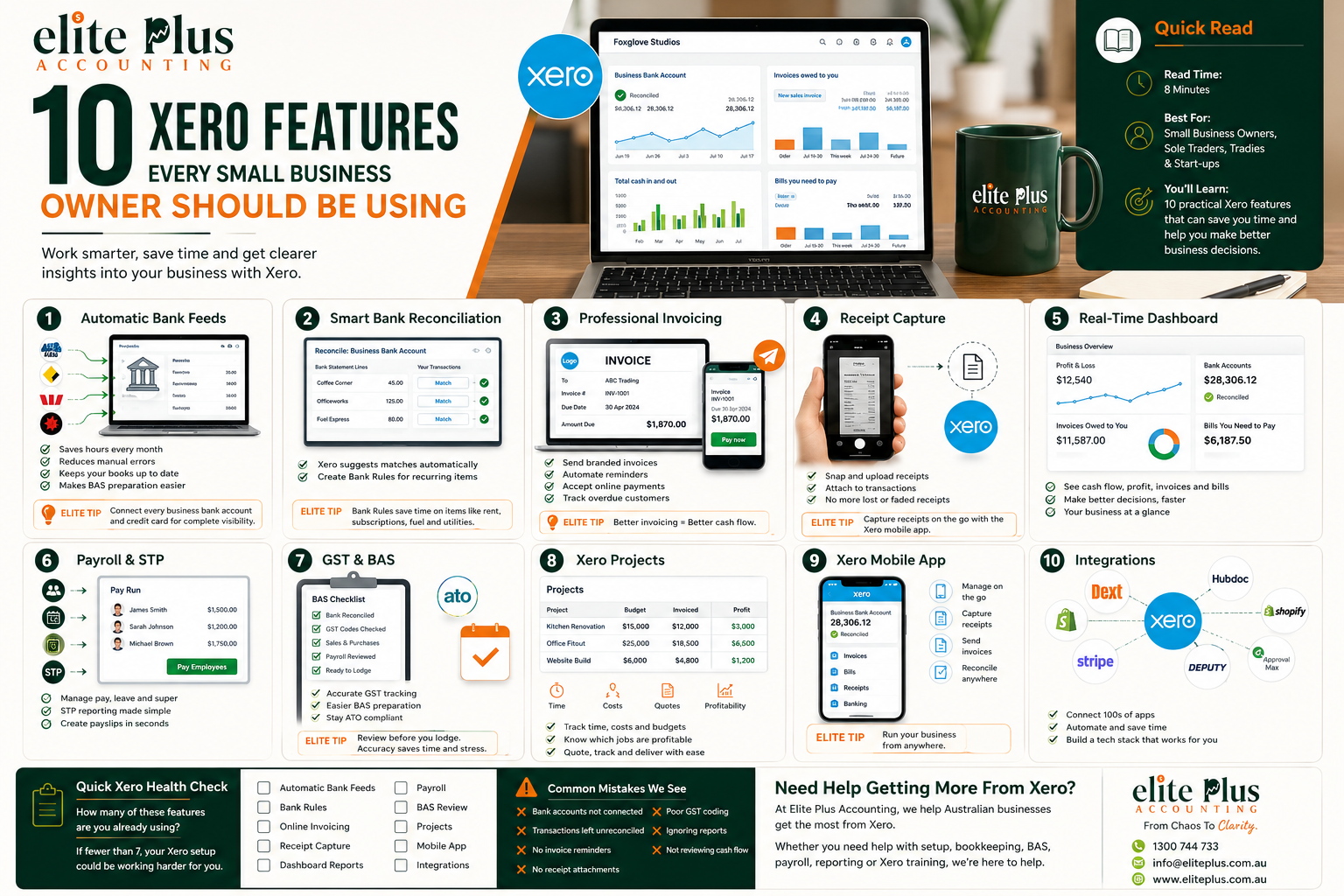
Discover 10 essential Xero features that help small business owners manage finances, save time, track expenses, improve accuracy, and make smarter business decisions with ease.
Read More